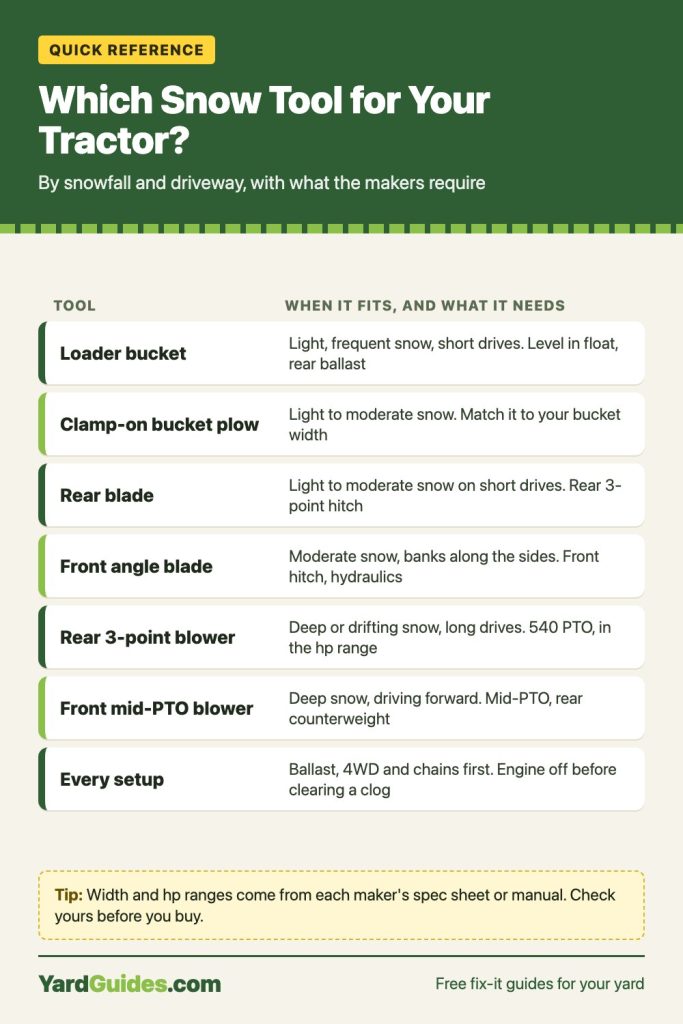
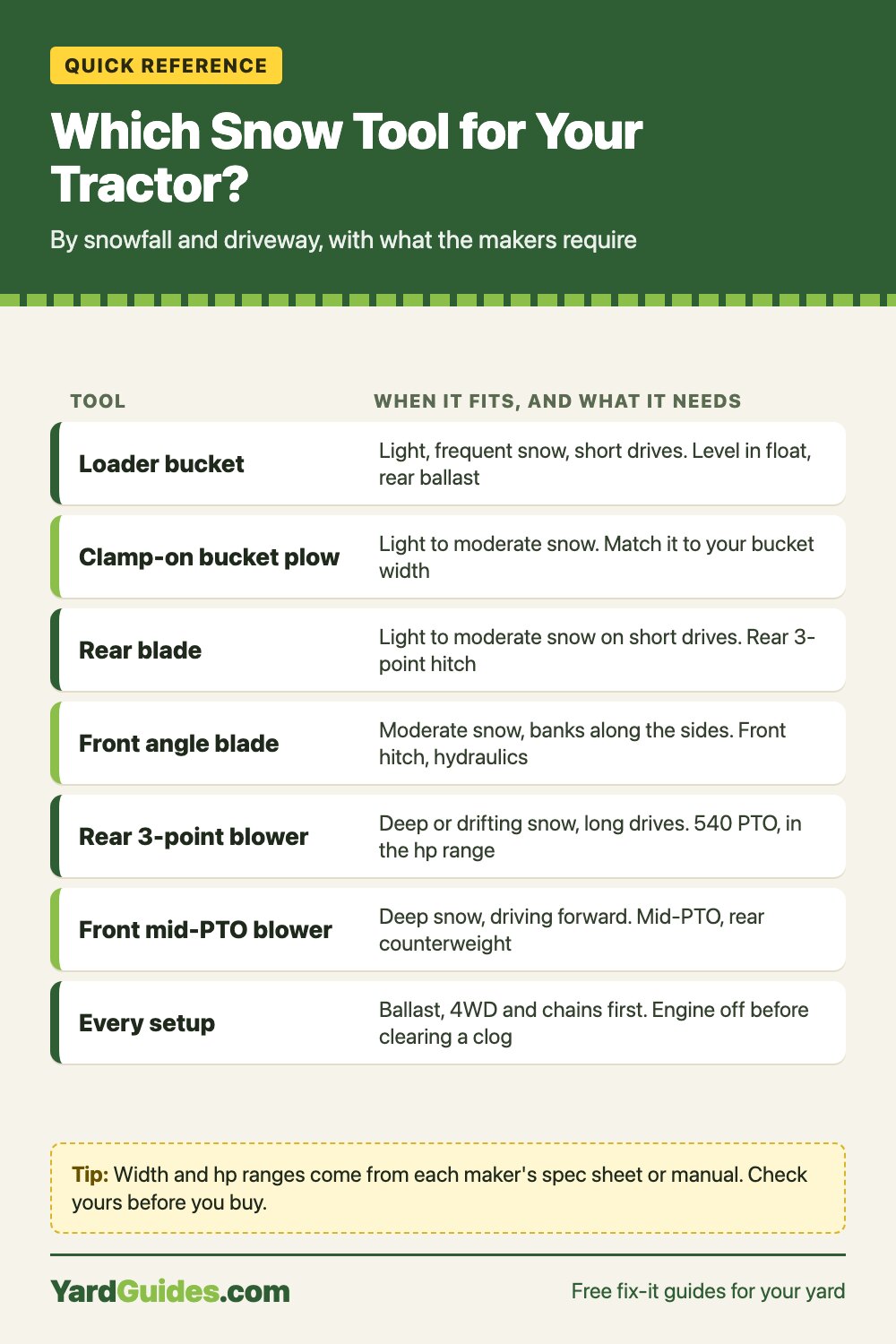
Quick answer: For light, frequent snow, the loader bucket or a rear blade is enough. For moderate snow on a short driveway, a front or rear blade moves it faster. For deep or drifting snow, long driveways, or nowhere to pile it, use a PTO snowblower, sized to the horsepower range its maker prints. Rear 3-point blowers run off the 540 rpm rear PTO. Front blowers need a mid-PTO (Deere calls it a front PTO) and a front hitch. Whatever you pick, set up ballast and traction first.
YardGuides may earn a commission from links on this page, at no cost to you. As an Amazon Associate I earn from qualifying purchases. Learn more.
Every width, horsepower range and ballast figure below comes from the maker’s own spec sheet or operator’s manual, and each row links to it. We haven’t tested these attachments. Makers update models and specs, so the manual for your serial number and your dealer have the final say.
Which snow tool fits your driveway?
Start with how much snow you get per storm, how long your driveway is, and where the snow can go.
| Tool | Snow it handles well | Driveway it suits | What your tractor needs |
|---|---|---|---|
| Loader bucket | Light, frequent snow | Short drives with room to pile | A loader, rear ballast |
| Clamp-on bucket plow | Light to moderate snow | Short to medium drives | A loader, rear ballast |
| Loader snow pusher | Moderate snow, pushed straight | Wide, open paved areas | A loader with a quick-attach plate, rear ballast |
| Front angle blade | Moderate snow | Medium drives with banks along the sides | Front hitch, a hydraulic outlet for angling |
| Rear blade | Light to moderate snow | Short to medium drives | 3-point hitch, front weight or a loader |
| Rear 3-point blower | Deep or drifting snow | Long drives, no room to pile | Rear 540 rpm PTO in the blower’s hp range |
| Front mid-PTO blower | Deep or drifting snow | Long drives, no room to pile | Mid-PTO, a front hitch, rear counterweight |
The surface matters too:
| Surface | Blade or bucket | Snowblower |
|---|---|---|
| Asphalt or concrete | Bucket level in float; a rubber edge is an option on some blades (Kubota sells one for its BX blade) | Skid shoes can sit lower |
| Gravel | Float, and raise the edge slightly (or use skid shoes) so you don’t scrape up stone | Land Pride says gravel needs a higher skid shoe setting, and never so low that it picks up rock |
Blades and buckets push snow, so you need somewhere to put it. After a few storms the banks get tall and the drive gets narrower. A blower throws snow past the edge, which is why it’s the answer for deep snow and long drives. It’s also the most expensive and the most maintenance.
Snow attachment requirements by maker
This is the table we couldn’t find anywhere else: each maker’s own width and horsepower figures side by side. Two warnings before you use it:
- Read the hp column carefully. Deere and Woods state PTO hp. Land Pride and Bercomac rate rear blowers by tractor hp. Bercomac rates its big front blowers by engine hp. Your tractor’s spec sheet lists both engine hp and PTO hp. PTO hp is the lower number.
- A blank means the maker doesn’t publish it. We didn’t fill gaps with forum numbers.
Rear 3-point snowblowers (540 rpm rear PTO)
| Blower (source) | Width | Maker’s hp range | Hitch |
|---|---|---|---|
| Deere Frontier SB1148 | 48 in | 16–35 PTO hp | Cat. 1 |
| Deere Frontier SB1154 | 54 in | 20–40 PTO hp | Cat. 1 |
| Deere Frontier SB1164 | 64 in | 20–50 PTO hp | Cat. 1 |
| Deere Frontier SB1174 | 74 in | 35–50 PTO hp | Cat. 1 and Cat. 2 |
| Deere Frontier SB1184 / SB1194 | 84 / 94 in | 40–80 PTO hp | |
| Woods SB54S | 54 in | Up to 25 PTO hp | Limited Cat. 1 and Cat. 1 |
| Woods SB64S | 64 in | 15–35 PTO hp | Limited Cat. 1 and Cat. 1 |
| Woods SB74C | 74 in | 30–50 PTO hp | Cat. 1 and Cat. 2 |
| Woods SB84C | 84 in | 35–60 PTO hp | Cat. 1 and Cat. 2 |
| Land Pride SB1051 | 51 in | 18–32 tractor hp | Cat. 1 |
| Land Pride SB1064 | 64 in | 18–59 hp in the spec table, but 18–32 hp under Tractor Requirements (p. 8), which says tractors outside the range “must not be used”; ask a dealer | Cat. 1 |
| Land Pride SB1574 | 74 in | 30–59 tractor hp | Cat. 1 |
| Land Pride SB2584 | 84 in | 43–105 tractor hp | Cat. 1 and Cat. 2 |
| Bercomac 64 in rear | 64 in | 18–40 tractor hp | Cat. 1 |
| Bercomac 72 in rear | 72 in | 25–40 tractor hp | Cat. 1 |
| Bobcat 3-point blower | 50, 60, 66, 74 in | Not published (“select the model appropriate for your tractor PTO horsepower”) | Cat. 1 |
What the rear-blower manuals say about ballast and setup:
- Land Pride: “Tractors outside the horsepower range must not be used.” PTO speed is 540 rpm. Hydraulic chute rotation and tilt (optional) each need a duplex hydraulic outlet. “Ballast weights may be required to maintain steering control” (SB10/15/25 manual 370-027M, Tractor Requirements, p. 8).
- Woods: a minimum of 20% of the tractor and equipment weight must stay on the front wheels in transport. Woods also says to set the rear wheels narrower than the blower’s cutting width (MAN0869, p. 11). A loader on the front usually covers the front weight.
- Bercomac: 540 rpm PTO, and counterweights may be needed to keep control of the tractor (rear blower manual 110361, p. 8).
Land Pride’s chart is from its manual for older serial numbers (S/N 881640 and lower), and Land Pride’s own Application paragraph in that manual says 30 to 105 hp. The newer manual (370-430M) may list different figures, so confirm with a dealer.
Front-mount snowblowers (mid-PTO or front PTO)
| Blower (source) | Width | Fits / maker’s hp range | Mount and drive |
|---|---|---|---|
| Deere 47 in heavy-duty blower | 47 in | Deere shows it on a 1025R; no fit list or hp range on the page | Front 3-point hitch, 2,000 rpm front PTO, hydraulic lift and spout |
| Deere 54 in heavy-duty blower | 54 in | No fit list or hp range on the page | Front 3-point hitch, hydraulic spout |
| Kubota BX2830 blower | 48 in | BX1880, BX2380, BX2680, BX23S | BX2810 front quick hitch, BX2811 mid-PTO driveline (mid PTO 2,500 rpm per the BX Series brochure, p. 13), loader valve for lift and chute |
| Kubota BX2822A blower | 55 in | BX series, not the BX1880 | Same as BX2830 |
| Bercomac 72 in front blower | 72 in | 40–55 engine hp | Mid-PTO (shaft “turns up to 2000 RPM”) |
| Bercomac 80 in front blower | 80 in | 48–65 engine hp | Mid-PTO |
| Bobcat front-mount blower | 49, 62, 72 in models | Not published | Front mount; height and chute run “from the loader control valve” |
Kubota’s BX blower manual requires a 350 lb rear counterweight. More on ballast below.
Snow blades
| Blade (source) | Width | Fits / maker’s hp range | Mount |
|---|---|---|---|
| Deere 60 in Quick-Hitch front blade | 60 in | X700 and “select compact tractors” | Hydraulic lift with float, optional hydraulic angle |
| Deere Frontier RB2060 / RB2072 / RB2084 rear blades | 60 / 72 / 84 in | 19–45 / 23–55 / 27–55 PTO hp | Rear 3-point Cat. 1, manual angle, tilt and offset |
| Kubota BX2812A blade | 60 in | BX series | BX2810 hitch and BX2417A loader valve, hydraulic angle |
| Kubota LX2960A / LX2972A blades | 60 / 72 in | LX series | Hydraulic angle; “Mid PTO is not required” |
| Land Pride RBT15 rear blades | 60, 72, 84 in | 17–40 hp | Rear 3-point, Cat. 1 |
Check your tractor’s manual too, not just the blower’s. Kubota’s BX23S manual caps a front snowblower at 50 in wide and 353 lb and says a sub frame is necessary (BX23S operator’s manual, implement limits table). Kubota’s brochure lists the 55 in BX2822A for BX tractors other than the BX1880, so if you own a BX23S, ask your dealer which limit applies to your serial number.
How to size a snowblower to your tractor
- Find your PTO hp. It’s on your tractor’s spec sheet and in the operator’s manual. Use PTO hp, not engine hp, unless the blower maker says otherwise (see the hp column above).
- Check the PTO. Rear blowers in this table all run at 540 rpm. Land Pride says to make sure a multi-speed PTO is set to 540. Front blowers need a mid-PTO. Kubota’s BX mid-PTO runs at 2,500 rpm, Deere lists 2,000 rpm for its 47 in front blower, and Bercomac’s front driveline turns up to 2,000 rpm.
- Pick a width inside the maker’s range. Land Pride says flatly that tractors outside the range must not be used.
- Cover your tires. Woods says to set the rear wheels narrower than the cutting width, so the blower clears a path for the tires. A blower narrower than your tractor leaves tire tracks of packed snow.
- Check the hitch and the lift. Category 1 vs Category 2 has to match, and your 3-point hitch has to lift the blower’s weight. Woods lists its SB64S at 436 lb and SB84C at 632 lb.
The “5 hp per foot” rule of thumb. On TractorByNet, owners often size blowers at about 5 PTO hp per foot of width (so 20 hp for a 48 in blower). Others call it “just a suggestion” and note that with a hydrostatic transmission you just slow down in heavy, wet snow. Compare it to the makers’ ranges: Deere rates its 48 in SB1148 from 16 PTO hp, Woods rates a 64 in blower at 15 to 35 PTO hp, and Land Pride rates a 51 in blower from 18 tractor hp. The makers’ ranges are wider than the forum rule, and they are the ones to follow.
Free printable: seasonal maintenance checklist for your mower & tractor
A 2-page spring-to-winter checklist for riding and push mowers and compact tractors. Then short, practical emails a couple of times a month. Unsubscribe anytime.
How to plow snow with a tractor loader bucket
Kubota’s loader manual gives the clearest guidance. From the BX23S / LA340 operator’s manual (p. 99):
- Keep the bucket level and use float. On hard surfaces, “keep the bucket level and put the lift control in the float position.” Kubota says float “will reduce the chance of surface gouging while removing snow.”
- Don’t push down on it. With hydraulic down pressure, “the bucket will wear faster than normal.”
- Don’t bulldoze with the bucket dumped. Kubota warns that pushing with the bucket in the dumped position puts “severe shock loads on the dump-linkage, the bucket cylinders, and the tractor” (pp. 101–102). Push with the bucket level and the cutting edge forward.
- Back-drag to clean up. Kubota allows back grading with “the heel of the bucket.” That’s how you pull snow away from a garage door before you push it.
- Carry the load low. Ohio State University Extension says to keep loader buckets “as low as possible when moving” (OSU fact sheet). A full bucket of wet snow held high on an icy slope is how tractors tip.
A clamp-on bucket plow bolts or clamps a blade onto the bucket’s cutting edge, so you get a wider, angled push without a front hitch. Match it to your bucket width and the maker’s stated bucket fit. Browse clamp-on bucket snow plows.
A loader snow pusher (a box with side wings on a quick-attach plate) carries more snow straight ahead without spilling. It’s best for wide paved areas, not narrow winding drives.
Rear blade, front blade or bucket: technique
- Rear blade: You push snow while backing up, or angle the blade and drag it forward to roll snow to one side. Land Pride calls its RBT blades “excellent for snow.” Backing up means you spend most of the job looking over your shoulder, so slow down and know where everyone is.
- Front blade: Angle it so snow rolls toward the side you’re piling on. Kubota’s BX blade offers skid shoes and a rubber edge as options, which help on gravel or pavers.
- Bucket: Level, in float, as above. Push the pile back past the edge of the drive early in the season, before the banks get tall.
Traction and ballast: set up before the first storm
Snow work combines everything that makes a tractor lose traction or tip: a heavy load on one end, ice, and slopes. Kubota’s B2301/B2601 manual says to make sure the tractor “is correctly ballasted to avoid skidding and loss of steering control” on icy surfaces, and to engage front wheel drive. Here’s what the attachment manuals say:
| Setup | Maker’s ballast requirement |
|---|---|
| Kubota BX2830 / BX2822A front blower | “a rear counterweight of 350 lbs.” (manual, p. 20) |
| Kubota LA340 loader on a BX23S | “add rear ballast to the 3-point hitch and to the rear wheels when using the loader.” The amount “will depend on the application” (manual) |
| Kubota LA525 loader (L2501, L3301, L3901) | “rear ballast must be added to the 3-point hitch and to the rear wheels when using loader” (manual, p. 8) |
| John Deere 1023E / 1025R tractor | “Add enough ballast to maintain steering control and prevent tip over” (operator’s manual, p. 27; dealer-hosted copy) |
| John Deere, any loader | Rule of thumb: about a 50/50 rear/front weight split for loader work, and “see your attachment operator’s manual for ballasting requirements” (Deere ballasting safety page) |
| Land Pride rear blowers | “Ballast weights may be required to maintain steering control” (370-027M, p. 8) |
| Woods rear blowers | At least 20% of the tractor and equipment weight on the front wheels in transport (MAN0869, p. 11) |
Notice what’s missing: neither Kubota loader manual gives one fixed weight for loader work. They say it depends on the job. The BX23S manual also says not to use rear wheel weights and liquid ballast at the same time.
Your options for rear weight:
- Liquid-filled rear tires. Our liquid ballast guide and calculator shows how much weight your tire size holds and which fluids won’t freeze.
- A ballast box on the 3-point hitch. You fill it with sand, gravel or concrete. It comes off for summer. Browse 3-point ballast boxes.
- Wheel weights that bolt to the rims, if your maker offers them.
A rear 3-point blower is heavy too, so with a rear blower and a front loader you’re often balanced. With a front blower or blade and nothing on the back, you need the counterweight.
Then traction:
- 4WD. Engage it for snow and loader work. See how to put a Kubota in 4 wheel drive, including the BX/B no-clutch steps.
- Chains. Chains make the biggest difference on packed snow and ice. Find your size in our tractor tire chain size finder.
- A tractor that starts at 5 a.m. Cold diesel, gelled fuel and glow plugs are covered in winter diesel for tractors.
- A block heater makes those cold starts easier. Our tractor block heater guide covers fit by model, heater type and plug-in time.
Shear bolts, skid shoes and gearbox oil on tractor-mounted blowers
Shear bolts
Every blower in our table protects its driveline with a shear bolt. It’s meant to break before something expensive does.
| Blower | What the manual specifies |
|---|---|
| Kubota BX2830 / BX2822A | “grade 2 shearbolt (70060-04465) on fan” and “special grade 5 grooved shear bolts (70060-01338) on the auger sections.” After one breaks, reposition the augers 180° from each other (manual, p. 25) |
| Deere Frontier SB1148 | Drive shaft 1/4″ NC x 1 3/4″ Grade 5; driveline M6 x 40 mm grade 8.8 (2009 manual, p. 29; check the current parts list) |
| Land Pride SB10/15/25 | Driveline shear bolt M8 x 50 (SB10/15) or M10 x 60 (SB25); auger drive shaft 1/4″-20 Grade 5 (370-027M spec table, p. 35) |
| Woods SB series | Auger drive 1/4 NC x 1 in Grade 5; driveline bolt size and grade by driveline maker in the parts list (MAN0869, pp. 18–20) |
| Bobcat 3-point | “A shear bolt through the input shaft protects the gearbox and driveline” (Bobcat) |
| Bercomac | “Use only original shear bolts” (110845 manual, p. 26) |
Never swap in a harder bolt. Woods warns that “using a hardened bolt or shear pin may result in damage to driveline or gearbox,” and that fasteners must be replaced “with the same grade as specified in the manual parts list.” Keep a few spares of the exact part number in the tractor. If one keeps breaking, Woods’ troubleshooting chart says to check whether the bolt is the right (not too soft) grade, and to keep the PTO shaft angle under 15 degrees.
Got a walk-behind blower too? Our snow blower shear pin lookup finds the part number by brand.
Skid shoes
Skid shoes set how close the housing rides to the ground.
- Gravel: Land Pride says gravel or crushed rock needs “a higher setting than hard flat surfaces such as asphalt and concrete. Never set Snow Blower so low as to pick-up gravel and rock.” It also says never to run gravel through the blower.
- Tilt: Woods says you can set depth with the skid shoes or by tilting the blower, but “excessive forward or backward tilt may cause U-joint to flutter resulting in PTO shear bolt failure.”
- Kubota BX2830 / BX2822A: skid shoes are adjustable and replaceable, with 3 positions.
- Walk-behind blower on gravel? See skid shoe settings by brand.
Gearbox oil
- Land Pride: check with the blower level and the oil cold. Remove the level plug; oil should reach the bottom of the hole. It specifies 80-90W EP gear lube.
- Woods: check quarterly and keep it half full (level hole halfway up the back of the gearbox). Change it after the first 30 hours or 30 days. Capacity is 0.52 qt SAE 80W-90.
Safety: the rules that prevent the worst injuries
- Never clear a clog with the engine running, and never by hand. Kubota’s blower manual: “disengage the PTO… shut off the tractor engine, remove the ignition key, wait for all movement to stop, and then clear the snow from the chute.” Woods warns that “stored energy can cause auger to quickly rotate when unclogging occurs,” and says to use “a sturdy piece of wood.” Frontier (Deere) says to use only a 36-inch “piece of wood.” Bercomac says to wait 10 seconds and use a cleaning tool at least 3 feet long, “NEVER YOUR HANDS.” The CPSC says more than 40% of snow blower injuries treated in ERs in 2021 were to the wrist, hand and finger.
- Keep every PTO guard on. Land Pride: the tractor PTO shield, gearbox shaft shield and driveline shields “must be secured in place” to avoid “injury or death from entanglement in driveline.” Ohio State Extension: “Safe operation of the PTO is not possible without these shields in place.” No loose scarves, drawstrings or untied boots near the shaft.
- Shut down before you get off. Land Pride: disengage the PTO, set the parking brake, shut off the engine, remove the key, and wait for the PTO to stop before dismounting.
- ROPS up, seatbelt on. Kubota recommends a ROPS and seat belt “in almost all applications.” Ohio State Extension says ROPS and seat belts are “99.9 percent effective in preventing deaths due to tractor overturns.” Don’t wear the belt with the ROPS folded down.
- Ballast before loader work, and carry the bucket low (see above).
- Watch where the snow goes. Never aim the chute at people, cars, windows or the road. Woods: “Never direct discharge toward people, animals, or property.” Check for kids, pets and mailboxes before you back up with a rear blower or blade.
- Visibility. You’ll often work in the dark. Use your work lights, run the route in daylight first to mark hidden edges and drains, and stake the driveway edges before the ground freezes.
Using a walk-behind blower as well? See how to start a snow blower for choke and primer settings by brand, and snow blower auger not turning when the engine runs but nothing throws snow.
FAQ
Can a sub-compact tractor (Kubota BX, John Deere 1025R) run a snowblower? Yes. Kubota sells a 48 in front blower for the BX1880, BX2380, BX2680 and BX23S that runs off the mid-PTO, with a 350 lb rear counterweight. Small rear blowers start low too: Deere’s 48 in Frontier SB1148 is rated 16 to 35 PTO hp, and Deere shows its 47 in front blower on a 1025R. Compare those ranges with the PTO hp on your tractor’s spec sheet. Check the front-implement limits in your tractor’s manual.
Front blower or rear blower? A front blower lets you drive forward and see your work. It needs a mid-PTO, a front hitch and rear counterweight, and it costs more. A rear 3-point blower uses the standard 540 rpm PTO and hitch, so it fits more tractors. You’ll do most of the work in reverse.
Is a rear blade enough for snow? For light snow on a short drive, often yes. Land Pride rates its RBT blades for 17 to 40 hp tractors. Blades push snow, so in snowy regions the banks eventually run out of room. That’s when owners move to a blower.
Do I need chains on my tractor for snow? On packed snow and ice, chains plus 4WD and ballast give the most traction. Kubota’s BX blower manual says to make sure the machine is counterweighted and has tire chains “as recommended by your dealer.” Find your size with our chain size finder.
How much ballast do I need for a loader in snow? It depends on your tractor and loader. Kubota’s loader manuals say the amount “will depend on the application.” The one fixed figure we found is Kubota’s 350 lb rear counterweight for its BX front blowers. Use your loader manual’s ballast table, then see our loader ballast tables by tractor (Deere and Kubota manuals) and the ballast calculator for liquid-filled tires.
Sources
Accessed 2026-11-20. “Archive copy” means a maker’s manual hosted on a third-party site.
- John Deere / Frontier, 3-Point Mounted Snowblowers SB11, SB12, SB13 brochure (DSFE71456, 2019): widths, PTO hp, shear bolt protection; SB1148 product page
- Frontier, SB1148 / SB1154 / SB1164 operator’s manual OM0369SB1148-A (2009; archive copy): safety and clogs pp. 7–9, shear bolts p. 29
- John Deere, 47 in and 54 in heavy-duty snow blowers, 60 in Quick-Hitch front blade
- John Deere / Frontier, Landscape Tools brochure (DSFE52266, 2013), RB20 rear blades
- John Deere, Ballasting safety information, and 1023E / 1025R operator’s manual (dealer-hosted copy): ballast p. 27, ROPS and seat belt
- Kubota USA, Snow Implements brochure (part 77700-13758, 2025): BX, LX and Grand L blowers and blades, fit and required kits
- Kubota, BX Series brochure (PTO spec: mid 2,500 rpm; ROPS statement)
- Kubota, BX2822A / BX2830 snowblower owner’s manual (P/N 77700-10178; archive copy): specs p. 9, safety p. 6, operation and 350 lb counterweight p. 20, clogs p. 22, shear bolts p. 25
- Kubota, BX23S / LA340 / BT603 operator’s manual (Kubota-published PDF): ballast, front implement limits, float p. 99, bulldozing pp. 101–102, ROPS
- Kubota, LA525 front loader operator’s manual (archive copy): rear ballast p. 8
- Kubota, B2301 / B2601 operator’s manual, p. 23 (ballast and 4WD on icy surfaces)
- Land Pride, SB10/SB15/SB25 snow blower operator’s manual 370-027M (S/N 881640 and lower; archive copy): tractor requirements p. 8, safety pp. 15 and 24, skid shoes p. 26, gearbox p. 34, specs p. 35
- Land Pride, RBT15 rear blade operator’s manual 301-144M (archive copy): specs
- Woods, SB54S / SB64S / SB74C / SB84C operator’s manual MAN0869 (archive copy): specs p. 4, safety p. 5, tractor requirements p. 11, skid shoes p. 14, shear bolts and gearbox pp. 17–20
- Bobcat, 3-point snow blower and front-mount tractor snowblower
- Bercomac, rear snowblower user manual 110361 (French), p. 8, and front snowblower user manual 110845: mid-PTO p. 10, clogs p. 19, shear bolts p. 26, specs p. 28
- U.S. CPSC, Winter safety tips (2023): snow blower injuries and cleanout tool
- Ohio State University Extension, Safe Use of the Power-Take-Off (PTO) and Rollovers and ROPS
- TractorByNet owner forum, “3-pt Snowblower PTO Requirement” (rule of thumb, not a maker spec)