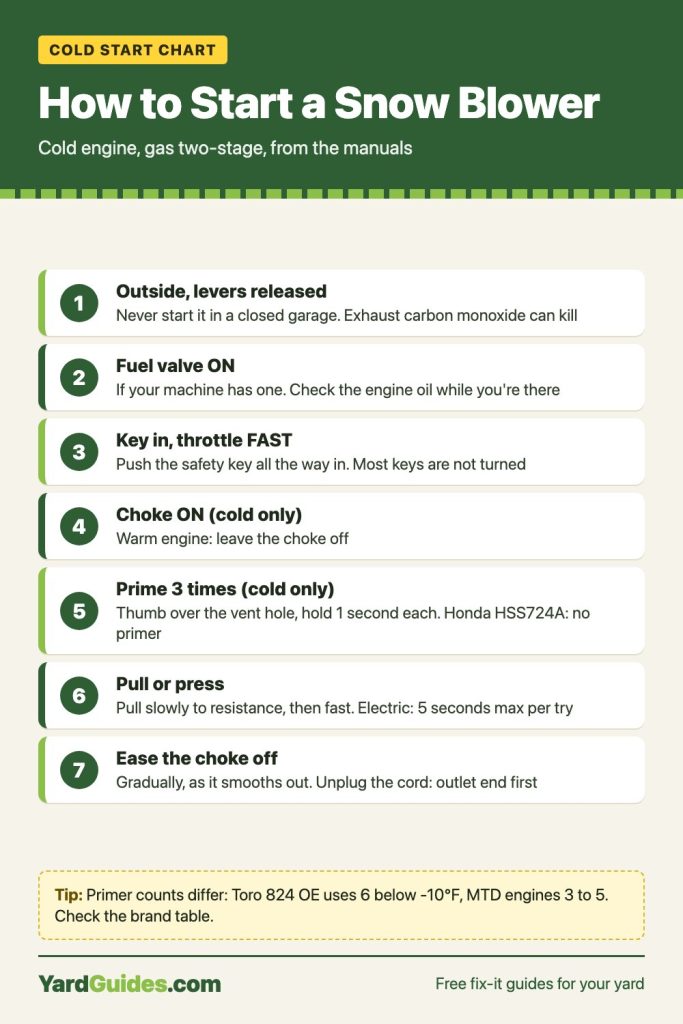
Quick answer: To start a cold gas snow blower, take it outside, release the auger and drive levers, open the fuel valve, push the safety key all the way in, and set the throttle to FAST. Turn the choke to ON (full choke), push the primer bulb about 3 times with your thumb over its vent hole, then pull the starter cord or press the electric-start button. As the engine smooths out, ease the choke to OFF. Warm engine? Skip the primer and the choke. Your brand’s exact settings are in the tables below.
Safety first: Start and run a snow blower outside. Honda’s manual says not to start or operate the engine “in an enclosed area such as a garage”, because the exhaust’s carbon monoxide “can collect rapidly”. Toro allows it only with “adequate ventilation (e.g., leaving an outside door open)”. If yours lives in the garage, open the door all the way and roll it out before you warm it up. Release both control levers before you pull the cord, and keep your hands and feet away from the auger and the chute.
Snow blower start controls by brand
Each row is one model family, taken from that maker’s own operator’s manual (linked). Controls change between models and years, so treat this as a map and check the manual for your model number. Cub Cadet and Troy-Bilt snow thrower manuals send you to the engine manual for starting (Troy-Bilt Storm manual, p. 16), so their row comes from MTD’s engine manual. Check the decal on your engine to confirm which manual applies.
Before you pull: fuel valve, key and throttle
| Machine (manual) | Fuel valve | Key or switch | Throttle |
|---|---|---|---|
| Toro Power Max 824 OE, two-stage (manual, p. 11-12) | Open it: 1/4 turn counterclockwise | Push the ignition key fully in | FAST |
| Toro Power Clear 721 R/E, single-stage (manual, p. 8-10) | None listed | Ignition key (turn to OFF to stop) | None listed |
| Ariens Deluxe 24, model 921069 (manual, p. EN-13) | ON | Insert the engine key | Fast |
| Cub Cadet / Troy-Bilt with an MTD 357/420 cc engine (manual, p. 9-10) | Open, if your machine has one | Push the safety key fully in. Don’t turn it, it can break | FAST, if equipped |
| Honda HSS724A (manual, p. 7, 10) | ON, after checking the carburetor drain knob is tight. Shift lever to N | Engine switch to ON (recoil) or START (electric) | FAST |
| Husqvarna ST 224 (manual, p. 11-12) | Fuel ON/OFF switch to ON | Insert the key until it clicks. Don’t turn it | FAST |
Choke and primer: cold start vs warm restart
| Machine | Choke, cold | Primer, cold | Warm restart |
|---|---|---|---|
| Toro Power Max 824 OE (p. 11-12) | CHOKE | 3 pushes at -10°F (-23°C) and above, 6 below. Hold each 1 second | Not covered in this manual. Toro’s 721 manual says no primer or choke on a hot engine |
| Toro Power Clear 721 R/E (p. 8-9) | Cold: see the manual’s start figures. Never on a hot engine | 3 pushes (machine decal). Take your glove off first | No primer, no choke |
| Ariens Deluxe 24 (p. EN-13, EN-23) | ON | Cold engines only: 3 pushes, vent hole covered, hold 1 full second | Don’t prime a warm engine |
| Cub Cadet / Troy-Bilt, MTD engine (p. 10) | FULL CHOKE | 3 to 5 pushes, vent hole covered, hold 1 second | No primer. Choke at NO CHOKE, speed FAST |
| Honda HSS724A (p. 8, 10) | Pull the choke knob out to CLOSED | No primer bulb on this model | Choke knob OPEN |
| Husqvarna ST 224 (p. 12) | FULL | 3 pushes | Recoil steps use choke and primer only “if the engine is cold” |
MTD’s smaller 179, 208 and 243 cc engine manual gives the same 3 to 5 primes and the same warm-restart rule (MTD 769-11570, p. 11).
Electric start: cord, cranking limit, unplugging
| Machine | Starter and cord | Cranking limit | Unplug |
|---|---|---|---|
| Toro Power Max 824 OE (p. 12-13) | 120 V plug-in. UL-listed 16-gauge outdoor cord, 50 ft max | 5 s on, 5 s off, 10 tries max, then see a dealer | Outlet first, then the machine |
| Toro Power Clear 721 E (p. 8) | 120 V into a GFCI outlet. UL-listed 16-gauge outdoor cord, 50 ft max | 5 s on, 5 s off, 10 tries. Then let it cool at least 40 minutes | Whenever you’re not starting it |
| Ariens Deluxe 24 (p. EN-13) | 120 V, 3-wire grounded outlet. Cord UL or CSA, 13 A minimum, grounded, outdoor-rated | 5 s max, then wait at least 1 minute | Outlet first, then the starter |
| Cub Cadet / Troy-Bilt, MTD engine (p. 9-10) | 120 V, GFI three-wire grounded system only. Cord rated 15 A at 125 V, grounded, outdoor | 5 s max per try | Outlet first, then the engine |
| Honda HSS724A (p. 10) | DC electric starter on the key switch (electric-start models carry a battery). No cord | 5 s max, then let it cool 10 s | Nothing to unplug |
| Husqvarna ST 224 (p. 12-13) | 120 V, three-wire grounded receptacle | 5 s max, wait 5 to 10 s between tries | Receptacle first, then the engine |
Craftsman, PowerSmart and other brands: we couldn’t find a current maker-hosted manual to cite, so they aren’t in the table. The sequence below still applies. Use your manual’s primer count, which you can find by the model number on the machine’s label.
How to start a cold snow blower, step by step
This is the common two-stage sequence that the manuals above share. The order of a few steps varies by brand (Ariens, for example, plugs in the cord first), but every control ends up in the same place before you pull.
- Check the oil and gas. Toro’s first step is checking the engine oil level (which oil and how much, by engine). Use fresh gas. If it’s been sitting since last winter, read about stale fuel first.
- Make sure it isn’t frozen. Ariens says to check for a frozen impeller before you start: with the key out, engage the auger lever and pull the recoil handle. If it won’t pull, move the machine somewhere warm to thaw.
- Roll it outside and release both control levers. Honda also wants the shift lever in neutral (N).
- Open the fuel valve, if your machine has one.
- Insert the safety key all the way. On Toro, Ariens, MTD and Husqvarna machines it just pushes in. Honda’s is a real key switch.
- Throttle to FAST.
- Choke to ON (CHOKE, FULL or CLOSED, depending on the label).
- Prime it. Push the primer bulb the number of times your manual gives, usually 3. See the next section.
- Pull or press. For the recoil, the MTD manual says to pull the handle out slowly until you feel resistance, then pull with one rapid full-arm stroke, and let it return slowly. For electric start, see using electric start safely.
- Ease the choke off. Toro says to move it toward Run gradually, waiting for the engine to run smoothly before each adjustment. MTD’s manual uses a half-choke stop on the way.
- Let it warm up. Husqvarna says to run the engine 2 to 3 minutes at idle before you throw snow. Honda says to warm it up for several minutes, and to squeeze the drive clutch lever in neutral for about 30 seconds to warm the transmission fluid.
How to use the snow blower primer bulb
The primer bulb is the soft rubber button near the carburetor. Pushing it squirts a little fuel into the carburetor so a cold engine catches. MTD’s manual describes it as forcing fuel “directly into the engine’s carburetor to aid in starting a ‘cold’ engine.”
- Cover the vent hole in the middle of the bulb with your thumb (Ariens, MTD). Toro says to take your glove off so air can’t escape from the primer hole.
- Push firmly and hold about 1 second each time (Toro, Ariens, MTD).
- Count. Most manuals above say 3. MTD gives a range of 3 to 5. Toro’s Power Max 824 OE goes to 6 below -10°F.
- Don’t prime a warm engine. MTD warns that priming a warm engine after a short shutdown “will flood the engine.” Too many pushes on a cold engine floods it too. If that happens, Husqvarna says to wait a few minutes and not push the primer again. Our won’t-start guide covers the flooded engine fix.
- No primer bulb? Some engines don’t have one. Honda’s HSS724A starts with the choke alone.
How to restart a warm snow blower
If you shut it off a few minutes ago (to clear the chute, or to move a car), the engine is still warm:
- Insert the key, open the fuel valve (if you closed it) and set the throttle to FAST.
- Leave the choke off and don’t prime. MTD’s manual says to restart a warm engine with the speed control at FAST and the choke at NO CHOKE. Honda’s manual says the choke’s open position is for “restarting a warm engine.”
- Pull or press to start.
If it won’t restart warm, it may be flooded. See the flooded engine fix.
Using electric start safely
Most gas snow blowers with “electric start” have a 120-volt starter that plugs into a house outlet. Honda’s HSS724A is the exception in our table: its electric start runs off a battery through the key switch.
- Use an outdoor-rated, grounded, three-prong cord that meets your manual’s rating (see the table: 16-gauge for Toro, 13 A minimum for Ariens, 15 A for MTD). Inspect it first. Toro says not to use a damaged cord.
- Plug the cord into the machine first, then into the outlet. Toro, Ariens, MTD and Husqvarna all give that order.
- Use a grounded outlet. Toro’s single-stage manual specifies a GFCI outlet. MTD’s says not to use the starter at all unless the house has a GFI three-wire grounded system.
- Don’t use it in the rain. The Troy-Bilt Storm manual warns against using the electric starter in the rain.
- Crank in short bursts. No more than 5 seconds at a time on any machine in the table, with a rest between tries (5 seconds to 1 minute, depending on the brand).
- Unplug as soon as it starts: outlet end first, then the machine. Toro warns that if you leave it plugged in, “someone can inadvertently start the machine.”
If the starter spins but the engine won’t catch, the starter is fine and the problem is fuel, flooding or spark. See the electric start section of our troubleshooting guide.
After it starts: clearing snow safely
- Throttle stays at FAST for snow. Honda says to use FAST for normal operation.
- Never use your hands to clear a clogged chute. Toro: shut off the engine, wait for all moving parts to stop, and use the snow-cleanout tool. Honda adds removing the spark plug cap, because a jammed auger “could suddenly move” when the clog breaks free.
- If the auger stops turning but the engine runs, you may have broken a shear pin. Use our snow blower shear pin lookup to find the right part for your model.
- On a gravel drive, set the skid shoes before you start clearing: snow blower on a gravel driveway has the setting from each maker’s manual.
How to clear a driveway with a snow blower
To clear a driveway with a two-stage snow blower from Toro, Ariens, Cub Cadet or Troy-Bilt (MTD), Honda or Husqvarna, keep the throttle at FAST and manage the load with ground speed and pass width instead. Throw the snow downwind and away from people, windows, cars and the street. Overlap each pass, and on a sloped driveway go up and down, never across. The table shows where each maker’s manual says so.
| Machine (manual) | Throttle and ground speed | Chute and wind | Passes, slopes and traffic |
|---|---|---|---|
| Toro Power Max 824 OE (manual, p. 10, 16, 26) | “Always set the throttle to the FAST position when throwing snow.” If the engine slows under load or the wheels slip, shift into a lower gear (p. 16) | “Never direct the discharge toward people or areas where property damage can occur” (p. 10) | If it throws poorly, the chart’s fixes include “Reduce the amount of snow removed per swath” (p. 26). Extreme caution on slopes (p. 10) |
| Toro Power Clear 721 R/E, single-stage (manual, p. 10) | In heavy snow, push forward on the handle, “but allow the machine to work at its own pace” | “Discharge the snow downwind whenever possible.” | “Overlap each swath to ensure complete snow removal.” Clear snow as soon as possible after it falls |
| Ariens Deluxe 24 (manual, p. EN-4 to EN-7, EN-13) | “For best snow-throwing results, ensure the throttle control lever is set to fast position” (EN-13). Don’t overload it by clearing snow too fast (EN-5) | Never aim the discharge at people or property (EN-5). “Do not throw snow higher than necessary” (EN-6) | “DO NOT clear snow across the face of slopes; go up and down” (EN-7). “Always be aware of traffic when operating near streets or along curbs” (EN-4) |
| Cub Cadet / Troy-Bilt 2- and 3-stage, MTD-built (manual, p. 2-3, 25) | Throttle at Fast (rabbit). “Select a speed appropriate for the snow conditions and a comfortable pace” (p. 25) | “Plan your snow-blowing pattern to avoid discharge towards windows, walls, cars etc.” (p. 3) | Plan it so nothing is thrown toward roads or bystanders. Keep bystanders, pets and children at least 75 feet away (p. 2). No steep slopes (p. 3) |
| Honda HSS724A (manual, p. 5, 7, 11-12) | Check the snow, then “Adjust your snow blower ground speed (not engine speed) and snow blowing swath accordingly” (p. 5). “Do not reduce engine speed while clearing snow” (p. 12). Faster ground speed in shallow or dry snow, slower in deep or wet, heavy snow (p. 11) | Aim the chute so snow doesn’t hit you, bystanders, windows or other objects (p. 7) | In hard or deep snow, clear a narrower swath with overlapping passes (p. 12). No slopes over 20 degrees. Watch for traffic near roads and driveways (p. 7) |
| Husqvarna ST 224 (manual, p. 4, 6, 14) | “Always run the engine at full throttle or near full throttle.” Set the drive speed so the machine “throws snow evenly” (p. 14) | “Always throw snow downwind whenever possible” (p. 14) | Not for slopes over 20 degrees, and the machine’s decal says no operation on slopes over 10 degrees (p. 4). Caution crossing gravel drives, walks or roads (p. 6) |
A pass pattern for a typical driveway
None of these manuals prints a pass-by-pass pattern, so the order below is our own plan. Each step is built to follow the manual rules in the table.
- Check the wind, then pick your throwing side. Choose the edge of the drive where the snow can go downwind and away from the house, windows, cars and the street (Toro 721, Husqvarna, MTD).
- Make the first pass up the middle, throwing toward that side. At the end, turn around and rotate the chute so the snow keeps going the same way. Then work outward toward that edge, one pass at a time. That way you never throw snow back onto cleared pavement. If the wind and both edges allow it, you can split the drive and throw each half to its own side.
- Overlap each pass so no ridge is left between them. Toro’s single-stage manual and Honda’s both say to overlap.
- Leave the throttle at FAST and control the load with ground speed. If the engine bogs or the wheels slip, shift down (Toro). Taking a narrower pass also helps: Honda says “Clear a narrower swath” and Toro says to “Reduce the amount of snow removed per swath.”
- On a sloped driveway, go up and down, not across (Ariens), and keep moves slow and gradual. Honda’s limit is 20 degrees.
- Do the street end last. Our reasoning: the ridge a road plow leaves is often the heaviest, most packed snow, and it sits next to traffic. Ariens and Honda both say to watch for traffic near streets, and MTD says to plan your pattern so nothing is thrown toward roads. Look both ways, throw away from the road, and use the heavy-snow tips below on the plow ridge.
- When you’re done, let the engine run a few minutes with the auger engaged to clear snow out of the housing, so moving parts don’t freeze (Toro Power Max manual, p. 17). Then turn it off.
Wet or heavy snow
Wet snow is where the manuals give their most specific advice. Their troubleshooting charts mostly blame the load: too much snow per pass, or moving too fast for the snow.
- Keep the engine at full throttle and slow the ground speed. Honda: “Slower speeds are required for deep and/or wet, heavy snow” (Honda HSS724A, p. 11). Its chart lists “Too fast ground speed when blowing wet, deep snow” as a cause of low engine power (p. 20).
- Take a narrower pass. Honda says to clear a narrower swath and make overlapping passes (p. 12). Toro’s chart says to reduce the snow per swath, and “Don’t overload the machine with extremely heavy or wet snow” (Toro Power Max 824 OE, p. 26).
- Deeper than the auger? Honda says to remove it in several steps (layers), or fit its optional drift-breaker kit (p. 12). On Toro’s Power Max, if the front rides up, shift to a lower gear, and if it keeps riding up, lift up on the handles (p. 16).
- Shallow slush is the exception. MTD’s chart lists low or slow ground speed in wet, slushy snow 1 to 3 in deep as a reason the machine pushes snow instead of blowing it. Its fix: “Increase ground speed and always operate snow blower engine at FULL throttle” (MTD 769-26795, p. 27). Our reading: deep, wet snow needs less ground speed, and shallow slush needs enough speed to feed the auger. Both keep the engine at full throttle.
- Clear it early. Honda: “For best efficiency, clear snow before it hardens and turns to ice” (p. 12). Toro’s single-stage manual and Husqvarna’s also say to clear snow soon after it falls.
- Single-stage machines: Toro says the Power Clear’s belt may slip or squeal in wet conditions. Its fix is to run the rotor without a load for 30 seconds to dry the drive (Toro Power Clear 721 manual, p. 13).
- If the chute clogs, shut the engine off and use the clean-out tool, never your hands (see the list above). If it still throws short, our snow blower not throwing snow far table goes cause by cause.
How to turn off a snow blower
The manuals agree on the basics. This is Toro’s and Ariens’ sequence combined:
- Release the drive lever. Ariens says to run the auger for a few minutes first to clear loose snow so the impeller doesn’t freeze.
- Release the auger lever and move the throttle to SLOW.
- Stop the engine (throttle to STOP, or remove the key) and wait for everything to stop moving.
- Take the key out and close the fuel valve.
- Pull the recoil handle 3 or 4 times. Toro says this “helps prevent the recoil starter from freezing up.”
Snow blower still won’t start?
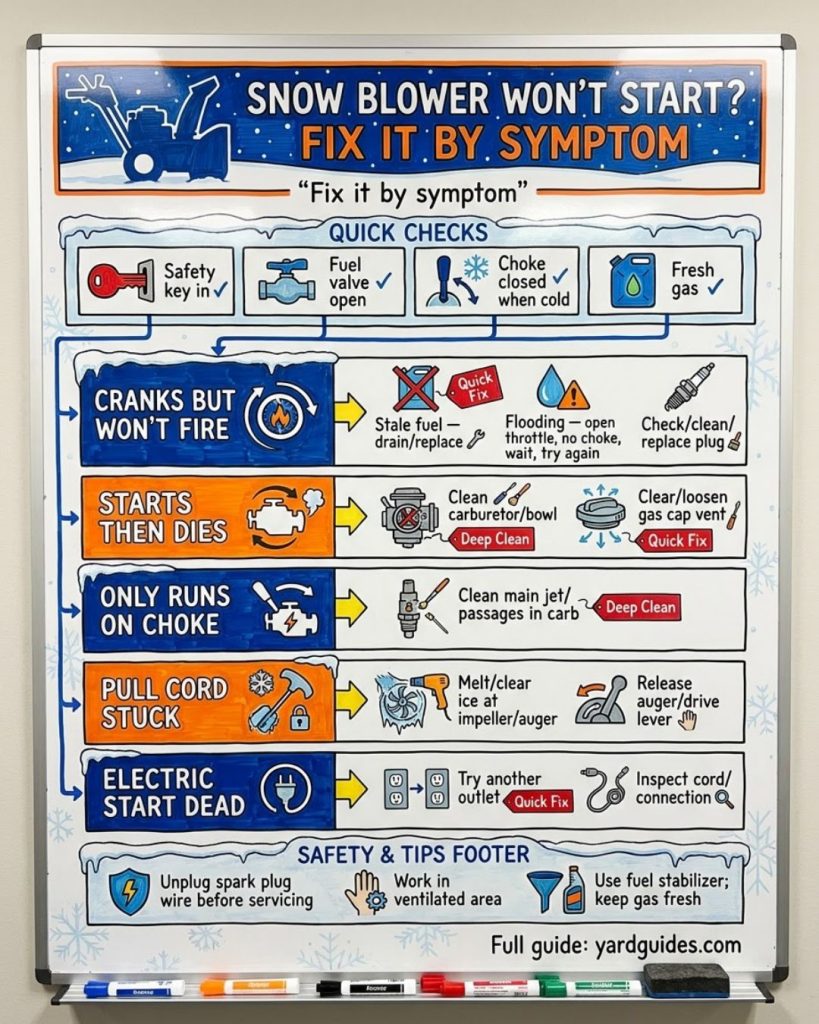
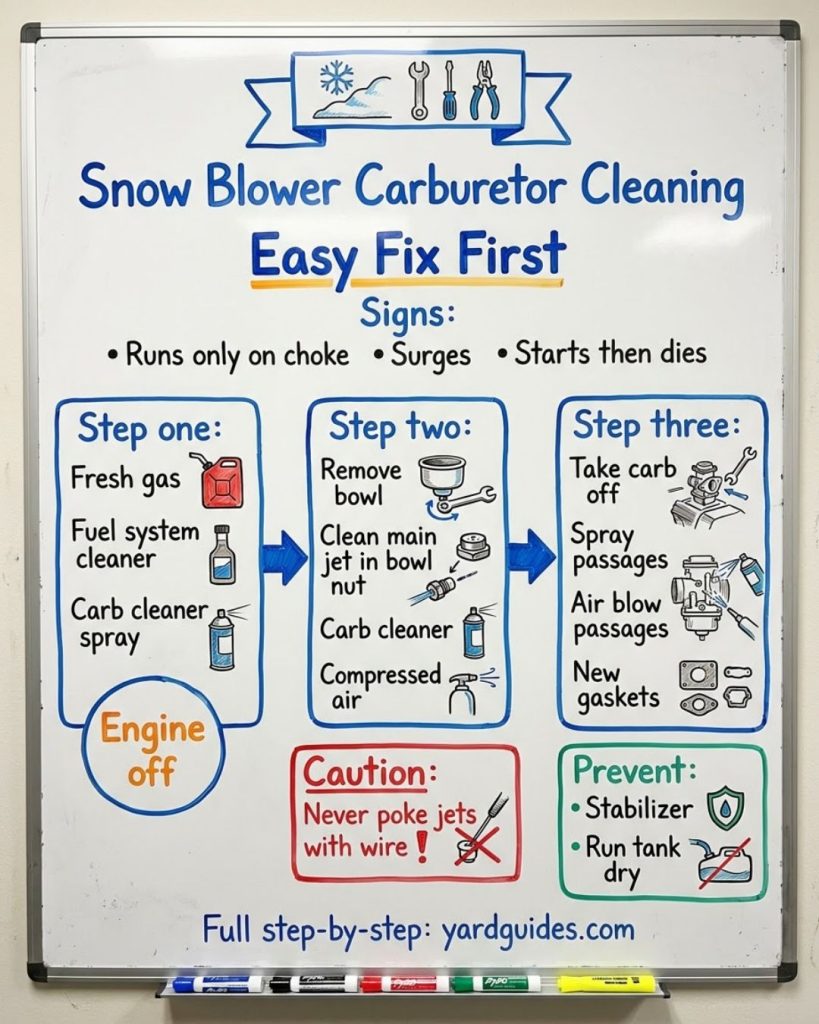
If you’ve followed your brand’s steps and it won’t fire, don’t keep pulling or cranking. Use our snow blower won’t start guide, which goes symptom by symptom: stale fuel, flooding, spark plug, electric start, a stuck pull cord, and an engine that starts and then dies. If old fuel has gummed up the carburetor, the carburetor cleaning guide starts with fixes that don’t need the carb removed.
Starting problems usually begin at storage time. Our fuel stabilizer guide explains how long gas really lasts, and the end-of-season routine in how to winterize a lawn mower works for snow blowers too.
Engine running but the auger won’t turn when you squeeze the lever? See snow blower auger not turning to tell a broken shear pin from a belt, cable or gearbox problem.
Part of our snow blower maintenance guide: see the maintenance schedule for your brand, with each maker’s intervals from the manual.
FAQ
How many times should you prime a snow blower? Usually 3 pushes on a cold engine, with your thumb over the vent hole. Toro, Ariens and Husqvarna all say 3 for the models above. MTD’s engine manuals, which cover the engines on many Cub Cadet and Troy-Bilt machines, say 3 to 5. Toro’s Power Max 824 OE says 6 below -10°F. Don’t prime a warm engine.
Should the choke be on or off to start a snow blower? On for a cold engine, off for a warm one. After a cold start, move it to off gradually as the engine smooths out. If the engine falters when you open the choke, MTD’s manual says to go back to full choke for a moment, then half, then off.
Can you run a snow blower with the choke on? Only while it warms up. Every manual above says to move the choke to off once the engine runs smoothly. If it only runs with the choke on, the carburetor is probably partly clogged. See starts then dies.
How long should a snow blower warm up before use? A few minutes. Husqvarna says 2 to 3 minutes at idle for the ST 224. Honda says several minutes, plus 30 seconds with the drive clutch squeezed in neutral to warm the transmission fluid.
Does a Honda snow blower have a primer bulb? The Honda HSS724A doesn’t. Its manual starts a cold engine with the fuel valve ON, the choke knob CLOSED and the throttle at FAST, then the key or the recoil.
Which way should you blow snow on a driveway? Downwind, and away from people, windows, cars and the road. Toro’s Power Clear 721 manual and Husqvarna’s ST 224 manual both say to throw snow downwind whenever possible. MTD’s manual says to plan your pattern so nothing is thrown toward roads, windows, walls or cars. On a sloped drive, Ariens says to go up and down, not across.
Should you go fast or slow with a snow blower in wet snow? Keep the engine at full throttle either way and change the ground speed. For deep, wet, heavy snow, Honda says to go slower and take a narrower swath. For shallow slush 1 to 3 inches deep, MTD’s manual says the opposite: if the machine pushes snow instead of blowing it, increase ground speed.
Sources
- Toro, Power Max 824 OE Snowthrower Operator’s Manual, Form 3415-760 (model 37793): Starting the Engine, Shutting Off the Engine, Clearing a Clogged Discharge Chute, Operating Tips, p. 10-16; Preventing Freeze-up, p. 17; Troubleshooting, p. 26
- Toro, Power Clear 721 R/E Operator’s Manual, Form 3423-722 (models 38741, 38742): decals, Starting the Engine, Operating Tips, p. 8-10; belt slip in wet conditions, p. 13
- Ariens, Deluxe Series Sno-Thro Operator’s Manual 30219300A (model 921069, Deluxe 24): Safety p. EN-4 to EN-7, Operation p. EN-12 to EN-13, Troubleshooting p. EN-23
- MTD, 357 cc and 420 cc OHV Horizontal Shaft Engines Operator’s Manual 769-26922 (2023): Starting the Engine, p. 8-10
- MTD, 179cc, 208cc and 243cc OHV Horizontal Shaft Engine Operator’s Manual 769-11570: Operation, p. 10-12
- MTD (Cub Cadet, Troy-Bilt), 2-Stage and 3-Stage Snow Blower Operator’s Manual 769-26795 (2023): safe operation, p. 2-3; driving and clearing, p. 25; troubleshooting, p. 27
- Troy-Bilt, Storm 2410, 2620 and 2840 Operator’s Manual 769-08981: safety, Chute Clean-Out Tool, Starting and Stopping the Engine, p. 5, 15-16
- Honda, HSS724A Owner’s Manual 00X31V45 A089: Safety p. 5-7, Operating the Controls p. 7-8, Starting and Stopping the Engine and Clearing Snow p. 10-11, Snow-clearing Tips p. 12, Troubleshooting p. 20
- Husqvarna, ST 224, ST 227P, ST 230P, ST 224P Operator’s Manual: Intended use p. 4, Safety p. 6-8, Operation p. 11-14, Maintenance p. 17