
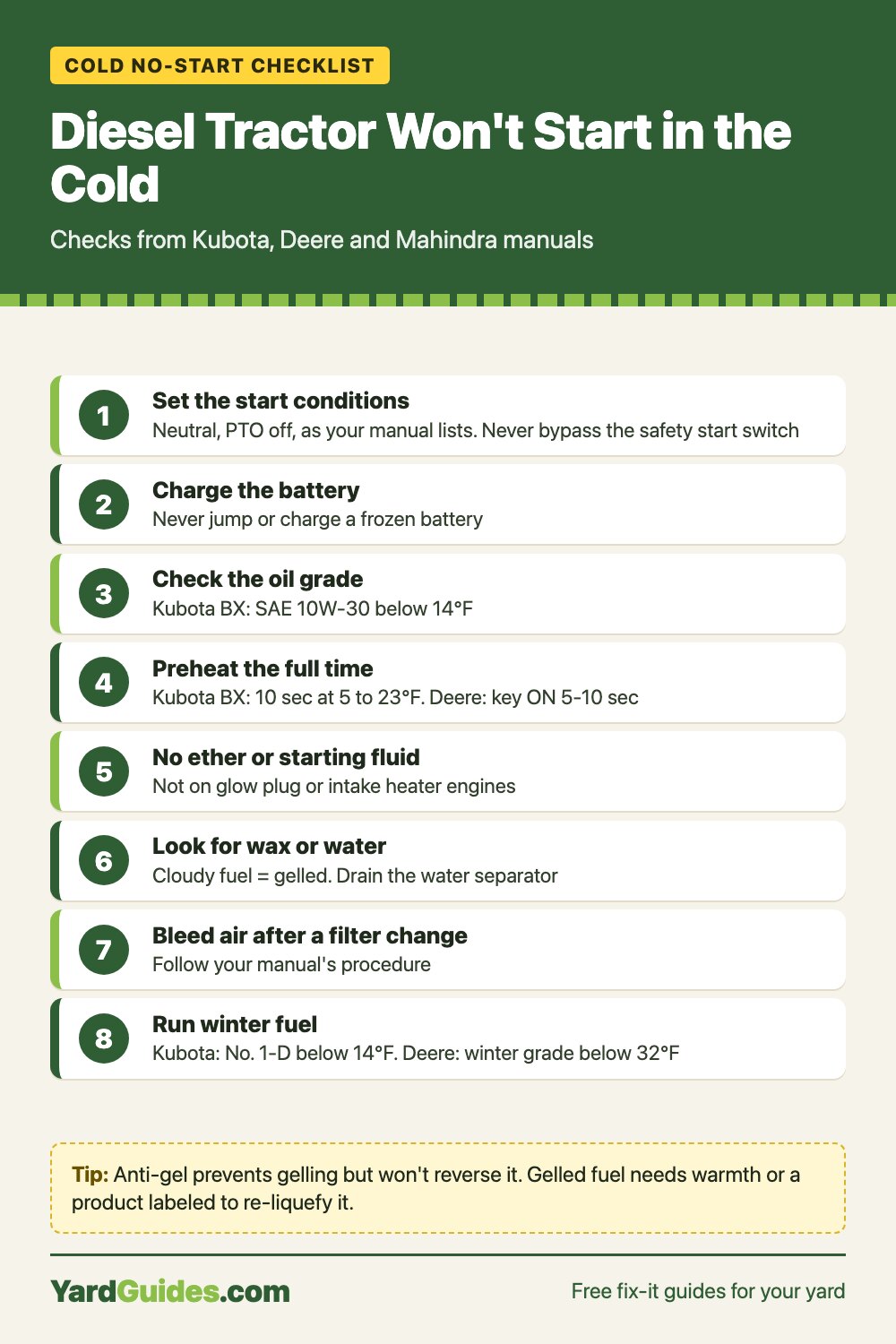
Quick answer: When a compact diesel tractor cranks but won't start in the cold, the usual causes are a preheat (glow plug or intake heater) that was too short, a weak battery or engine oil too thick for the temperature, or fuel that has started to wax (gel) at its cloud point. Preheat for as long as your manual says for that temperature. Never use ether or starting fluid on a glow-plug or intake-heater engine. Switch to winter fuel before the cold arrives: Kubota's manuals call for No. 1-D below 14°F (-10°C), and Deere's say winter grade (No. 1-D) is best below 32°F (0°C). [1][2]
Jump to the table: Winter diesel table: No. 1 vs No. 2 vs winter blend ↓
YardGuides may earn a commission from links on this page, at no cost to you. As an Amazon Associate I earn from qualifying purchases. Learn more.
Jump to: Troubleshooter · Winter diesel table · Anti-gel additives · Fuel already gelled · FAQ
Diesel tractor won’t start in the cold: step-by-step troubleshooter
Pick what the engine does when you turn the key. Each step lists the checks in the order the operator manuals point to, with the manual section linked. Engines differ by model, so your own manual wins over anything here.
What happens when you turn the key?
Do the preheat first if your tractor has one: hold or leave the key in the preheat/ON position until the glow plug lamp goes out or the time your manual gives.
No crank: check the start conditions and the battery
- Set the controls the way your manual's starting procedure lists them (typically shift lever in neutral, PTO off, parking brake set; some models need you in the seat). The safety start switch stops the starter otherwise. Test or replace a faulty switch; don't bypass it. See Kubota safety switch for how to test one. [1] Safety: "Do not start the engine by shorting across starter terminals or bypassing the safety start switch."
- Clean and tighten the battery terminals, then charge the battery. Kubota's troubleshooting table says: "In cold weather, always remove the battery from the engine, charge and store the battery indoors." [1] Engine troubleshooting
- If the battery may be frozen, don't jump-start or charge it. Deere says to warm it to 60°F (16°C) first. A discharged battery can freeze in low temperatures (Mahindra). [3][4] Prevent Battery Explosions, p.240-1; Battery, p.129
After charging, what does it do?
Slow crank: a cold battery and thick oil
- Fully charge the battery. Mahindra's cold-temperature checklist starts with "BATTERY – Must have a full charge." A battery maintainer between uses keeps it topped up. [4] Cold Temperature Operation, p.49
- Check the engine oil grade against the temperature. Kubota's troubleshooting table: "In winter, oil viscosity increases, and engine revolution is slow." The fix: oil of the right viscosity for the temperature. The BX chart calls for SAE 10W-30 below 14°F (-10°C). [1] Engine troubleshooting; Lubricants table, p.73
- Deere: "Use oil viscosity based on the expected air temperature range during the period between oil changes." Read the chart in your own manual; ranges differ by engine. [3] Engine oil, p.200A-4
- Use a block heater if your tractor has one. Kubota offers one as a dealer option for ambient temperatures below 5°F (-15°C), and Deere recommends the optional block heater below 0°F (-18°C). [3][5] Cold weather starting; p.20-2
Now what does it do?
Cranks fine, won't fire: do the preheat right
- Kubota BX: turn the key to the preheat position and hold it for 2 to 3 seconds above 32°F, 5 seconds at 23 to 32°F, and 10 seconds at 5 to 23°F. The preheat lamp is lit while the engine is preheating. [1] Starting the Engine, step 11, p.39
- John Deere 3E/1E: "Turn key to ON position for 5-10 seconds to activate glow plugs." The glow plugs and air heater keep working while you crank. [3][6] Cold Weather Starting Aids, p.20-2
- Mahindra 2816: turn the key to the heat and ON position and wait until the glow plug lamp goes out (about 1 to 3 seconds). [4] Starting, p.45
- Rest the starter between tries. Kubota BX: if it won't start after 10 seconds in cold weather, key off for 30 seconds (30-second continuous limit). Kubota L3200: no more than 10 seconds. Deere: no more than 20 seconds, then wait two minutes. Mahindra: 10 seconds, then wait one minute. [1][3][4][7] Starting sections
Preheated the full time and still won't fire?
Check the fuel: look in the filter bowl or water separator
Deere: "Cloud point is the temperature at which wax begins to form in the fuel. This wax causes fuel filters to plug." Look at the fuel in the clear sediment bowl or filter cup, or drain a little into a clear jar. [2]
Gelled (waxed) fuel
- Stop cranking and get the tractor warm. Yanmar's tip: "Just warm up the entire tractor." A gelled tractor "may limp along until you can get it into a warmer area, like garage or barn." [8]
- Add an emergency product whose label says it re-liquefies gelled fuel, at the label dose. Power Service Diesel 9•1•1's directions also say to fill the fuel filters with a 50/50 mix of product and diesel. [9]
- Replace a filter that plugged, or drain it and refill it with room-temperature fuel (Yanmar). Bleed the fuel system afterward if your manual calls for it. [8][10]
- Once it runs, keep it from happening again: winter-grade fuel or a No. 1/No. 2 blend, plus a preventive anti-gel at every fill. [11]
Did it start?
Water or ice in the fuel
- Drain the water separator or sediment bowl. Deere: "If water and deposits are detected, drain water." In cold weather Mahindra says to remove water from the fuel filter cup every day. [3][4] Check and Clean Fuel Filter Sediment Bowl, p.230-6; p.49
- If water got into the filter, Kubota's troubleshooting says: "Remove the water from the system and replace the fuel filter." [1] Engine troubleshooting
- Ice in the filter or separator has to thaw before fuel will flow. Warm the tractor in a building, or use a product whose label says it de-ices frozen fuel filters. [8][9]
- Prevent it: Deere says "Fill the fuel tank at the end of each day's operation to prevent water condensation and freezing during cold weather." [3] Diesel fuel, p.200A-2
Did it start?
Air in the fuel after a filter change or running dry
- Kubota: air must be removed "When the fuel filter or lines are removed" and "When the tank is completely empty." On the BX the procedure is key ON for about 30 seconds, then run the engine for about 30 seconds. [1] Bleeding the fuel system, p.97
- John Deere 3E: "Fuel system is self-bleeding." Turn the key ON for 10 to 15 seconds before starting so the electric pump purges the air. [3] p.230-7
- Mahindra 2816 bleeds through the air vent screws in a set order. Follow your manual's sequence. Older or different engines may need a hand primer; see bleeding a John Deere Gator. [4] Fuel System Air Removal, p.105
Did it start?
Starts, then stalls or loses power
Fuel that is at or below its cloud point can pass enough to start, then plug the filter with wax as fuel flows. Deere's fuel spec says the cold filter plugging point (CFPP) should be at least 9°F (5°C) below the lowest expected temperature, or the cloud point below the lowest ambient temperature. [3]
Slightly less power on winter fuel is normal
- Deere: "On average, winter grade diesel fuel has a lower Btu (heat content) rating. Using winter grade fuel may reduce power and fuel efficiency, but should not cause any other engine performance effects." [2]
- Check the fuel grade before you chase a low-power problem in cold weather, as Deere's manual advises. [2]
It started: warm it up before you work it
- Kubota BX: warm up without load for at least 5 minutes above 32°F, 5 to 10 minutes at 14 to 32°F, 10 to 15 minutes at -4 to 14°F, and more than 15 minutes below -4°F, at about half of rated rpm. [1] Warming up, p.40
- Deere 3E: set the hand throttle to the 1/2 position for 5 minutes without load. Blue-white exhaust smoke during warm-up is normal. [3] Warm and Idle the Engine, p.20-2
- Mahindra 2816: run at 1500 rpm for about 5 minutes. In the cold, don't leave it at low idle for long periods. [4] p.49 to p.50
Still won't start: time for a dealer or a meter
- When the battery, preheat, fuel and air checks all pass, the problem is usually electrical (glow plug or intake heater circuit, a relay, a fuse, the starter) or in the injection system. These need a meter or a dealer. Your manual's engine troubleshooting table lists the causes for your model. [1][4] Engine troubleshooting tables
- Brand guides with model notes: Kubota BX2200, Kubota TG1860, John Deere 2130, John Deere 4400.
Winter diesel table: No. 1 vs No. 2 vs winter blend
"Winter diesel" usually means No. 1-D, a No. 1/No. 2 blend, or No. 2 with cold-flow additives. ASTM D975 defines the No. 1-D and No. 2-D grades but sets no fixed cold limit. It says low-temperature properties "should be agreed upon between the fuel supplier and purchaser for the intended use and expected ambient temperatures." So ask your supplier for the cloud point of what they deliver.
| Fuel | What it is | Cold flow (as published) | Trade-off | What tractor manuals say |
|---|---|---|---|---|
| No. 2-D (ULSD, S15) | ASTM D975's general-purpose grade, the normal year-round fuel | Cloud point reached at air temperatures of 6 to 14°F, depending on where you buy it (CHS). eXtension gives a range of -18°F to +20°F. | Full energy content; gels first | Kubota BX: No. 2-D normally. Mahindra: "a good grade of Number Two Diesel Fuel" [1][4][13][14][15] |
| No. 1-D (S15) | ASTM D975's lighter, more volatile grade (kerosene-type) | About -40°F (eXtension). One supplier spec sheet (GROWMARK No. 1) lists a cloud point below -25°F. | Fewer Btu per gallon, so slightly less power and fuel economy (Deere) | Kubota: No. 1-D below 14°F (-10°C). Deere: winter grade (No. 1-D) best below 32°F (0°C) [1][2][13][15][16] |
| Winter blend (No. 1 + No. 2) | Supplier mix of the two grades; ratio varies by supplier and region | Each 10% of No. 1 lowers the cloud point about 3°F (CHS). A 50/50 blend dropped one supplier's cloud point from 14°F to -2°F (Agtegra). | Between the two grades | Mahindra: a No. 1/No. 2 mixture "is permitted for a short period of time" when it is very cold [4][14][17] |
| Winterized premium diesel | No. 2 or a blend with cold-flow improver (CFI) added at the terminal | Cenex Roadmaster XL and Ruby Fieldmaster: -25°F CFPP. Cenex Wintermaster (70% No. 1 / 30% No. 2): rated to -30°F. | CFI lowers CFPP, not the cloud point (Agtegra) | Deere: CFPP at least 9°F (5°C) below the lowest expected temperature [3][14][17][18] |
| Biodiesel blends (B5 to B20) | Diesel blended with biodiesel | "The cloud point of biodiesel is generally higher than petroleum-based diesel fuel" (DOE AFDC) | Wax can form at warmer temperatures | Deere: B5 or lower below 32°F; only winter-grade petroleum diesel below 14°F [2][19] |
Cloud point, CFPP and pour point
Three temperatures matter, and they always fall in the same order as the fuel cools: cloud point first, then the filter plugging point, then the pour (gel) point.
| Term | What it means | Test method |
|---|---|---|
| Cloud point | "The temperature at which wax just begins to precipitate and the fuel becomes cloudy" (Chevron). ASTM D975 calls it "a fair indication of the low temperature operability limit of fuels without cold flow additives in most vehicles." | ASTM D2500 [13][20] |
| Cold filter plugging point (CFPP) | "The lowest temperature at which diesel fuel can pass through the equipment's filtration device without problems" (CHS). Without additives, CFPP is typically 3.5 to 5°F below the cloud point (DOE AFDC). | ASTM D6371 [14][19] |
| Pour point (gel point) | About 6 to 10°F below the cloud point (without pour point depressant), "the fuel becomes so thick it will no longer flow" (Chevron). | ASTM D97 [20] |
Published winter blend ratios (varies by supplier and region)
These are the only blend ratios we found published by named fuel suppliers or extension services. Your supplier's fuel may differ, so ask for the cloud point of what they deliver.
| Source | Air temperature | Blend they publish |
|---|---|---|
| CHS (2025) | Below 30°F | About 70% No. 2 / 30% No. 1 [14] |
| CHS (2025) | Near 0°F | 30% No. 2 / 70% No. 1 [14] |
| CHS (2025) | Below -30°F | Straight No. 1 [14] |
| Cenex (2018) | Below 35°F | About 70% No. 2 / 30% No. 1, with a cold-flow improver [21] |
| Cenex (2018) | Below -30°F | Straight No. 1 [21] |
| Agtegra | Example | 50/50 drops the cloud point from 14°F to -2°F. CFI adds operability but "will not reduce the cloud point." [17] |
What anti-gel diesel additives do (and don’t do)
An anti-gel (cold-flow improver) changes the shape of wax crystals so fuel keeps flowing through the filter at colder temperatures. It's a preventive you add before the fuel gets cold. Emergency "winter rescue" products are a different thing.
What the labels say they do
- Keep wax crystals small so fuel keeps flowing. Penn State Extension: "Cold-weather additives change the shape of these wax particles to allow fuel to continue to flow at colder temperatures." [12]
- Lower the CFPP and pour point. Lucas's data sheet says one quart per 150 gallons lowers CFPP "to as low as -10°F", depending on how the fuel was refined. [22]
- Extend No. 2 a little. Deere says its Fuel-Protect winter formula "generally extends operability to about 10°C (18°F) below the fuel cloud point." [2]
- Many also handle water: Power Service's white bottle "protects against fuel-filter icing", and Howes Diesel Treat removes water by demulsifying it. [11][23]
What they don’t do
- Lower the cloud point. DOE AFDC: "Additives do not usually alter cloud point but can lower CFPP and LTFT." Agtegra: CFI "will not reduce the cloud point of fuel." [17][19]
- Fix fuel that has already gelled. Howes: "No. Diesel Treat will not reverse diesel gelling." Lucas says fuel treated below its cloud point "will not achieve the full performance potential of the product." [22][23]
- Replace winter fuel in deep cold. Deere: "For operability at even lower temperatures, use winter grade fuel." [2]
- Work the same way as an emergency product. Only products labeled for it re-liquefy gelled fuel, and those aren't preventives: "Diesel 911 does not prevent fuel gelling" (Power Service). [9]
| Product | Type | Label claim | When / dose (as printed) |
|---|---|---|---|
| Power Service Diesel Fuel Supplement +Cetane Boost (white bottle) | Preventive anti-gel | "Prevents fuel gelling and protects against fuel-filter icing" | For use when temperatures drop below +30°F. 12 oz per 40 gal above 0°F; per 20 gal below 0°F [11] |
| Power Service Diesel 9•1•1 | Emergency | "Reliquefies gelled fuel and de-ices frozen fuel-filters"; does not prevent gelling | 16 oz per 20 gal in the tank; fill the filters with 50% product / 50% diesel [9] |
| Howes Diesel Treat | Preventive anti-gel | Prevents gelling, removes water; "will not reverse diesel gelling" | 1 oz per 5 gal above 0°F, 1 oz per 2.5 gal below 0°F; label says double for cars, pickups and tractors [23] |
| Howes Diesel Lifeline | Emergency | "Safely reliquefies gelled fuel" and de-ices frozen filters; not a substitute for Diesel Treat | "As needed, read label" [24] |
| Lucas Anti-Gel | Preventive anti-gel | Lowers CFPP to as low as -10°F (1 qt per 150 gal); results depend on refining | Add while fuel is at least 15 to 20°F above its cloud point [22] |
| John Deere Fuel-Protect (winter formula) | Preventive anti-gel | Adds a CFPP improver and a deicer; about 18°F below cloud point per Deere's manual | Treat when outside temperature drops below 32°F (41°F for biodiesel) [2][25] |
| Kubota Polar D Winter Treatment | Preventive anti-gel | "Lowers pour point and cold filter plug point"; absorbs water | See label [26] |
What to do if your diesel already gelled
Gelled fuel looks cloudy or waxy and won't pass the filter. A preventive anti-gel won't fix it. Here's the order the makers and extension services describe.
- Stop cranking (you'll only flatten the battery) and get the whole tractor somewhere warm, like a heated shop or barn. [8]
- Add an emergency product labeled to re-liquefy gelled fuel, at the label dose for the gallons in your tank. Power Service and Howes both make one. [9][24]
- Deal with the filter. Replace it if it plugged (Howes), or drain it and refill it with room-temperature fuel (Yanmar). Power Service's directions fill the filter with a 50/50 mix of its emergency product and diesel. [8][9][10]
- Bleed air from the fuel system if your manual calls for it after a filter change, then start using the preheat procedure. [1] Bleeding the fuel system, p.97
- Once it runs, stop it happening again: switch to winter fuel or a No. 1 blend, or treat every fill with a preventive anti-gel. Keep spare filters and an emergency additive on hand, and keep the tank at least half full (NDSU). [10][27]
Winter kit for a diesel tractor
If you need any of these, the cheapest one that matches your manual is fine. Each Amazon link opens a search, so you can compare current options.
- Anti-gel diesel additive: a preventive, added before fuel gets cold. Check the label for your gallons.
- Emergency diesel re-liquefier: for fuel that has already gelled. Keep one on the shelf.
- Engine block heater: our guide lists which heater fits your engine; your dealer can give you the part number.
- Battery maintainer: keeps the battery fully charged between uses.
FAQ
At what temperature does diesel fuel gel?
It depends on the fuel. CHS says No. 2 diesel reaches its cloud point (wax starts forming) at air temperatures of about 6 to 14°F, depending on where you buy it. Without a pour point additive, it stops flowing about 6 to 10°F below the cloud point (Chevron). Filters can plug near the cloud point, so that's the number to plan around. [14][20]
Is winter diesel the same as No. 1 diesel?
Not always. "Winter diesel" can mean straight No. 1-D, a No. 1/No. 2 blend, or No. 2 with a cold-flow improver. The blend ratio varies by supplier and region. Ask yours for the cloud point or CFPP. [13][14]
Can I mix No. 1 and No. 2 diesel in my tractor?
Yes, suppliers publish blends. CHS suggests about 70% No. 2 / 30% No. 1 below 30°F and 30/70 near 0°F. Blend while the fuel is 10 to 15°F above its cloud point (Agtegra). Mahindra's 2816 manual permits a mix of No. 1 and No. 2 for a short period when it is very cold. [4][14][17]
Will anti-gel additive unfreeze gelled diesel?
A preventive anti-gel won't. Howes says plainly that Diesel Treat "will not reverse diesel gelling." You need an emergency product whose label says it re-liquefies gelled fuel, such as Power Service Diesel 9•1•1 or Howes Diesel Lifeline. [9][23][24]
Can I use starting fluid (ether) on a diesel tractor?
Not on engines with glow plugs or an intake air heater, which covers most compact tractors. Kubota: "Do not use starting fluid or ether." Deere: "Do not use starting fluid on an engine equipped with glow plugs or an air intake heater." Mahindra says not to use ether as a cold-temperature starting aid. [1][3][4]
How long should I hold the glow plugs on a tractor?
Use your manual's table. Kubota BX: 2 to 3 seconds above 32°F, 5 seconds at 23 to 32°F, 10 seconds at 5 to 23°F. Deere 3E/1E: key ON for 5 to 10 seconds. Mahindra 2816: until the glow plug lamp goes out, about 1 to 3 seconds. [1][3][4]
Do I need a block heater on my tractor?
In real cold it helps. Kubota offers one as a dealer option: its B2301/B2601 and B3150 manuals say for temperatures below 5°F (-15°C), and its L3240–L5740, MX5200 and M5040–M7040 manuals say below -4°F (-20°C). Deere recommends its optional block heater for temperatures below 0°F (-18°C). See our tractor block heater guide for which heater fits your engine and how long to plug it in. [3][5][28][29][30][31]
What engine oil is best for cold starts?
The one your manual's chart lists for your temperature range. Kubota's BX chart calls for SAE 10W-30 below 14°F (-10°C). Deere says to choose viscosity by the expected air temperature until the next oil change. [1][3]
Related guides
- Kubota safety switch won't let it start? Test and fix it
- How to bleed air from the fuel line on a John Deere Gator
- Kubota TG1860 problems (including cold starts)
- Kubota BX2200 problems
- John Deere 2130 problems
- Tractor hydraulic fluid cross-reference
- Tractor tire chain size finder
- Liquid ballast for tractor tires
Methodology and sources
Every troubleshooting step comes from a manufacturer's operator manual (Kubota BX/B/L series, John Deere 1E/3E series, Mahindra 2816), with the section named. The fuel facts come from ASTM D975-24, Chevron's Diesel Fuels Technical Review, the U.S. DOE Alternative Fuels Data Center, extension services, and fuel suppliers' own published guidance. Additive claims are quoted from the makers' own product pages and data sheets. Blend ratios are only those a named supplier publishes, and they vary by supplier and region. Some Deere and Mahindra manuals are dealer-hosted copies of the OEM PDF. We haven't tested any product here. Checked on 2026-11-20.
- Kubota BX1880/BX2380/BX2680 Operator's Manual (PDF) · Kubota, via kubota.com.au manuals page
- John Deere operator's manual OMTR112398: Minimizing the Effect of Cold Weather on Diesel Engines · manuals.deere.com
- John Deere 3025E/3032E/3038E Operator's Manual OMTR135276 (PDF) · dealer-hosted copy (Hartville Hardware)
- Mahindra 2816 HST Operator Manual (PDF) · dealer-hosted copy; edition year not printed
- Kubota B2301/B2601 Operator's Manual (PDF) · Cold weather starting: block heater
- John Deere 1023E/1026R Operator's Manual OMLVU24604 (PDF) · dealer-hosted copy
- Kubota L3200/L3800 Operator's Manual (PDF)
- Yanmar Tractor, Weather the Winter by Winterizing Your Tractor
- Power Service, Diesel 9•1•1
- Howes, Anti-Gel for Diesel Trucks: How and When to Use It
- Power Service, Diesel Fuel Supplement +Cetane Boost
- Penn State Extension, Preparing and Storing Farm Equipment for Winter (2024)
- ASTM D975-24 Standard Specification for Diesel Fuel (Table 1 note K; Appendix X5)
- CHS, Prepare diesel equipment for winter conditions (Jan 10, 2025)
- Farm Energy (eXtension), Biodiesel Cloud Point and Cold Weather Issues
- GROWMARK, No. 1 Diesel Fuel spec sheet (PDF)
- Agtegra Cooperative, Fuel (winter blending)
- Cenex, Winterized Premium Diesel
- U.S. DOE Alternative Fuels Data Center, Biodiesel Handling and Use Guide (6th ed.) · pp. 9, 23 to 24
- Chevron, Diesel Fuels Technical Review (2007) · pp. 8, 86; mirror copy of the Chevron PDF
- Cenex, Diesel Gelling and How to Stop It This Winter (2018)
- Lucas Oil, Anti-Gel Cold Weather Diesel Treatment product data sheet (PDF)
- Howes, Diesel Treat
- Howes, Diesel Lifeline
- John Deere Fuel-Protect Diesel Fuel Conditioner (Cold Weather Formula) TY27725
- Kubota USA 2023 Workshop Products Catalog (PDF), Polar D Winter Treatment · p.28
- NDSU Extension, winter tractor safety
- Kubota B3150/B3150SU Operator's Manual (PDF) · Block heater (option), p. 18
- Kubota L3240–L5740 Operator's Manual (PDF) · Block heater (if equipped), p. 24
- Kubota MX5200 Operator's Manual (PDF) · Block heater (if equipped), p. 41
- Kubota M5040/M6040/M7040 Operator's Manual (PDF) · Block heater (if equipped), p. 15
Brand names belong to their owners. YardGuides is not affiliated with any tractor, fuel or additive maker. We have not tested these products; everything here comes from the linked manuals, standards and labels.