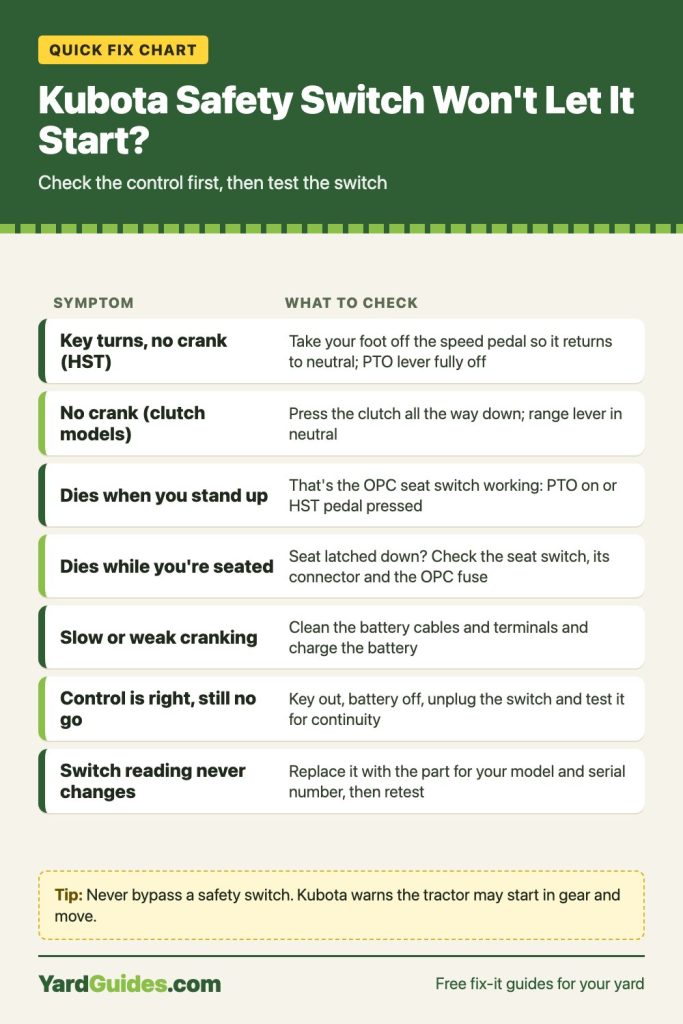
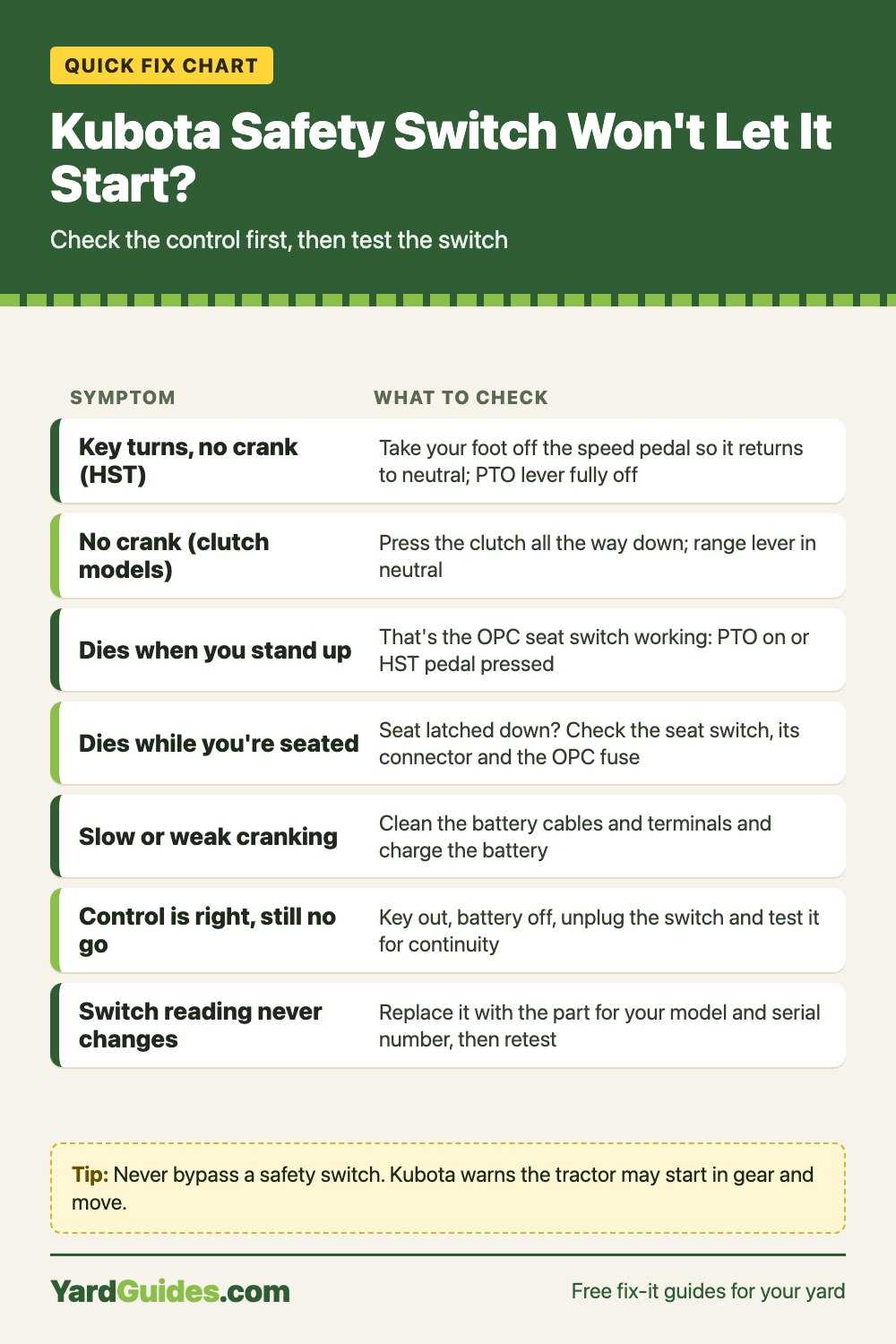
Quick answer: If your Kubota won’t crank, or dies when you shift in the seat, a safety interlock is either doing its job or has failed. Kubota’s manuals say the engine only starts with the speed pedal (or gear levers) in neutral, the PTO off and, on clutch models, the clutch pressed. The seat switch (Operator Presence Control, or OPC) stops the engine about a second after you stand up with the PTO on or the HST pedal pressed. Check each control, then test the suspect switch with a meter, key out, and replace it if it’s bad. Bypassing it is how people get run over.
Jump to the table: What each Kubota safety switch does (and where to look) ↓
Why people search “how to bypass the safety switch on a Kubota”
The tractor won’t start mid-job, or it dies every time you bounce over a rut, and a jumper wire looks like the fastest fix. We won’t show you how to do that, and here’s why.
Kubota’s own operator’s manuals warn: “Do not start the engine by shorting across starter terminals or bypassing the safety start switch. The tractor may start in gear and move if normal starting circuitry is bypassed” (Kubota BX1880/BX2380/BX2680 operator’s manual, p. 6). The B2301/B2601 manual carries the same warning (Kubota B2301/B2601 operator’s manual).
That’s not lawyer talk. Farm safety specialists from Penn State, Ohio State, Iowa State and the University of Nebraska Medical Center list starting a tractor from the ground while it’s in gear (bypass starting) as one of the classic ways people get run over, and they advise: “Do not disable or wire around the safety interlocks installed by the manufacturer” (Farm and Ranch eXtension in Safety and Health, Preventing Tractor Runover Incidents). Federal fatality investigators have written up deaths exactly like this, for example a farmer run over while starting his tractor when he wasn’t in the operator’s seat (FACE Report 98IA073, Iowa).
The seat switch matters for the same reason. If you’re thrown off or step down with the PTO spinning or the pedal pressed, the OPC stops the engine before the tractor or the implement can hurt you.
The real fix is usually easy. Here’s how to find it.
What each Kubota safety switch does (and where to look)
Which switches you have depends on the model and transmission. The list below comes from Kubota’s operator’s manuals. The operator’s manuals tell you which control each switch watches, but not exactly where the switch is mounted, so the “where to look” column is a starting point. The Kubota workshop manual for your model, or your dealer, can pinpoint it.
| Switch | What it checks | Where to look | What you’ll notice if it’s open or failed |
|---|---|---|---|
| Speed control (HST) pedal switch | Pedal is in neutral before the engine can crank | Near the HST speed pedal linkage | Key turns, starter does nothing |
| PTO clutch lever switch | PTO is off before cranking | Near the PTO clutch lever linkage | Won’t crank with the PTO lever on, or with a bad switch even when off |
| Seat switch (OPC) | Someone is in the seat while the PTO is on or the HST pedal is pressed | Under the operator’s seat | Engine dies about 1 second after you lift off the seat |
| Clutch pedal switch (clutch models) | Clutch is fully pressed before cranking | Near the clutch pedal | Won’t crank unless the pedal is all the way down |
| Range / gear shift switch (gear models) | Range lever is in neutral | Near the range shift linkage | Won’t crank with the range lever in gear |
What the manuals say, model by model:
- BX1880, BX2380, BX2680 (HST): “The engine will not start except when the speed-control-pedal is in the neutral position and the PTO-clutch-lever is in the off position” (p. 37). Standing up with the speed pedal pressed (p. 33) or with the PTO engaged (p. 54) stops the engine because of the OPC (manual).
- B2301, B2601 (HST): Same logic, and standing up with the speed set device on also stops the engine (manual).
- L2501: The start-system check covers a range gear shift switch and a PTO switch on manual-transmission models, and a speed pedal, PTO and clutch pedal switch on HST models. Every test is done with the clutch fully pressed except the clutch switch test itself (L2501 operator’s manual, p. 57, via ManualsLib).
Model-specific symptoms are covered in our Kubota B2920 problems and Kubota BX23S problems guides.
Free printable: seasonal maintenance checklist for your mower & tractor
A 2-page spring-to-winter checklist for riding and push mowers and compact tractors. Then short, practical emails a couple of times a month. Unsubscribe anytime.
First, rule out the simple stuff (no tools)
Most “bad safety switch” calls turn out to be a control that isn’t quite where the switch expects it. Sit in the seat and go through this in order:
- Parking brake set. Kubota’s starting procedure begins with it.
- PTO lever fully off. Not “mostly” off. Wiggle it to the stop.
- HST pedal in neutral. Take your foot off it. On a BX, Kubota notes the pedal returns to neutral on its own when released (p. 38). Mud, ice or a sticky linkage can keep it from fully returning.
- Range lever in neutral (and the shuttle in neutral on shuttle models).
- Clutch pressed all the way to the floor on clutch models. A floor mat or a worn pedal stop can keep it from fully triggering the switch. See our Kubota tractor clutch problems guide if the pedal itself feels wrong.
- Speed set (cruise) off on models that have it (BX2380/BX2680, B-series).
- Battery and cables. A weak battery acts a lot like a dead switch. Kubota’s troubleshooting table says to clean the battery cables and terminals and charge the battery when the engine “does not turn over quick enough” (BX manual p. 100).
If it starts now, you’re done. If it still won’t crank, or it keeps dying when you shift in the seat, keep going.
Common causes of a Kubota safety switch problem
The switch isn’t being pressed. The lever or pedal moves, but its tab or bracket no longer reaches the switch plunger. This happens with bent brackets, worn bushings, or a loose switch mount. Look at the switch while someone moves the control.
Misadjusted switch. Many interlock switches mount on a slotted bracket or a threaded body so they can be set to trip at the right point. If yours was moved during other repairs, it may now trip too late or not at all. The correct setting is in the Kubota workshop manual for your model. If you don’t have it, this is a quick job for a dealer.
Seat switch problems. If the seat isn’t latched down or you bounce off it on rough ground, the OPC switch opens and the engine dies. Check that the seat is locked in place and the switch plunger is clean and moves freely. If it dies while you’re firmly seated, suspect the switch or its wiring.
Wiring and connectors. Rodents, corrosion and vibration are hard on the small harness that runs to each switch. Look for chewed insulation, a connector that’s half off, or green corrosion on the terminals. Clean the terminals with electrical contact cleaner and make sure the connector clicks fully home.
A blown fuse. On the BX1880, BX2380 and BX2680, the fuse box includes a 10 A fuse for the OPC circuit (fuse no. 4, p. 97). Kubota says to replace a blown fuse with one of the same capacity, but first find out why it blew, and never bypass the fuse system.
A failed switch. Plunger switches wear out. If the control is in the right position, the wiring looks good, and the switch doesn’t change state on a meter (below), replace it.
How to test a Kubota safety switch with a multimeter
This test is done with the switch out of the circuit and the tractor off, so nothing can start or move.
What you’ll need – A basic digital multimeter with a continuity or ohms setting – A screwdriver or small wrench – Electrical contact cleaner – Your operator’s manual (and workshop manual, if you have it)
Steps 1. Park on level ground, lower any implement, set the parking brake and block the wheels. 2. Turn the engine off and remove the key. Put it in your pocket. 3. Disconnect the negative battery cable. This keeps the circuit dead while you work. 4. Unplug the connector from the switch you’re testing. Note how it goes back on. 5. Set the meter to continuity or the lowest ohms range. Touch the probes together to confirm it beeps or reads near zero. 6. Probe the switch’s two terminals (on the switch side, not the harness). 7. Press and release the plunger (or move the control that presses it). A good switch changes state cleanly: continuity in one position, none in the other. Which position should be closed depends on the switch, so check the workshop manual if you need to know. 8. Watch for bad signs: no change at all, a reading that flickers as you press, or a switch that only works if you push hard or at an angle. Any of those means replace it. 9. Reconnect the switch and the battery cable, then run Kubota’s checks below.
Replacing a Kubota safety switch
- Get the right part. Order by model and serial number from a Kubota dealer or Kubota’s parts lookup. Interlock switches look alike but differ, so don’t guess.
- Swap it like for like. Key out, negative cable off, unplug, unbolt, fit the new switch in the same position, plug it in.
- Set it so the control fully presses it, using the workshop manual setting or your dealer.
- Test it the Kubota way (next section). It isn’t fixed until it passes.
Check it afterward: Kubota’s own safety-switch tests
Kubota tells owners to check the engine start system and the OPC every 50 hours and before use (BX manual pp. 6, 82). Sit in the seat with nobody near the tractor:
- Speed pedal switch: range lever in neutral, PTO off, press the speed pedal, turn the key to start. The engine must not crank.
- PTO switch: speed pedal in neutral, PTO lever on, key to start. The engine must not crank.
- Seat (OPC) switch: start the engine, then either press the speed pedal or engage the PTO, and stand up without getting off. The engine should shut off after about 1 second.
On clutch models, the L2501 manual adds a clutch switch test: clutch released, key to start, the engine must not crank. If any test fails, Kubota says don’t operate the tractor and see your dealer.
Running a chipper or pump with the PTO? There’s a factory way
If you wanted to get around the seat switch so the PTO keeps running while you’re off the tractor, check your manual’s stationary PTO section first. Kubota lays out a procedure for parked PTO work like a chipper or pump. On the BX1880/2380/2680 it’s “Using stationary PTO” on p. 54, and it starts with setting the parking brake, blocking the tires and putting every shift lever in neutral. The B2301/B2601 manual notes that if you stand up and release the parking brake with the PTO engaged, the engine stops. Follow your own manual’s steps exactly, and stay clear of the driveline. (Kubota’s manuals are worth keeping handy for other controls too, like putting a Kubota in 4-wheel drive.)
FAQ
Where is the seat safety switch on a Kubota tractor? Under the operator’s seat. Kubota calls the system Operator Presence Control (OPC). Tilt or lift the seat per your manual to see the switch and its connector.
Why does my Kubota die when I stand up or hit a bump? That’s the OPC. Kubota’s manuals say the engine stops if you stand up with the PTO engaged or the HST pedal pressed. If it dies while you’re firmly seated, check the seat latch, the switch, the connector and the OPC fuse.
Can I bypass the safety switch on my Kubota? We don’t recommend it and won’t give steps. Kubota warns that with the starting circuit bypassed, the tractor may start in gear and move. Test the switch and replace it if it’s bad.
How do I know if a Kubota safety switch is bad? With the key out and the switch unplugged, a good switch changes from open to closed (or back) when you press its plunger. No change, or a flickering reading, means replace it.
Sources
- Kubota, BX1880, BX2380, BX2680 Tractor Operator’s Manual (safety start warning p. 6; OPC pp. 33, 54; starting p. 37; start system and OPC checks p. 82; fuses p. 97; troubleshooting p. 100; stationary PTO p. 54)
- Kubota, B2301, B2601 Tractor Operator’s Manual (starting precautions, OPC, stationary PTO, Checking Engine Start System)
- Kubota, L2501 Operator’s Manual, Checking Engine Start System (ManualsLib)
- Farm and Ranch eXtension in Safety and Health (Penn State, Ohio State, Iowa State, UNMC), Preventing Tractor Runover Incidents
- NIOSH-funded FACE program, Report 98IA073: Farmer Is Run Over By A Tractor While Starting It When Not In the Operator’s Seat (Iowa)