
Quick answer: If your zero turn won’t start, or the engine cuts out when you hit a bump or shift your weight, the safety interlock system is either doing its job or one of its switches has failed. Most zero turns only crank with the motion control levers locked out in park (which sets the parking brake on most models) and the blade (PTO) switch off. Check those first. If it dies when you bounce in the seat, check the seat switch connector, your seat adjustment and the switch itself. Test it with a multimeter, key out, and replace it if it fails. Don’t bypass it: the seat switch is what stops the blades if you’re thrown off.
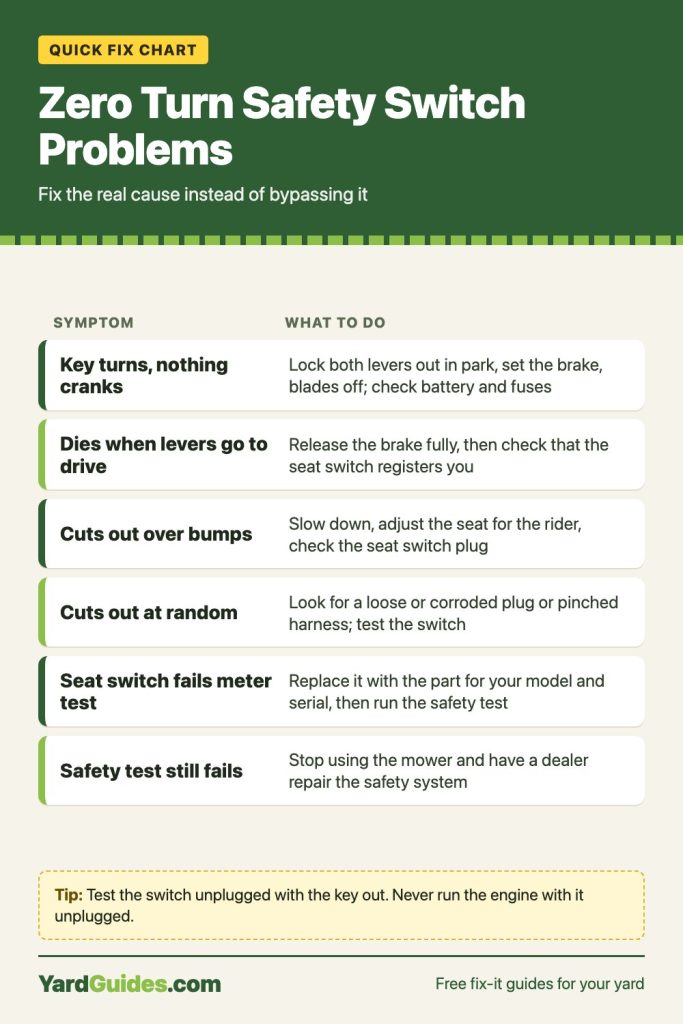
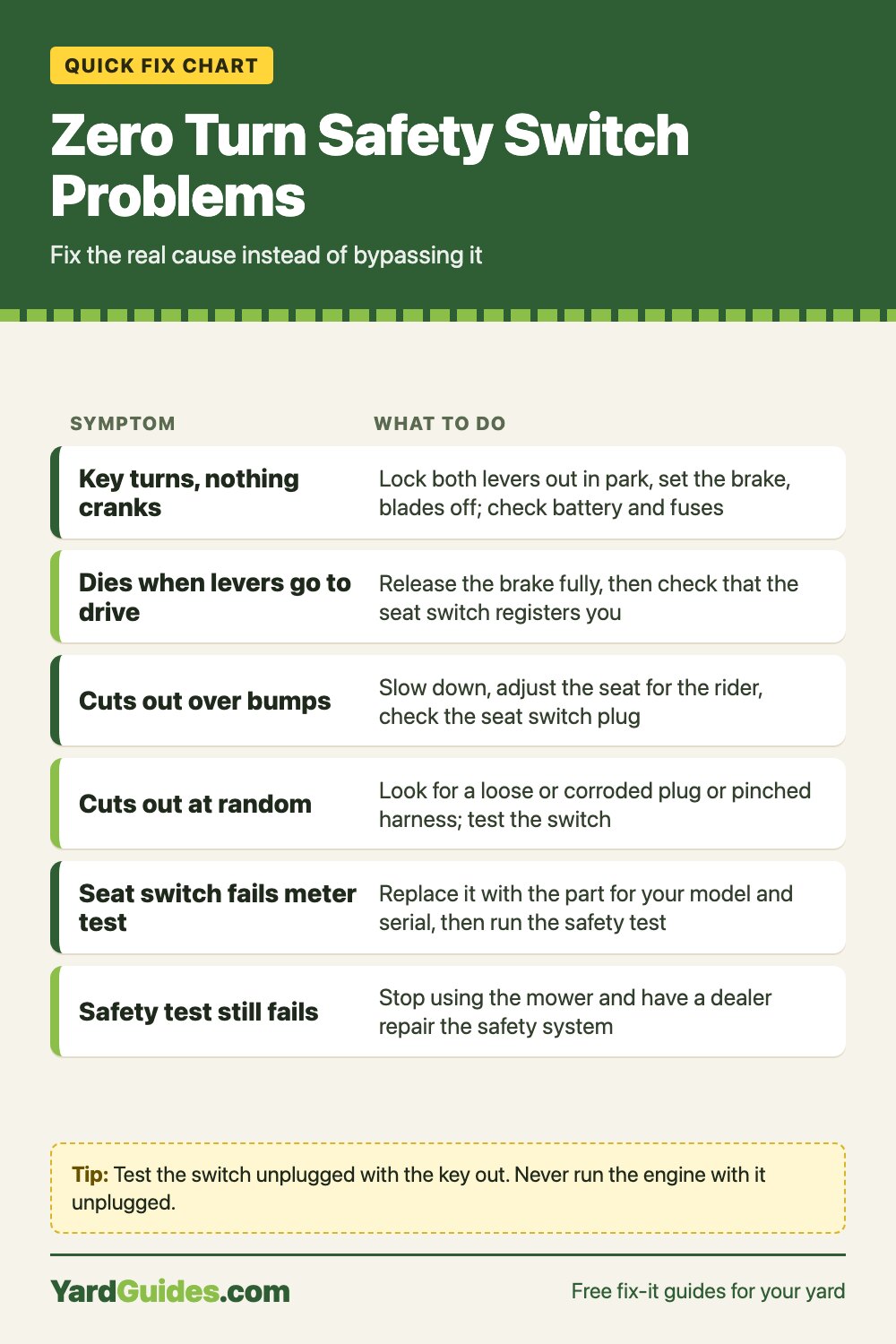
Jump to the table: Zero turn safety switch problems: quick symptom chart ↓
A seat switch that kills the engine every time you hit a root is maddening, so it’s no surprise people look for a way to cut it out. But a bypass only hides a fault in the system built for the worst moment of your mowing season. The real cause is usually simple: a control not fully in position, a loose connector, a seat set wrong for your weight, or a worn switch. This guide walks through each one.
How zero turn safety interlocks work
Every zero turn has four interlocks: the motion control levers, the parking brake, the blade (PTO) switch and the seat switch. The wording varies by brand, but the logic is close to the same:
- Toro (TimeCutter SS 5060 manual): the engine won’t start unless the blades are disengaged and the motion control levers are in park. It stops the engine if you rise from the seat with the levers out of park (Toro).
- Husqvarna (Z454XS manual): starting needs the levers in neutral, the brake applied, the blades off and the seat switch (the OPC) pushed down. The engine must stop if you lift off the seat with the brake off or the blades on (Husqvarna).
- Cub Cadet (Z-Force 54 manual): no cranking unless both drive levers are fully outward, the parking brake is set and the PTO is off. The engine shuts off if you leave the seat before setting the brake, and if you move the levers out of neutral while the brake is still set (Cub Cadet).
- John Deere (Z300 series manual): the park brake locks when you move both levers fully outward, and the starter won’t turn with the brake unlocked or the mower engaged (John Deere).
One useful detail: with the blades off and the parking brake set, the engine is supposed to keep running if you rise slightly off the seat. John Deere’s seat switch test checks exactly that.
Zero turn safety switch problems: quick symptom chart
| Symptom | Most likely cause | What to do |
|---|---|---|
| Key turns, nothing cranks | A lever not locked out, PTO on, brake off, weak battery, blown fuse | Reset every control, charge the battery, check fuses |
| Dies the moment you push the levers into drive | Seat switch not registering you, or brake still set | Release the brake fully, then check the seat switch |
| Cuts out over bumps or on slopes | You’re lifting off the seat, seat adjusted wrong, loose connector | Slow down, adjust the seat, check the plug |
| Cuts out at random, even sitting still | Loose or corroded connector, pinched harness, worn switch | Inspect wiring, test the switch with a meter |
| Starts with blades on, or keeps running when you stand with blades on | Failed or tampered interlock | Stop using it until the switch is fixed |
Zero turn won’t start? Check these first
- Levers locked fully outward. The Toro, Husqvarna and John Deere troubleshooting charts all list levers not in park or neutral as a no-start cause. Push both firmly into the park position.
- Parking brake engaged. On many zero turns, locking the levers outward sets the brake. On models with a separate brake lever, set it.
- Blade switch fully off. A PTO knob that’s slightly up can still read as “on.”
- Sit all the way back in the seat. Some models need the seat switch closed to crank.
- Battery and terminals. Toro’s chart lists a dead battery and corroded or loose connections. Clean the terminals and charge the battery. See our winterizing guide for battery storage tips.
- Fuses. The Toro, Husqvarna and John Deere charts all list a blown fuse. Husqvarna’s Z454XS keeps its fuse box under the seat.
- The switches themselves. If all of that checks out, John Deere’s chart lists a defective brake, mower engagement or key switch, and Husqvarna’s lists a damaged OPC (seat switch).
If it cranks but won’t fire, look at fuel and spark instead: stale gas, a loose plug wire or a clogged fuel filter. Our Husqvarna M ZT 52 problems guide covers model-specific issues.
Why your zero turn cuts out over bumps or when you shift your weight
This is the classic seat switch complaint. The switch sits under the seat and closes under your weight. If the seat springs up for a split second while the blades are on or the brake is off, the engine stops. John Deere’s troubleshooting chart even lists “operator raising off of the seat” as a cause of an engine that stops or misses on hillsides (John Deere).
Free printable: seasonal maintenance checklist for your mower & tractor
A 2-page spring-to-winter checklist for riding and push mowers and compact tractors. Then short, practical emails a couple of times a month. Unsubscribe anytime.
1. You really are lifting off. Rough ground at speed bounces you, so slow down. CPSC also warns that holes, ruts and bumps can overturn the machine (CPSC).
2. The seat suspension or position is set wrong. Many seats have a weight or ride setting. On the Cub Cadet Z-Force 54, for example, the lever has light, medium and heavy settings, and Cub Cadet says to set it with no one in the seat (Cub Cadet). If your seat has a setting like this, match it to the rider and check the fore and aft position too.
3. A loose or corroded connector. The seat switch plugs into the main harness under the seat. A plug that isn’t fully latched, or has dirty or spread terminals, can break contact on every bump. With the key out, unplug it, inspect and clean it, and plug it back in until it latches.
4. A pinched or rubbed harness. Cub Cadet’s setup instructions warn not to cut, crimp or damage the seat switch harness when installing the seat (Cub Cadet). Look for a wire that gets squeezed when the seat pivots or compresses.
5. A worn switch. The switch gets pressed every time you sit. Worn contacts can open with only a slight change in pressure. A meter test confirms it.
Dies when you push the levers into drive? Once the parking brake is released, the seat switch has to register you, or the engine stops. On Cub Cadet models, moving the levers out of neutral with the brake still set also shuts it off (Cub Cadet).
How to test a zero turn seat switch with a multimeter
What you’ll need
- A digital multimeter with a continuity or ohms setting
- Basic hand tools to tilt or remove the seat
- Your operator’s manual (and the wiring diagram, if you have the service manual)
Steps
- Make it safe. Park on level ground, blades off, parking brake set. Stop the engine and take the key out. Let the engine and muffler cool.
- Tilt the seat up to reach the switch connector. On most zero turns the seat pivots forward.
- Unplug the seat switch from the main harness. You’re testing the switch on its own, out of the circuit.
- Set your meter to continuity or ohms and put the probes on the switch-side terminals.
- Check both states. Toro’s service manual for its Groundsmaster 360 describes the seat switch as normally open: with no pressure on the seat there should be no continuity, and with the switch pressed there should be continuity (Toro service manual via ManualsLib). Toro warns not to reach in through openings in the seat plate to press it.
- Wiggle test. Hold it closed and wiggle the leads. A flickering reading means a bad switch or pigtail.
- Plug it back in.
Some switches have three or four terminals. If your readings don’t match a simple open/closed pattern, check your model’s wiring diagram or ask your dealer. Never run the engine with the switch unplugged or the seat removed to “see what happens.”
Replacing the seat switch
If the switch fails the meter test or the readings jump around, replace it:
- Buy the right part. Look it up by model and serial number on the manufacturer’s parts site or at a dealer.
- Swap it like for like. Note how the old switch sits and how the harness is routed, and install the new one the same way so the seat can’t pinch the wire.
- Run the safety interlock test. Toro’s test (it says to run it before each use) checks that the engine won’t crank with the blades on or either lever unlocked, and that the engine stops when you rise slightly with the blades engaged (Toro). John Deere’s test also checks that the engine keeps running when you rise with the brake locked and blades off.
If the new switch doesn’t cure it, or any part of the test fails, stop there. Toro says to have an authorized dealer repair the safety system “immediately,” and Husqvarna says an operator presence fault must be handled by an authorized Husqvarna dealer (Husqvarna). Our Simplicity mower electrical problems guide has more wiring checks.
Why bypassing the safety switch is dangerous
CPSC estimates about 35,000 riding mower injuries were treated in emergency rooms each year in 2012 to 2014, and about 90 deaths a year were linked to riding mowers in 2008 to 2010. The common fatal patterns: the machine tips over, someone falls under or is run over by it (including young children), or the operator is thrown from it (CPSC).
The seat switch is built for exactly those moments. CPSC describes operator presence control, part of the ANSI/OPEI B71.1 voluntary safety standard, as a device that stops the blades if you leave the operator’s position without disengaging them first. The same safe-practice list, reproduced from the ANSI standard, says: “Never tamper with safety devices. Check their proper operation regularly.” Toro’s manual warns that disconnected or damaged interlock switches can let the machine “operate unexpectedly causing personal injury.”
In 2025, CPSC staff told the industry group OPEI that 7 child runover or backover incidents and 13 rollover incidents turned up in just 20 recent in-depth investigations (CPSC staff letter).
If you need to step off, do what CPSC says: turn off the blades, set the parking brake, stop the engine and take the key out. Tractor owners with the same problem can see our Kubota safety switch guide.
Still clicks or won’t crank? See riding mower clicks or won’t crank: interlocks, fuse, battery, then solenoid.
Battery flat? See how to charge a riding mower battery: charge rates, voltage and jump-start rules by maker.
FAQ
Can a bad seat switch stop a zero turn from starting? Yes, on many models. Husqvarna’s Z454XS troubleshooting chart lists a damaged OPC (seat switch) as a reason the starter won’t turn the engine over.
Why does my zero turn die when I release the parking brake? Once the brake is off, the system needs to know you’re seated. If the seat switch isn’t closing, because of a bad switch, a loose plug or a seat that isn’t pressing it down, the engine stops.
Can I stand up for a second without the engine dying? On most models, yes, if the blades are off and the parking brake is set. Shut it down and pull the key before you actually get off.
Should I take it to a dealer? If the safety test fails after a new switch, yes. Cub Cadet owners can also check our Cub Cadet ZT1 50 problems guide.
Sources
- Toro TimeCutter SS 5060 Operator’s Manual (Form 3385-342): safety-interlock conditions, test procedure, troubleshooting
- Toro Groundsmaster 360 Service Manual, Seat Switch (via ManualsLib): seat switch continuity test
- Husqvarna Z454XS Operator’s Manual: operation conditions, troubleshooting
- Husqvarna Help Center: Faulty operator presence switch(es)
- Cub Cadet Z-Force 54 Operator’s Manual (769-08885): safety interlock system, seat and harness notes
- John Deere Z300 Series Operator’s Manual (OMUC45276): safety system tests, troubleshooting chart
- CPSC Riding Lawnmowers fact sheet (Pub. 588): injury data, operator presence control, ANSI/OPEI B71.1 safe practices
- CPSC staff letter to OPEI on riding mower hazards (April 25, 2025)