
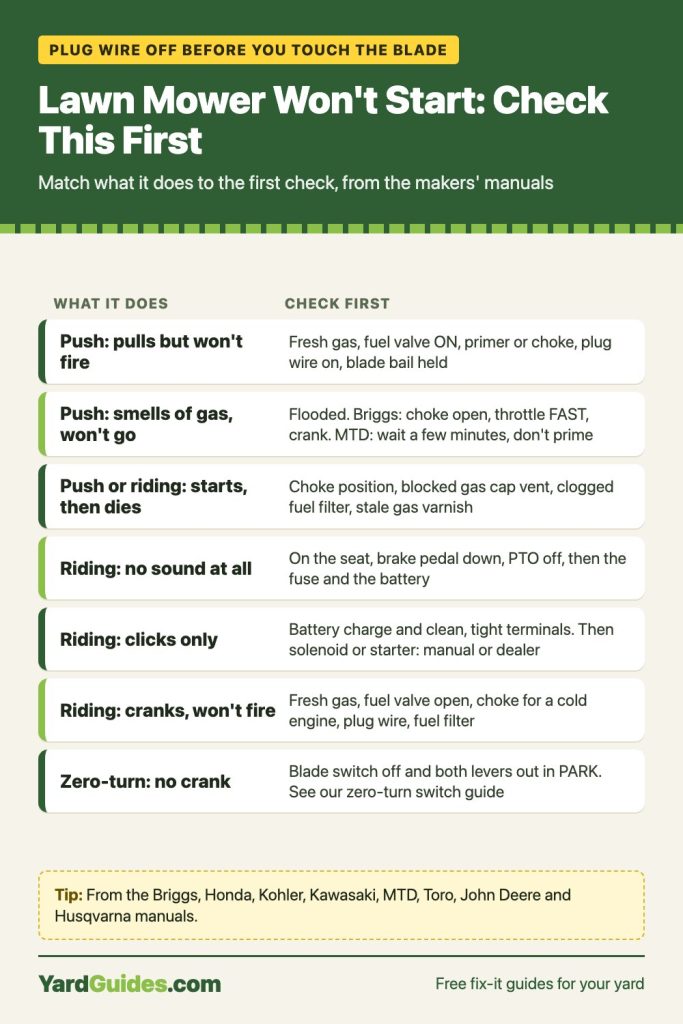
Quick answer: Stale gas is the most common reason a mower won’t start after winter. Briggs & Stratton says “stale fuel, dirt, and debris are the most common cause of outdoor power equipment not starting or running properly”. On a push mower, refill with fresh gas, turn the fuel valve ON if it has one, and prime 3 times or set the choke (Briggs and MTD). Hold the blade bail and pull. Then check the plug wire, spark plug and air filter. On a riding mower that won’t crank or only clicks, sit on the seat with the brake pedal down and the blades (PTO) off. Then check the battery and fuse.
Jump to the table: Push mowers (pull-start or push-button) ↓
YardGuides may earn a commission from links on this page, at no cost to you. As an Amazon Associate I earn from qualifying purchases. Learn more.
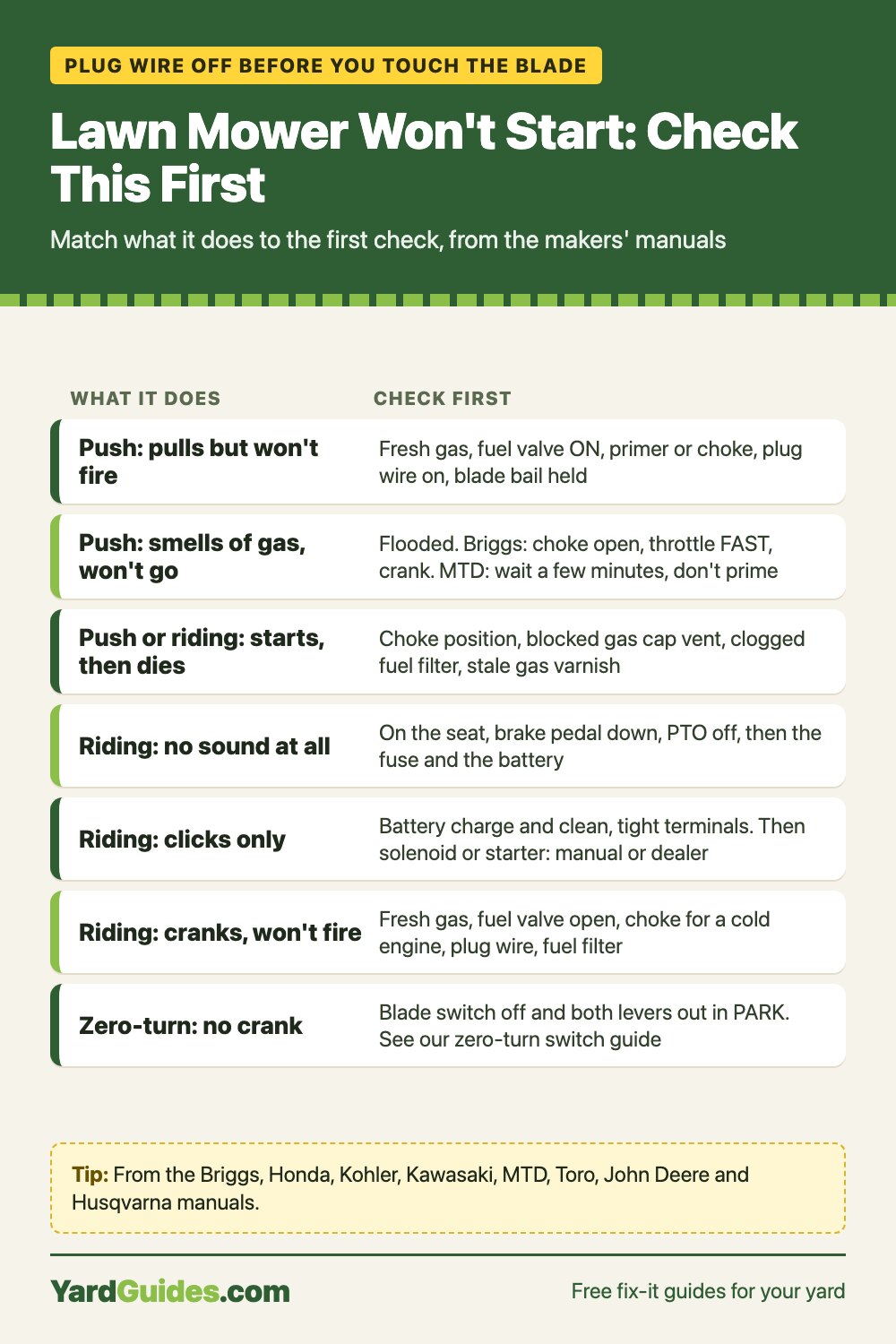
Safety before you touch anything: disconnect the spark plug wire and keep it away from the plug before you reach under the deck or touch the blade (Briggs, p. 8). On riders, Briggs also says to disconnect the battery’s negative wire before repairs. Start and run the engine outdoors only. Briggs warns exhaust “contains carbon monoxide, a poisonous gas that could kill you in minutes,” and says not to run it in garages or sheds, “even if you use fans or open doors and windows for ventilation” (p. 7). Never bypass or jumper a seat, brake or blade safety switch. John Deere: “Never tamper with safety devices” (p. 11). Don’t use spray starting fluid either: Briggs says “do not use pressurized starter fluids” (p. 7).
Every cause and check below comes from an engine or mower maker’s manual or support page, linked with the page. Where the makers disagree, we show both. Got a Toro Recycler 22? It has its own guide: Toro Recycler 22 won’t start. Zero-turn? See our zero-turn safety switch guide.
The 5-minute checklist (no tools)
Run down this list before you take anything apart. Each item is a cause in at least one maker’s “will not start” chart.
- Gas older than about a month? Briggs says untreated gas “begins to break down after about a month,” and Toro says old fuel “is the leading cause of hard starting” (p. 25). Drain it and refill with fresh gas.
- Fuel valve ON (Honda, Kawasaki, some Briggs engines). Honda lists “Fuel valve is OFF” first in its chart (GCV manual, p. 12).
- Primer or choke. Primer engines: 3 pushes (Briggs, MTD). Manual choke: CLOSED or CHOKE for a cold engine. Automatic choke (Briggs ReadyStart, Honda Auto Choke, Kohler Smart-Choke): no choke step at all.
- Plug wire pushed fully onto the spark plug. MTD and John Deere both list a loose or disconnected plug wire.
- Blade bail held against the handle (push mowers). Honda and MTD list it first. On a Honda HRN, “the engine stops when the blade control lever is released” (p. 8).
- Riders: on the seat, brake pedal down, PTO (blades) off, in neutral or park. The interlocks block the starter otherwise.
- Riders: battery charged and terminals clean and tight, and the fuse not blown.
Diagnose by symptom
Find what your mower does, then work across. Causes are listed in the order the makers’ charts give them.
Push mowers (pull-start or push-button)
| What it does | Likely causes (maker charts) | First check | Fix or next step |
|---|---|---|---|
| Pulls fine but never fires | Blade control not held, plug boot off, empty tank or stale gas, fuel valve off, not primed or choked, bad plug, clogged fuel filter, flooded (MTD, p. 13; Honda HRN, p. 16) | Fresh gas, valve ON, 3 primes or choke, then the plug | Work down the 5-minute checklist, then spark plug checks |
| Smells of gas, still won’t fire | Flooded: too many primes (Briggs, p. 7) or cranking on choke (Kawasaki, p. 17). MTD lists “Engine flooded” (p. 13) | Wet spark plug | Flooded engine steps by maker |
| Fires, then dies in seconds | Choke left on, blocked gas cap vent, water or dirt in the fuel (MTD “Engine runs erratic,” p. 13); stale fuel (also on Toro’s riding-mower chart, p. 50) | Choke position, then loosen the gas cap and retry | Starts then dies |
| Runs only with the choke on | No chart lists this symptom by name. Our reading: a partly clogged carburetor. Briggs: “A dirty carburetor can cause poor engine performance or starting problems” | Fresh gas first | Carb cleaning |
| Smokes after it starts | Mower tipped plug-side down, oil overfill, oil from storage prep (MTD, pp. 9 and 12; Briggs FAQ) | How it was tipped and the dipstick | Brief smoke after storage is “normal” (MTD). Overfilled? See lawn mower oil. Constant blue or white smoke: Briggs FAQ |
Riding mowers and lawn tractors (key start)
| What it does | Likely causes (maker charts) | First check | Fix or next step |
|---|---|---|---|
| Nothing at all when you turn the key | Brake pedal not down, blades (PTO) engaged, dead battery, blown fuse, corroded terminals, wiring, ignition switch, solenoid or starter, operator presence switch (Husqvarna, p. 26; John Deere, p. 47) | Seat, brake, PTO, neutral. Then the fuse | Won’t crank or clicks |
| Clicks but won’t turn over | Weak or dead battery, corroded terminals, loose wiring, faulty solenoid or starter (Husqvarna, p. 26) | Charge the battery and clean the terminals | Battery, then solenoid |
| Cranks but won’t fire | Out of fuel, not choked, flooded, bad plug, dirty air or fuel filter, water in the fuel (Husqvarna, p. 26); plug wire, improper fuel, defective safety switch (John Deere, p. 46) | Fresh gas, fuel valve open, choke for a cold start | First start by engine maker |
| Starts, then dies | Choke not set for the conditions, dirty fuel filter, stale fuel (Toro TimeCutter, p. 50); blocked tank vent (Kawasaki, p. 34); low fuel on a slope or rising off the seat (John Deere, p. 47) | Choke and gas cap, then the seat | Starts then dies |
| Starter spins, engine doesn’t turn | Pinion gear sticking or damaged, starter clutch slipping, reversed battery cables (Briggs starter FAQ) | Battery cable polarity | Briggs recommends its repair manual or a dealer |
Same engine on your snow blower? Many snow blowers use the same engine makers and have the same fuel and spark causes. The snow version of this page is snow blower won’t start.
First start of the season, by engine maker
Check the label on the engine, not just the mower. A Toro, Cub Cadet, John Deere or Husqvarna can carry a Briggs, Kohler, Kawasaki, Honda or in-house engine, and each engine manual has its own starting steps.
| Engine | Before you pull or turn the key | If it doesn’t start | Source |
|---|---|---|---|
| Briggs & Stratton push mower (primer) | Throttle FAST, push the red primer 3 times, hold the bail, pull slowly to resistance then quickly. “If you push the primer button too many times, the engine will flood and it will be hard to start” | Flooded: choke OPEN (if fitted), throttle FAST, crank until it starts | Briggs 80098074, p. 7 |
| Briggs ReadyStart or choke system | ReadyStart has an automatic choke and no primer. Choke system: choke CLOSED, OPEN as it warms. The choke “is usually not necessary” on a warm engine | Electric start: 5 seconds max, wait 1 minute | Briggs 80098074, p. 7 |
| Briggs V-twin riders | Fuel shut-off OPEN, throttle FAST, choke CLOSED. A dry fuel system needs extra cranking on choke so the fuel pump can prime | “If the engine starts but will not continue to operate, move the choke control … to the OPEN position” | Briggs 80107981, p. 7 |
| Honda GCV (Honda HRN mowers) | Fuel valve ON. Manual choke to CHOKE when cold. Auto Choke models: hold the blade lever and pull, no choke step | Flooded: dry and reinstall the plug, start with the lever in FAST and the choke OFF | Honda GCV170/200, pp. 8 and 12 |
| MTD vertical shaft (Cub Cadet, Troy-Bilt push mowers) | Primer: 3 pushes about 2 seconds apart, 5 below 50°F. Auto-choke: no primer, just hold the bail and pull | Flooded: “Wait a few minutes to restart, but do not prime” | MTD 769-25030, pp. 8 and 13 |
| Toro 22in Recycler | No choke or primer step. Hold the blade-control bar and pull (or push the electric-start button) | Several tries and nothing: Toro says to contact a dealer. Our Recycler guide has the checks | Toro 3441-821, p. 15 |
| Kohler 7000 with Smart-Choke | No choke step. Smart-Choke “will automatically adjust engine choke on start up with throttle in any position” | Wait 3 to 5 seconds between tries (5 to 10 seconds at 32°F and below). After the third, wait 1 minute (or key OFF 2 minutes, by serial). Dealer after the fifth. See Smart-Choke problems | Kohler 32 590 31, p. 4 |
| Kawasaki FR (riders) | Fuel valve open, throttle at half, full choke when cold (half or none when warm). “Usually engine will start within 3 seconds” | Starter 5 seconds max, wait 15 seconds. Don’t keep cranking on choke: it floods | Kawasaki FR manual, p. 17 |
Long cranking hurts the starter, and the makers set different limits: 5 seconds, then wait a minute (Briggs). 5 seconds, then wait 15 (Kawasaki). “Not more than 5 seconds” (John Deere, p. 23). Don’t hold the key in START “for longer than ten seconds at a time” (Cub Cadet, p. 17). “Do not run starter continuously for more than fifteen seconds per minute” (Husqvarna, p. 12). Use your manual’s number.
How to start a riding lawn mower
The order is nearly the same on every rider. The interlocks won’t let the starter turn unless you’re seated with the brake on and the blades off. This sequence follows the John Deere S100 to S180 manual (pp. 22 to 23), with the differences from Husqvarna and Cub Cadet noted:
- Sit on the seat. The seat switch is part of the interlock circuit.
- Blades off. Disengage the mower (PTO) lever or switch.
- Brake pedal fully down. Husqvarna also has you set the parking brake, and Cub Cadet says to fully engage the brake.
- Throttle to full. If the engine is cold, John Deere has you push the throttle lever into the choke area and hold it. Husqvarna and Cub Cadet use a choke position or knob.
- Turn the key to START and let go when it fires. John Deere: not more than 5 seconds.
- Off the choke. John Deere: release the choke to full throttle. Husqvarna: below 50°F, let it run on choke until it “runs roughly,” then move to fast. Cub Cadet: “Do NOT leave the choke control on while operating the tractor.”
On a hydrostatic Husqvarna, make sure the freewheel control is in the transmission-engaged position first (p. 12). If it still won’t start after several tries, Husqvarna says to move the throttle to fast, wait a few minutes and try again, then go back to choke.
Free printable: seasonal maintenance checklist for your mower & tractor
A 2-page spring-to-winter checklist for riding and push mowers and compact tractors. Then short, practical emails a couple of times a month. Unsubscribe anytime.
Zero-turns add one more interlock. On a Toro TimeCutter, the engine won’t start unless the blade-control switch is off and both motion-control levers are out in PARK (p. 16). The seat, lever and blade switches have their own guide: zero-turn safety switch.
Riding mower clicks or won’t crank
Work in this order: interlocks, then the fuse and battery, then the solenoid and starter.
1. Interlocks. Briggs’ starter FAQ lists “the safety interlocks” among the reasons an engine won’t crank. The Husqvarna and John Deere charts list the brake pedal not pressed and the mower (PTO) engaged before any electrical cause. John Deere’s checks run the other way: sit on the seat, release the park brake and try to start. “Engine must not turn over” (p. 21). If any interlock test fails, John Deere says “do not operate machine. See your authorized dealer for service.” Cub Cadet: “Do not operate the tractor if the interlock system is malfunctioning” (p. 17). Never jumper a switch to get it running. If the key switch itself is suspect, our 5-pole ignition switch guide shows the terminals. Simplicity owners can use our Simplicity electrical guide.
2. Fuse. Cub Cadet: “If the electrical system does not function, or your tractor’s engine will not crank, check to be certain that the fuse has not blown” (XT1 manual, p. 26). Husqvarna and John Deere list a blown fuse too.
3. Battery. A click with no crank is a weak or dead battery or dirty terminals first, per Husqvarna’s “Engine clicks but will not start” row (p. 26).
- Testing parts: Briggs says “If you are testing any parts with a multimeter, you should get a reading of 12 volts or more.” That is a parts-test figure, not a battery state-of-charge spec.
- Charge it: rates differ by maker (2 to 10 amps); see our riding mower battery guide. Cub Cadet says max 10 amps, and at least 8 hours on a charger that isn’t automatic (p. 26). Husqvarna: 6 to 10 amps for 1 hour (p. 15). Briggs: if it isn’t fully charged within 8 hours, “your battery is dead and you’ll need to replace it.”
- Clean the terminals: disconnect the negative (black) cable first and reconnect it last (John Deere, p. 41). Clean with a wire brush until bright.
- Jump-starting: follow your manual’s order. Both John Deere and Cub Cadet make the last connection on the engine block, away from the battery. Cub Cadet: “Never jump start a damaged or frozen battery,” and don’t run the car’s engine while it’s connected (p. 26). Kohler 7000 Series and Command PRO engines: Kohler says do not jump start; charge the battery instead.
Battery safety: John Deere warns “the battery produces a flammable and explosive gas.” Keep flames and sparks away, wear eye protection and gloves, and don’t let metal touch across the posts (pp. 40 to 41). Briggs adds: charge in a well-ventilated area and don’t tip the battery.
4. Solenoid or starter. If the battery is charged, the terminals are clean and you still get only a click, Husqvarna’s next cause is a “faulty solenoid or starter.” Briggs lists the solenoid and the starter motor switch too. Neither maker prints a home test procedure or voltages for these. Briggs points you to its repair manual or a dealer. We don’t guess at test numbers here: use your engine’s repair manual, or have a dealer test it.
Starts, then dies
This is the “it ran for 5 seconds” problem. The charts point to fuel getting in but not enough of it, or the choke set wrong:
- Choke. Briggs V-twin: if it starts but won’t keep running, move the choke to OPEN (p. 7). MTD lists “Unit running with CHOKE … applied” under “Engine runs erratic” (p. 13). Cub Cadet says leaving the choke on makes a “rich” mixture that runs poorly (p. 17). In the cold, Husqvarna has you stay on choke until the engine “runs roughly” (p. 12).
- Blocked gas cap vent. MTD: “Vent in gas cap plugged,” under “Engine runs erratic” (p. 13). Kawasaki lists “Blocked air vent in tank cap” under “Engine won’t start or output is low” (p. 34). John Deere lists a plugged fuel tank vent under vapor lock (p. 46). Quick check: loosen the cap and restart. If it keeps running with the cap loose, clean or replace the cap (that test is our reasoning, not a maker’s).
- Clogged fuel filter, or dirt or water in the fuel. Toro’s TimeCutter chart has a heading for an engine that “does not start, starts hard, or fails to keep running” (p. 50). Husqvarna: water in the fuel means emptying the tank and carburetor and replacing the fuel filter (p. 26).
- Stale gas and varnish in the carburetor. Fresh gas first. If it still only runs on choke, our reading is that the carb needs cleaning. Our lawn mower carburetor cleaning guide covers the bowl-and-jet steps. Why gas goes bad: does fuel stabilizer work?
- Riders: rising off the seat, or low fuel on a slope. John Deere: “Fuel tank less than half full of fuel” and “Operator raising off of the seat” (p. 47).
- Low oil. Engines with low oil protection will “stop the engine” when oil is low (Briggs, p. 6). Kohler’s chart lists incorrect oil level under both “Will Not Start” and “Stops Suddenly” (p. 8).
If it starts and then surges or hunts instead of dying, our reading is that it’s usually the governor or carb. See Briggs V-twin governor problems and Kawasaki governor problems.
Flooded engine: what each maker says
A flooded engine has too much fuel in the cylinder, usually from extra primer pushes or cranking on full choke. A wet spark plug is the sign Honda gives (p. 12). The makers fix it differently:
| Maker | Flooded-engine steps | Source |
|---|---|---|
| Briggs & Stratton | Choke to OPEN or RUN (if fitted), throttle to FAST, crank until it starts. “Do not crank the engine with the spark plug removed” | Briggs 80098074, p. 7 |
| Honda | “Dry and reinstall the spark plug. Start the engine with the choke/throttle lever in the FAST position. Choke in the OFF position.” | Honda GCV, p. 12 |
| MTD | “Wait a few minutes to restart, but do not prime” | MTD 769-25030, p. 13 |
| Husqvarna riders | “Wait several minutes before attempting to start” | Husqvarna YTH18542, p. 26 |
| Kawasaki FR | “Open choke. Rotate engine with spark plugs removed to discharge excess fuel. Clean spark plugs” | Kawasaki, p. 34 |
Kawasaki disagrees with Briggs and MTD on turning the engine over with the plug out. MTD: “DO NOT crank engine with spark plug removed” (p. 11). Follow your own engine’s manual. On a Briggs or MTD engine, don’t crank with the plug removed. Either way, keep the plug wire away from the plug, and don’t check for spark with the plug out. Briggs says to use an approved spark tester (p. 8).
Spark plug and air filter quick checks
Briggs calls disconnected, dirty or fouled plugs “common causes for engines that won’t start.” Pull the plug (wire off, engine cool) and look. Replace it if the electrodes are worn or the insulator is cracked (Honda HRN, p. 14). Set the gap only to your engine’s number:
| Engine | Plug gap | Source |
|---|---|---|
| Briggs 080000, 090000, 093J00 (push mowers) | 0.020 in (0.51 mm) | Briggs 80098074, pp. 9 to 10 |
| Briggs 100000 (163 cc) | 0.030 in (0.76 mm) | Briggs 80098074, p. 10 |
| Honda GCV170, GCV200 and HRN216 | 0.028 to 0.031 in (0.7 to 0.8 mm) | Honda GCV, p. 13; HRN216, p. 14 |
| MTD 79, 132 and 140 cc vertical shaft | 0.030 in (0.76 mm) | MTD 769-25030, p. 11 |
| Kohler 7000 (KT610 to KT745) | 0.030 in (0.76 mm) | Kohler 32 590 31, p. 8 |
| Kawasaki FR651V, FR691V, FR730V | 0.030 in (0.75 mm) | Kawasaki, p. 29 |
Even within one Briggs manual, the gaps differ by 0.010 in between models. Don’t copy a gap from another engine. A dirty air filter shows up in the “will not start” rows for Husqvarna and Kohler, so check that too. If the mower was tipped the wrong way over winter, oil can soak the filter: Briggs says it then “will not easily start because of oil or fuel contamination of the air filter or the spark plug” (p. 8).
When to take it to a dealer
Stop and call a dealer when:
- It fails an interlock test, or you’d have to bypass a switch to make it run.
- The starter clicks with a charged battery and clean terminals, and you don’t have the repair manual’s solenoid and starter tests.
- You’ve done the fuel, plug and filter checks and it still won’t start. Honda sends “Fuel filter clogged, carburetor malfunction, ignition malfunction, valves stuck, etc.” to a dealer (HRN, p. 16). Husqvarna does the same for engine valves out of adjustment (p. 26).
- Compression is suspect. Briggs says valve clearance or leak problems “can lead to hard starting or prevent the engine from starting at all,” and recommends a dealer if you don’t have a leak-down tester.
- A Smart-Choke Kohler won’t start by the fifth try (Kohler, p. 4).
Prevent it next spring
Next fall, either stabilize the gas and run it through the engine, or drain it, depending on your engine maker. The rules by maker are in does fuel stabilizer work?. The full fall routine, including tipping the mower the right way, is in how to winterize a lawn mower. On riders, keep the battery charged over winter. Kohler’s cold-weather tip is to “make sure battery has a full charge” (p. 4).
What you’ll need
- Fresh regular gas in a clean can: 87 octane with up to 10% ethanol in the Briggs, Kohler, Kawasaki and Toro manuals (Honda accepts 86). Pages and details in our fuel guide
- Fuel stabilizer for the new gas, used at the bottle’s ratio
- A spark plug socket, and the plug your engine manual names. Buy by the part number in your manual
- A 12-volt battery charger or maintainer for riders. Cub Cadet says to use one designed for 12V lead-acid batteries
- A wire brush for battery terminals, plus gloves and eye protection
- Carburetor cleaner if it only runs on choke
Spring tune-up: see the lawn mower maintenance checklist and the plug and filter table by engine.
FAQ
Why won’t my lawn mower start after winter? Usually stale gas. Briggs & Stratton says untreated gas begins to break down after about a month, and says “stale fuel, dirt, and debris are the most common cause of outdoor power equipment not starting or running properly”. Toro calls old fuel “the leading cause of hard starting.” Replace it with fresh gas, then check the fuel valve, primer or choke, plug wire and spark plug.
Why does my mower start then die? The choke is usually set wrong, the gas cap vent is blocked, or the fuel filter or carburetor is partly clogged. MTD lists a plugged gas cap vent and running with the choke on under “Engine runs erratic.” Toro lists a dirty fuel filter and stale fuel for engines that fail to keep running. On riders, John Deere adds low fuel on slopes and rising off the seat.
Why does my riding mower click but not start? A weak or dead battery or corroded terminals, most often. Husqvarna’s chart lists the battery, terminals, wiring and then a faulty solenoid or starter. Charge the battery, clean the terminals, and check the fuse. Then have the solenoid and starter tested if it still only clicks.
How many times should I prime a lawn mower? Three pushes on Briggs & Stratton and MTD primer engines. MTD says 5 below 50°F, with about two seconds between pushes. Briggs warns that priming too many times floods the engine. Engines with an automatic choke, like Briggs ReadyStart and Honda Auto Choke, have no primer.
Can old gas stop a mower from starting? Yes. Stale or bad fuel is on the “will not start” list in the Honda, MTD and Toro manuals, and on Husqvarna’s “hard to start” list. Stabilizer won’t fix it: Honda says stabilizer “will not reconstitute stale fuel” (GCV manual, p. 15). Drain the old gas and refill with fresh.
Sources
- Briggs & Stratton, Operator’s Manual 80098074 Rev B, Models 080000, 090000, 093J00, 1000000: low oil protection p. 6; starting, flooding, primer, carbon monoxide p. 7; tilting and repairs safety p. 8; plug gap pp. 9 to 10. Copy hosted by Toro
- Briggs & Stratton, Operator’s Manual 80107981 Rev A, 400000, 440000, 490000 V-twin: flooding p. 6; start systems p. 7
- Briggs & Stratton, Small engine problem solving tips (updated April 6, 2026)
- Briggs & Stratton, Why won’t my lawn mower engine starter engage? (updated January 15, 2026)
- Briggs & Stratton, How to test a small engine charging system, battery and alternator (updated January 15, 2026)
- Briggs & Stratton, Engine emits white or blue smoke
- Honda, GCV170 / GCV200 Owner’s Manual 00X37Z9V0001: starting p. 8; troubleshooting p. 12; plug gap p. 13; stale fuel p. 15
- Honda, HRN216 Lawn Mower Owner’s Manual 00X31VR8B004: starting p. 8; spark plug pp. 13 to 14; removing from storage and troubleshooting p. 16
- MTD, 79cc, 132cc and 140cc OHV Vertical Shaft Engine Operator’s Manual 769-25030: starting p. 8; tipping p. 9; plug gap p. 11; storage p. 12; troubleshooting p. 13
- Toro, 22in Recycler Lawn Mower Operator’s Manual 3441-821: starting p. 15; storage p. 25
- Toro, TimeCutter 5000 Operator’s Manual 3466-168: safety interlock p. 16; troubleshooting p. 50
- John Deere, S100 to S180 Lawn Tractors Operator’s Manual OMUC22642 Issue H0: safety p. 11; interlock tests p. 21; starting pp. 22 to 23; battery and booster pp. 40 to 42; troubleshooting pp. 46 to 47. Retailer-hosted copy (Lowe’s)
- Husqvarna, YTH18542 Operator’s Manual 114 25 66-32: safety p. 3; starting p. 12; battery p. 15; troubleshooting p. 26
- Cub Cadet, XT1 and XT2 Enduro Series Operator’s Manual 769-10976: starting p. 17; jump starting, charging and fuse p. 26
- Kohler, 7000 Series KT610-KT745 Owner’s Manual 32 590 31: starting and cold weather hints p. 4; troubleshooting and plug gap p. 8
- Kawasaki, FR651V / FR691V / FR730V Owner’s Manual 99920-2289-03: starting p. 17; spark plug p. 29; troubleshooting p. 34
More mower fixes: Toro Recycler 22 won’t start · Kohler Smart-Choke problems · zero-turn safety switch · Cub Cadet 7254 problems · how to winterize a lawn mower