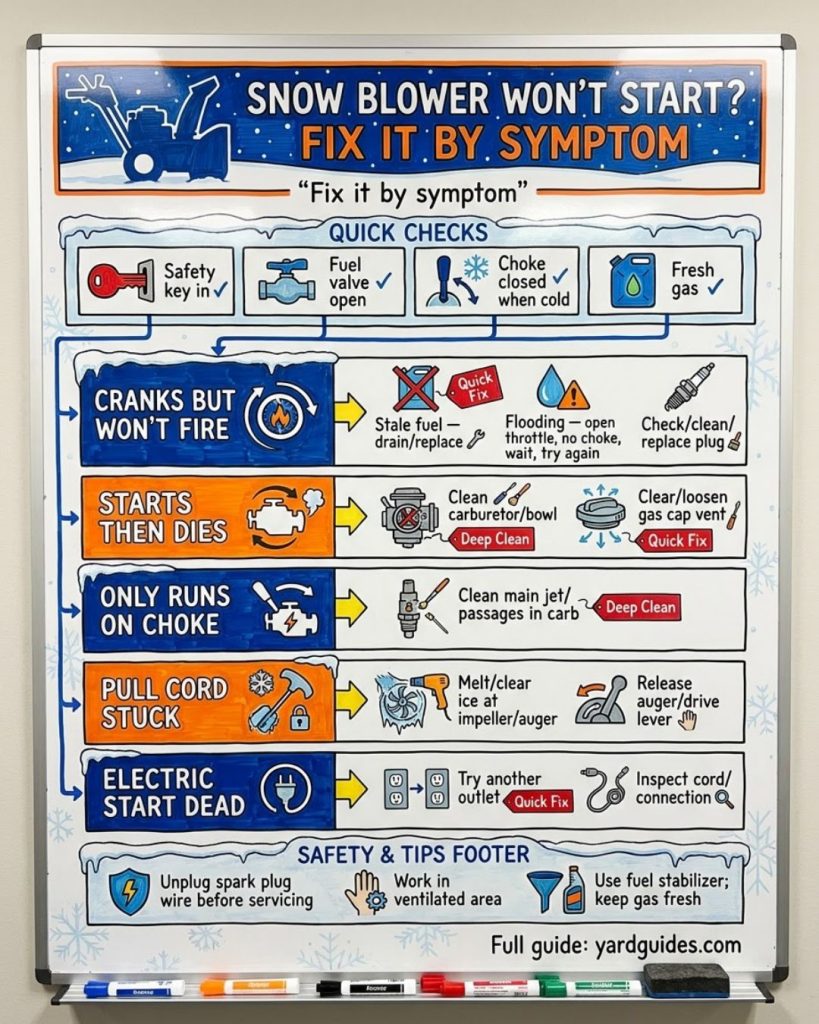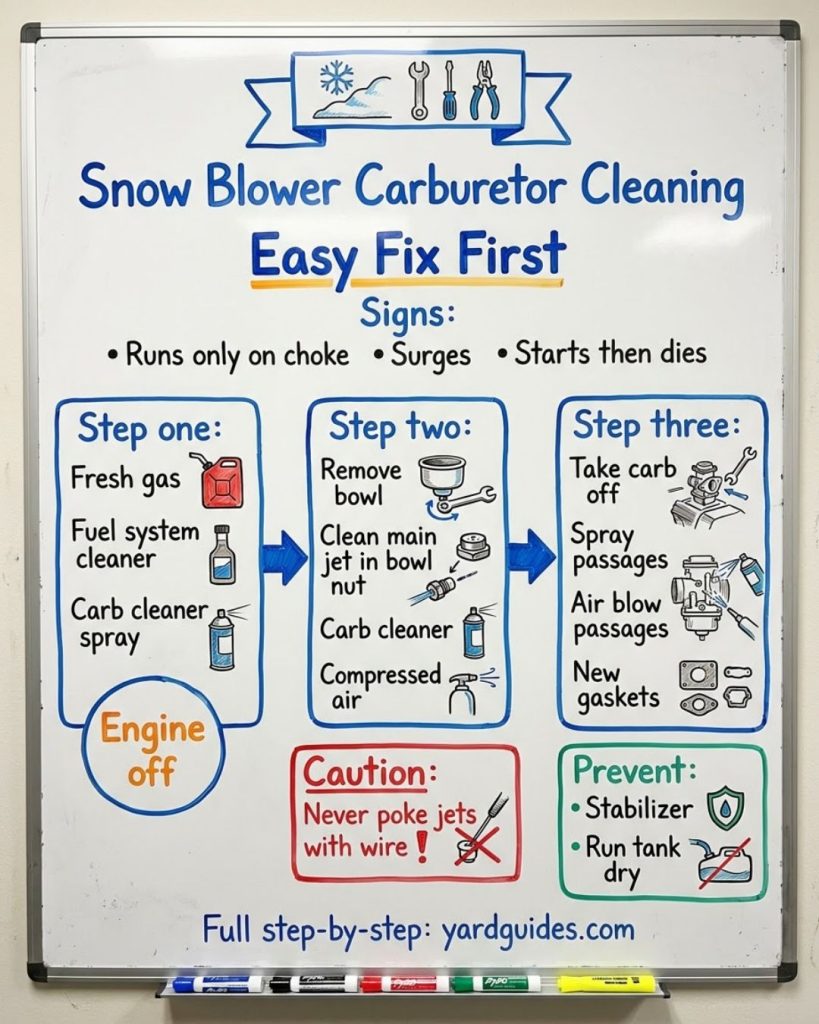
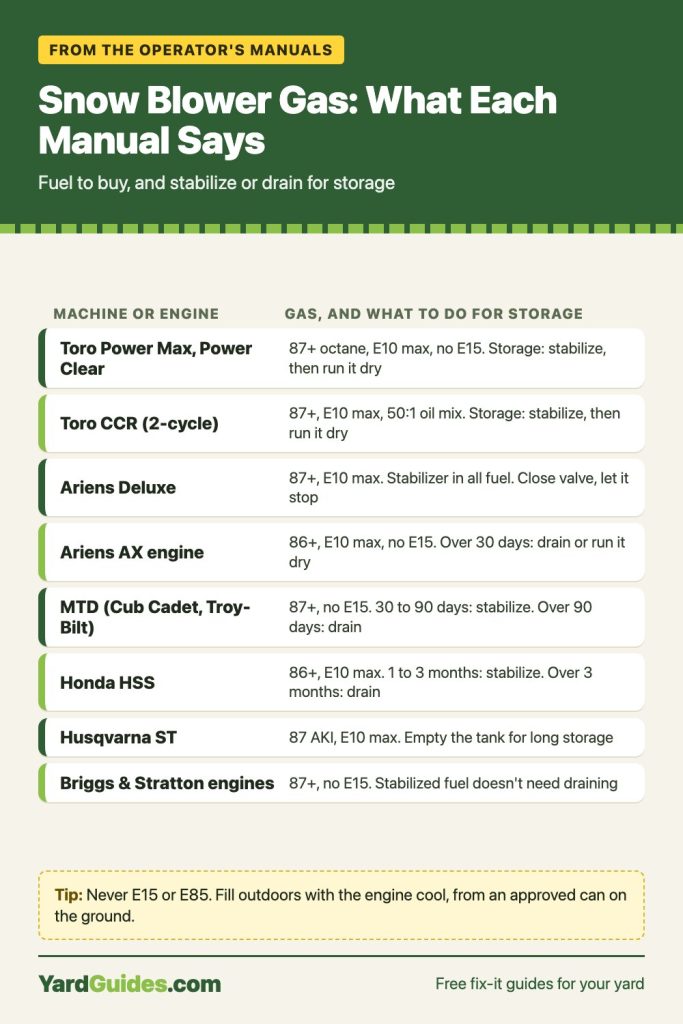
Quick answer: Put fresh unleaded gas, 87 octane or higher, with no more than 10% ethanol (E10) in your snow blower. Never use E15 or E85. Toro, Ariens, MTD (Cub Cadet, Troy-Bilt), Honda, Husqvarna and Briggs & Stratton manuals all cap ethanol at 10%, and Honda HSS and Ariens AX engines accept 86 octane. Buy only what you’ll use in about 30 days, or add fuel stabilizer when you fill the can. Older 2-cycle Toro CCR blowers also need oil mixed in at 50:1. For storage, makers split: Briggs says stabilized fuel can stay in the engine, while Honda, Husqvarna’s ST 224 manual and MTD’s snow engine manuals say to drain it for long storage, and Toro says to stabilize and then run it dry.
YardGuides may earn a commission from links on this page, at no cost to you. As an Amazon Associate I earn from qualifying purchases. Learn more.
At the pump: regular unleaded is fine. Look for the ethanol sticker and skip any pump labeled E15 or E85. Fill an approved gas can set on the ground, not in your trunk or truck bed.
Snow blower gas requirements by brand
Every row comes from that maker’s operator’s or engine manual (linked, with the page). Check the engine label too: an MTD-built Cub Cadet can carry a Briggs engine, and the engine manual wins. Craftsman isn’t listed because we couldn’t find a maker-hosted manual to cite.
| Machine or engine (manual) | Minimum octane | Ethanol limit | Don’t use |
|---|---|---|---|
| Toro Power Max 824 OE (manual, p. 10) and Power Clear 721 (manual, p. 7), 4-cycle | 87 ((R+M)/2) | Up to 10% ethanol, or 15% MTBE | E15, E85, gas with methanol. “Do not add oil to gasoline” |
| Toro CCR 2450 / 3650, 2-cycle (manual 3326-125, p. 11) | 87 | No “gasohol containing more than 10% ethanol” | Methanol, premium gasoline, white gas. Mix oil in at 50:1 |
| Ariens Deluxe 24 to 30 (manual 30219300A, p. EN-12, EN-28) | 87 | 10% maximum. Blends over 10% void “any and all warranties” | E20, E30, E85 |
| Ariens AX snow engine (manual PGM45009, p. 10) | 86 (pump octane) | 10% maximum | E15, E85, oil and gas mixed |
| MTD engines in Cub Cadet and Troy-Bilt (769-26922, p. 6; 769-11570, p. 8) | 87 | Up to 10% (E10), or 15% MTBE | E15, E85, methanol, oil and gas mixed |
| Honda HSS724A (manual, p. 5-6, 23) | 86 (pump octane) | No more than 10% ethanol (E10) or 5% methanol | Higher-ethanol gas, oil and gas mixed |
| Husqvarna ST 224 (manual, p. 11, 24) | 87 AKI (90 RON) | 10% maximum (E10) | Anything under 87 AKI. Alkylate gas preferred if you can get it |
| Briggs & Stratton snowthrower engines (manual 80024465, p. 9) | 87 AKI (85 above 5,000 ft) | Up to 10% | E15, E85, oil mixed in |
What the table tells you:
- E10 regular is safe in every one of them. That’s ordinary pump gas in most of the U.S. No maker requires premium.
- E15 is out everywhere. The U.S. Department of Energy’s fuel data center lists “all engines in off-road equipment” as not approved for E15.
- The 2-cycle Toro is the odd one. It is the only machine here that needs oil in the gas, and the only one whose manual says not to use premium.
Is ethanol-free gas worth it for a snow blower?
No manual in the table requires it. All of them accept gas with up to 10% ethanol. Here’s what they do say about ethanol:
- Honda explains why it caps ethanol at 10%: higher levels “attract water, and can corrode or damage the fuel system.”
- Husqvarna says to use low-emission alkylate gasoline “if available,” and regular unleaded otherwise.
- Ariens’ AX engine manual uses ethanol-free gas for one job: for storage over 30 days, run the tank dry, add 4 to 6 oz of ethanol-free fuel, and run it until it stops.
If you want it, some stations sell ethanol-free gas at a separate pump, often labeled recreation fuel or REC-90. Hardware stores also sell canned ethanol-free fuel. If the octane on the label is 87 or higher, it meets every manual above. For a 2-cycle blower, a canned premix only works if it’s mixed at your machine’s ratio.
How much fuel stabilizer, and when to add it
Use the ratio on the stabilizer bottle. MTD’s engine manual says to “always follow mix ratio found on the stabilizer container.” Timing matters more than brand:
- Add it when you buy the gas. Ariens says to add stabilizer to the can before you pour in the fuel. Honda says to add it to the can if the gas will last more than 60 days. Toro says stabilizer keeps newly bought fuel fresh “for up to 6 months.”
- Run the engine after you add it so treated gas reaches the carburetor. Briggs says 2 minutes, Ariens and Toro’s 2-cycle manual 5 minutes, and Honda, MTD and Toro’s 4-cycle manuals 10 minutes.
- It won’t fix old gas. Honda: fuel stabilizer “will not reconstitute stale gasoline.” Drain bad gas instead (below).
For the evidence on whether stabilizer works and how long treated gas lasts, see does fuel stabilizer really work?
Old gas in a snow blower: how to drain it safely
Stale gas is the #1 cause in our troubleshooting guide. Signs include a no-start after the machine sat since last winter, or an engine that starts, then dies. Our won’t start guide walks through the symptoms, and signs your gas has gone bad covers the gas itself.
You also need an empty tank before you tip the machine for an oil change or a belt replacement. Husqvarna’s belt procedure starts with “Remove the fuel from the fuel tank” (p. 18), and MTD says to empty the tank before tipping the engine to drain oil (p. 12).
To drain it:
- Go outdoors and let the engine cool. Ariens says never to fill or drain a fuel tank indoors. Keep it away from flames, sparks and pilot lights.
- Close the fuel valve if your machine has one. Honda and Ariens blowers do. Our start controls guide shows where it is by brand.
- Pump the tank out into an approved gas can. Toro says to use a hand pump. MTD says to use a suction device made for gasoline, and “DO NOT pour fuel from the engine or siphon fuel by mouth.” Don’t tip the machine to pour it out: Toro warns fuel can leak if you tip it with fuel in the tank.
- Drain the carburetor bowl if it has a drain. On a Honda HSS, put a can and funnel under the carburetor and loosen the carburetor drain knob, then clean the fuel sediment cup (p. 18-19). Toro’s Power Clear 721 has a carburetor-drain bolt (p. 17). Ariens’ AX engine manual says to drain the remaining fuel from the carburetor bowl (p. 13).
- No bowl drain? Run it dry. Toro’s method: run the engine until it stops, start it again, then choke or prime and start it a third time until it won’t start. MTD and Troy-Bilt manuals also say to run the engine until it stops from lack of fuel.
- Refill with fresh gas that meets the table and start it. It may take extra pulls to draw new fuel through. If it still won’t run right, old fuel has likely varnished the carburetor: see snow blower carburetor cleaning.
What to do with the old gas: Toro’s manuals say to “recycle it according to local codes, or use it in your automobile.” Husqvarna says to discard it at a disposal location. The EPA lists pouring household hazardous waste down the drain or on the ground as improper disposal, and many communities run collection days for it. Check with your town or county.
2-cycle snow blowers: the gas and oil mix
Most snow blowers are 4-cycle, with oil in the crankcase and plain gas in the tank. Older single-stage Toros like the CCR 2450 and CCR 3650 are 2-cycle.
How to tell yours is a 2-stroke: the fuel decal says so. Toro’s CCR 2450 decal reads “Use unleaded gasoline; 50:1 gas:oil mixture” (manual 3355-468, p. 4). A 2-cycle engine also has no dipstick or oil fill.
The mix: 50:1 gas to oil, which is 2.6 oz of 2-cycle oil per US gallon (80 ml per 3.8 L), or 5.2 oz per 2 gallons (p. 7). Toro’s steps:
- Pour a half gallon of fresh unleaded gas into an approved fuel can.
- Add the 2-cycle oil (Toro 50:1 oil or an equivalent NMMA TC-W certified oil).
- Cap it, shake it, then add the rest of the gas.
Don’t mix it in the snow blower’s tank, and don’t use car oil like SAE 30 or 10W-30. Use 87 octane or higher, with no more than 10% ethanol, and skip premium and white gas (manual 3326-125, p. 11). Toro’s 50:1 oil has stabilizer added, so you don’t need extra. Even stabilized, Toro says not to store the mix more than 90 days.
Never put mixed gas in a 4-cycle machine. Toro’s 4-cycle manuals say “Do not add oil to gasoline,” and Briggs, Honda, Ariens and MTD all say not to use an oil and gas mixture. For the oil side, see snow blower oil by engine.
Stabilize or drain for storage? What each maker says
This is where the manuals disagree, and some makers’ own manuals disagree with each other. Follow the manual for your engine.
| Machine or engine (manual) | Stabilize or drain? | What the manual says to do |
|---|---|---|
| Toro Power Max 824 OE (p. 18, 24) | Both | Add stabilizer to fresh fuel on the last fill, run 10 minutes, then run it until it runs out of fuel. Restart until it won’t start |
| Toro Power Clear 721 (p. 17) | Both | Stabilize and run 10 minutes. Then siphon the tank or run it dry, and drain the carburetor through its drain bolt |
| Toro CCR 2-cycle (3355-468, p. 11) | Both | Stabilize (not needed with Toro 50:1 oil), run 5 minutes, pump the tank out or run it dry. Stabilized fuel: 90 days maximum |
| Ariens Deluxe (p. EN-25) | Stabilize | Stabilizer “in all fuel.” Run 5 minutes outdoors, then close the fuel valve and let the engine stop on its own |
| Ariens AX engine (p. 13) | Depends | Up to 30 days: stabilize. Over 30 days: drain or run it dry, run 4 to 6 oz of ethanol-free fuel through, drain the carburetor bowl |
| MTD engines (769-26922, p. 15-16) | Depends | 30 to 90 days: stabilize, and it’s “NOT necessary to drain stabilized fuel from carburetor.” Over 90 days: drain the fuel |
| Troy-Bilt Storm (769-08981, p. 19) | Drain | Unused 30 days or longer: run the engine until the tank is empty |
| Honda HSS724A (p. 18, 23) | Depends | Under 1 month: fill with fresh gas. 1 to 3 months: fill full, stabilize, run 10 minutes, drain the carburetor. Over 3 months: drain tank and carburetor |
| Husqvarna ST 224 (p. 23) | Drain | “Empty the fuel tank before you put the product in storage for a long period of time” |
| Briggs & Stratton engines (p. 16) | Stabilize | “No need to drain the fuel” if stabilizer is added. Run 2 minutes. No stabilizer: drain it, then run it dry |
So, should you run your snow blower out of gas for the summer? For a Toro, Husqvarna, Honda or MTD-engine machine, yes: a summer is more than 90 days, and those manuals say to empty it. A Briggs engine can be stored with stabilized fuel. Ariens’ machine manual says to stabilize, but its engine manual says to drain anything stored over 30 days. If yours has an Ariens AX engine, the stricter engine manual is the safer read.
Whichever you do, keep any gas you store in an approved can, and never keep the machine or the can near a furnace, water heater or other pilot light. The same storage logic applies to your mower: see how to winterize a lawn mower.
Refueling safety
- Outdoors, engine off and cool. Briggs says to let the engine cool at least 2 minutes, and MTD at least 5. Honda says to refuel “only outdoors in a well-ventilated area with the engine OFF.”
- Never fill it in the garage or near a pilot light. Ariens and Husqvarna say never to fill the tank indoors. Troy-Bilt says never to store the machine or a fuel can where there’s an open flame, spark or pilot light, like a furnace, water heater or clothes dryer. Never start or run it in the garage, either: Honda warns exhaust carbon monoxide “can collect rapidly in an enclosed area.”
- Use an approved container, on the ground. Toro says to put the can and machine on the ground before filling, “not in a vehicle,” to prevent a static spark. Ariens adds never to fill cans in a truck bed with a plastic liner.
- Don’t overfill. Toro: no higher than the bottom of the filler neck. Troy-Bilt: about 1/2 inch below the neck. Honda: about 1.4 inches (35 mm) below the top of the tank, so the fuel has room to expand.
- Wipe up spills and move away before starting. Husqvarna says to move the machine at least 10 feet (3 m) from where you filled it before you start it.
What you’ll need
- Fuel stabilizer, any brand, used at the bottle’s ratio
- An approved gas can. Honda suggests a sealed plastic can kept out of sunlight
- A siphon or hand fuel pump made for gasoline, for draining
- 2-cycle oil, 50:1, only for a 2-stroke machine like the Toro CCR
Part of our snow blower maintenance guide: see the maintenance schedule for your brand, with each maker’s intervals from the manual.
FAQ
Can you use E15 gas in a snow blower? No. Toro, Ariens, MTD and Briggs & Stratton manuals all name E15 as a fuel not to use, and Honda and Husqvarna cap ethanol at 10%. The U.S. Department of Energy lists “all engines in off-road equipment” as not approved for E15.
Should I use premium gas in my snow blower? You don’t need to. The minimum is 87 octane on most machines and 86 on Honda HSS and Ariens AX engines, and regular meets that. Toro’s older 2-cycle CCR manual goes further and says not to use premium gasoline.
Can I use regular car gas in a snow blower? Yes, if it’s unleaded, at least 87 octane and no more than 10% ethanol. MTD’s engine manuals say to “use automotive gasoline,” and Honda says regular unleaded with no more than 10% ethanol.
How long can gas sit in a snow blower? Not long. Honda says gas can go bad in as little as 30 days, and not to leave it in the tank more than 3 months (about 90 days) of inactivity. Toro says to buy only what you’ll use in 30 days. For how stabilizer changes that, see does fuel stabilizer work?
Do I need to drain the gas after every use? No. During the season Honda says to keep the tank full of fresh fuel, with the fuel valve off, so air doesn’t age the gas. If it will sit 3 to 4 weeks, Honda says to drain just the carburetor. Drain the tank only for storage, as your manual’s storage section says (see the table above).
Sources
- Toro, Power Max 824 OE Snowthrower Operator’s Manual 3415-760: fuel safety and filling the fuel tank p. 10, maintenance schedule p. 18, storage p. 24
- Toro, Power Clear 721 R/E Operator’s Manual 3423-722: filling the fuel tank p. 7, storage and carburetor drain p. 17
- Toro, CCR 2450 GTS Operator’s Manual 3355-468: decal 105-1979 p. 4, fuel safety and mixing gasoline and oil p. 7, storage p. 11
- Toro, CCR 2450 GTS / CCR 3650 GTS Operator’s Manual 3326-125: mixing gasoline and oil, octane and fuels to avoid p. 11
- Ariens, Deluxe Series Sno-Thro Operator’s Manual 30219300A: fuel safety p. EN-7, pre-start fuel check p. EN-12, add fuel stabilizer p. EN-15, storage p. EN-25, warranty p. EN-28
- Ariens, Snow Engine Operation Manual PGM45009: fuel recommendations p. 10, short- and long-term storage p. 13
- MTD, 357cc and 420cc OHV Engine Operator’s Manual 769-26922 (2023): fuel requirements p. 6, drain fuel before tipping p. 12, draining fuel p. 14, storage p. 15-16
- MTD, 179cc, 208cc and 243cc OHV Engine Operator’s Manual 769-11570 (2016): fuel requirements p. 8, storage p. 17-18
- Troy-Bilt, Storm 2410, 2620 and 2840 Operator’s Manual 769-08981: fuel safety p. 4, off-season storage p. 19
- Honda, HSS724A Owner’s Manual 00X31V45 A089: add fuel p. 5-6, refuel with care p. 7, storage and draining the carburetor p. 18-19, avoiding fuel-related problems p. 23
- Husqvarna, ST 224 / ST 227P / ST 230P / ST 224P Operator’s Manual (2019): fuel safety p. 7-8, to fill fuel p. 11, preparing for belt replacement p. 18, storage and disposal p. 23, technical data p. 24
- Briggs & Stratton, Snowthrower Operator’s Manual 80024465: adding fuel p. 9, storage p. 16. Retailer-hosted copy (Home Depot)
- U.S. Department of Energy, Alternative Fuels Data Center, E15 (vehicles and engines not approved for E15)
- U.S. EPA, Household Hazardous Waste (improper disposal, community collection)