Quick answer: Most compact tractor diesels don’t need a block heater until it gets truly cold. Kubota’s B-series manuals offer a dealer-option block heater for starts below 5°F (-15°C), and its L, MX and M manuals say below -4°F (-20°C). John Deere says to install its optional coolant heater below 0°F (-18°C). Plug it in 3 to 4 hours before you start, per heater maker Phillips & Temro (Zerostart), on a timer.
YardGuides may earn a commission from links on this page, at no cost to you. As an Amazon Associate I earn from qualifying purchases. Learn more.
Everything below comes from the tractor makers’ operator’s manuals and the heater makers’ own catalogs and instruction sheets, and each source is linked. If a manual or catalog doesn’t state something, we leave it blank instead of guessing. Your engine tag and your dealer have the final say on fit.
Before a heater: a lot of cold no-starts are really preheat, fuel or battery problems. Run through our winter diesel cold-start troubleshooter first. It covers glow plug times by model, winter fuel and anti-gel.
Do you need a block heater on your tractor?
Use the temperature in your own operator’s manual. Here’s what each manual we checked says.
| Tractor (engine) | Factory heater in the manual | Manual says use it below |
|---|---|---|
| Kubota BX1880 / BX2380 / BX2680 (D722 / D902 / D1005) | None listed in the BX operator’s manual | Not stated |
| Kubota B2301 / B2601 (D1005 / D1105) | Block heater (option) from your dealer, p. 13 | 5°F (-15°C) |
| Kubota B3150 (V1505) | Block heater (option) from your dealer, p. 18 | 5°F (-15°C) |
| Kubota L3200 / L3800 (D1503 / D1803) | Engine block heater, listed under Options | Not stated (“extremely cold weather”) |
| Kubota L3240 to L5740 (D1703 to V2403-T) | Block heater (if equipped), dealer option, p. 24 | -4°F (-20°C) |
| Kubota MX5200 (V2403-M-TE3) | Block heater (if equipped), dealer option, p. 41 | -4°F (-20°C) |
| Kubota M5040 / M6040 / M7040 (V3007 / V3307) | Block heater (if equipped), dealer option, p. 15 | -4°F (-20°C) |
| John Deere 1023E / 1026R (Yanmar 3TNM72 / 3TNV76) | Optional engine coolant heater, p. 17 | 0°F (-18°C) |
| John Deere 3025E / 3032E / 3038E (Yanmar 3TNV88 / 3TNV86) | Optional engine coolant heater, pp. 20-2 and 200A-3 | 0°F (-18°C) |
| Mahindra 2816 HST (Mitsubishi diesel) | None listed. The manual’s cold-weather checklist (p. 49) covers battery, fuel, oil and coolant | Not stated |
None of these operator’s manuals gives a heater wattage or part number. Kubota and Deere both send you to the dealer for the kit, so ask for it by your tractor’s serial number.
Above those temperatures, the manuals lean on preheat, the right oil and winter fuel. When cold, thick oil slows cranking, Kubota’s troubleshooting chart lists “Use engine block heater (Option)” alongside switching to the right oil viscosity for the temperature (B2301/B2601 manual, p. 71).
Which heater fits your engine?
If your dealer can’t supply the factory kit, the heater makers publish fit lists by engine. This table comes from the Kubota section of the Phillips & Temro (Zerostart) 2023 Product Application Guide, pp. 66 to 68. Find your engine model on the engine’s tag or in your manual’s specification table.
| Kubota engine (example tractors) | Zerostart heater listed | Type and watts |
|---|---|---|
| D722 (BX1880) | 3100099 on Tier 2 or older; 3100132 on newer D722 | 30 mm freeze plug, back of head. 400 W |
| D902 (BX2380) | Two listings: 3100132 (Super Mini 02 series) and 3100149 (D902-ET02). Match your engine tag | 400 W |
| D1005, D1105 (BX2680, B2301, B2601) | 3100003 (“Super 5” series) | 1″ NPT threaded immersion, left front. 400 W |
| V1505 (B3150) | 3100003 (Super 5 list) or 3100093 (V1505 listing) | Threaded immersion. 400 W |
| D1703, D1803 (L3240, L3540, L3800) | 3100025 | 35 mm freeze plug, back of head, element at 2 o’clock. 400 W |
| V2003, V2203 (L3940, L4240) | 3100025 | 35 mm freeze plug, back of head, element at 2 o’clock. 400 W |
| V3307 (M6040, M7040) | 3500120 | 1″ NPT threaded immersion. 400 W |
| V2403 (L4740 to L5740, MX5200), D1503 (L3200), V3007 (M5040) | No engine-specific listing. The guide’s generic “L Series” and “M Series (3 & 4 cyl.)” rows list 3100093 (400 W, 3/4″ NPT immersion, right front, 1″ x 3/4″ bushing) | Confirm with your Kubota dealer before ordering |
The guide’s Yanmar section doesn’t list the 3TNM72, 3TNV76, 3TNV86 or 3TNV88 engines in Deere’s 1 and 3 Family tractors, so get those heaters from your Deere dealer. Owner forums trade Kubota part numbers that conflict with each other, so we left them out. Confirm any part number against your serial number before you drain coolant.
Block heater vs oil pan heater (and the other types)
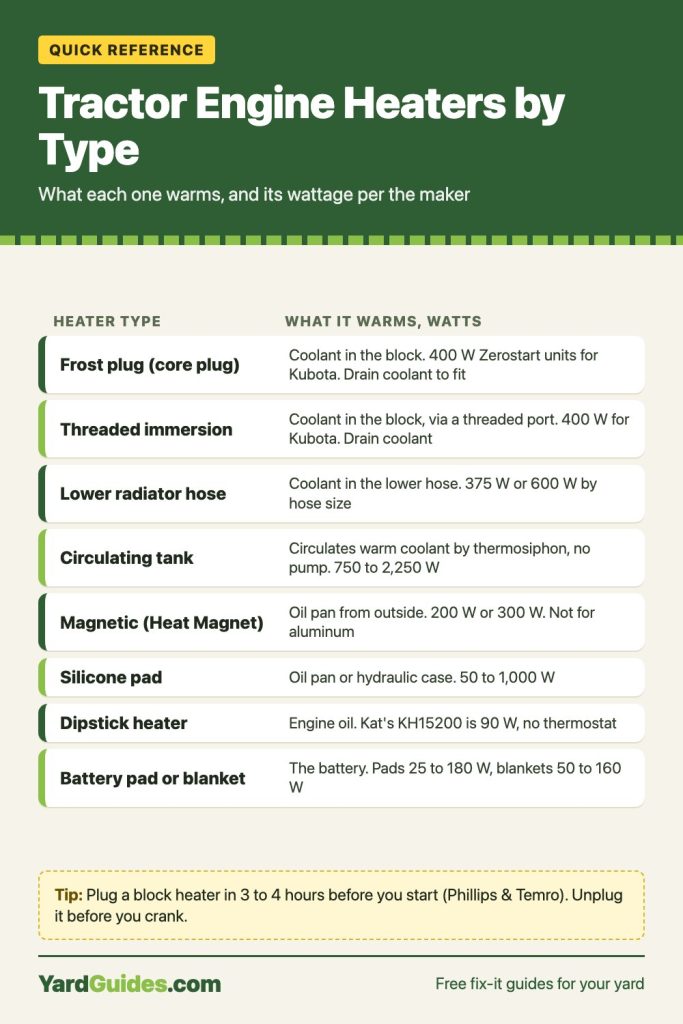
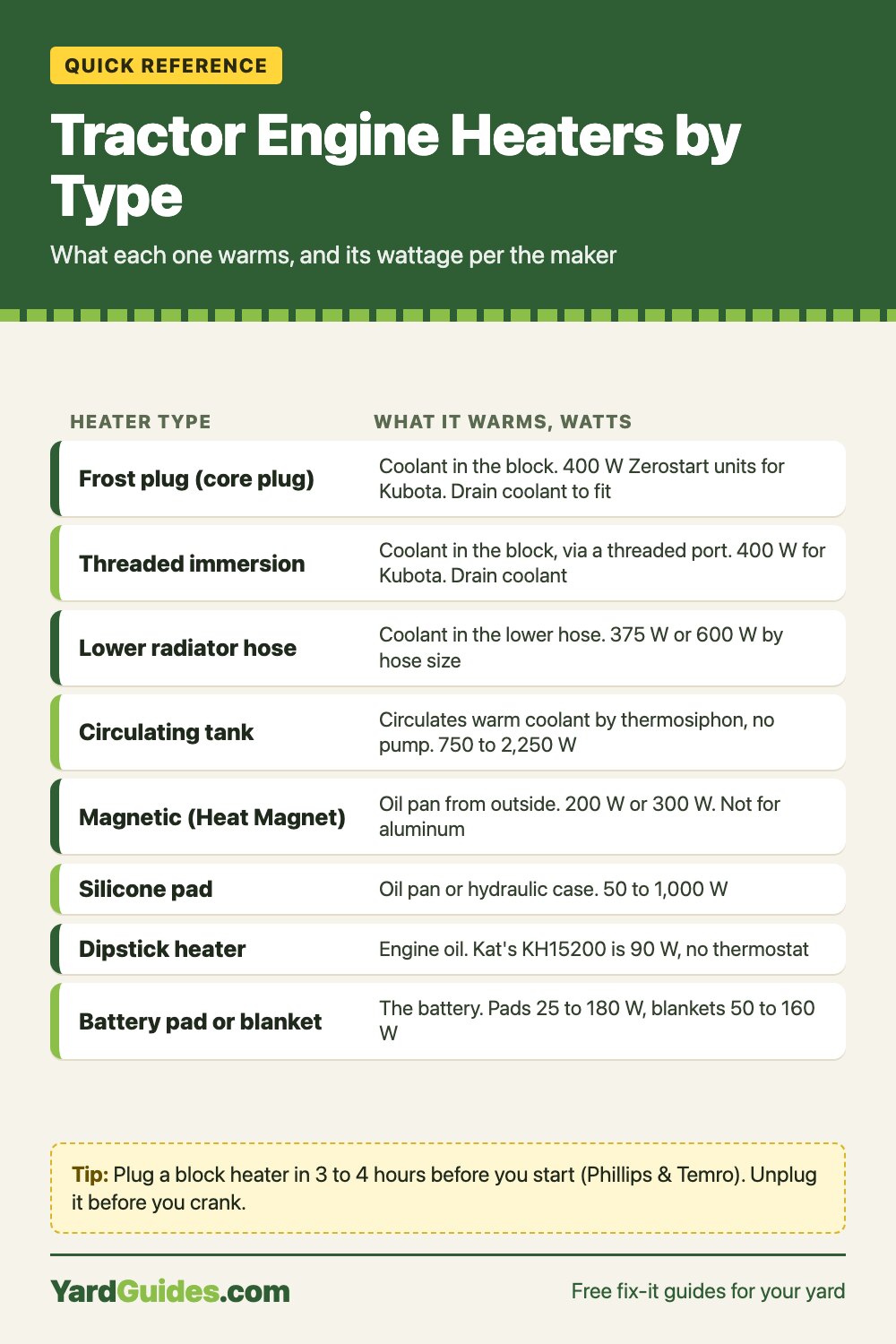
A block heater warms the coolant, and the coolant warms the whole engine. Oil pan, pad and dipstick heaters warm the oil from below or inside. The wattages below come from the makers’ own spec sheets.
| Heater | What it heats | Install | Watts (maker data) |
|---|---|---|---|
| Frost plug (core plug) | Coolant in the block | Drain coolant, replace a core plug. Often a dealer job | 400 W for the Kubota units above |
| Threaded immersion | Coolant in the block | Drain coolant, thread into a block port | 400 W for the Kubota units above |
| Lower radiator hose | Coolant in the lower hose | Cut into a smooth molded hose with at least a 15° rise | 375 W (1″ and 1-1/4″ hose), 600 W (1-1/2″ to 2″) |
| Circulating tank | Coolant, moved by thermosiphon | Plumbed into the block drain and a heater hose | 750 to 2,250 W |
| Magnetic (Heat Magnet) | Oil pan, from outside | Sticks on. No draining. Not for aluminum | 200 W or 300 W |
| Adhesive silicone pad | Oil pan, hydraulic or transmission case | Glues to clean, smooth metal | 50 to 1,000 W |
| Dipstick | Engine oil | Replaces the dipstick | 90 W (Kat’s KH15200) |
| Battery pad or blanket | The battery | Under or around the battery | Pads 25 to 180 W, blankets 50 to 160 W |
Sources: Phillips & Temro 2023 guide (lower hose heater, p. 123), circulation tank heater, Heat Magnet, silicone pad, battery heater and battery blanket sheets. The dipstick heater’s wattage is from etrailer’s listing.
Frost plug heater
This is what Kubota and Deere mean by a block heater or coolant heater. It sits in the coolant jacket, so it warms the block, head and coolant together. It’s the first choice if your engine has a listed one. The catch is that fitting it means draining the coolant and knocking out a core plug.
Lower radiator hose heater
Phillips & Temro’s version must go in a smooth, molded (not corrugated) hose that rises at least 15° and has direct access to the engine’s water jacket. Check that your tractor’s lower hose meets all three rules before you buy one.
Magnetic oil pan heater: do magnetic block heaters work?
They warm the oil, not the coolant, so they’re a different tool from a block heater. Phillips & Temro sells its Heat Magnet for tractors and farm equipment with non-aluminum engine blocks, as well as oil pans, transmissions and hydraulic equipment. It’s thermostat-limited to 250°F (200 W) or 266°F (300 W). If a magnet won’t hold firmly on your oil pan or case, this type won’t work on it. It’s the easiest bolt-on fallback when no frost plug heater is listed for your engine.
Silicone pad and dipstick heaters
Pads glue onto smooth metal, and Phillips & Temro lists them for oil and hydraulic fluids. They’re a fit for a transmission or hydraulic case, which matters on tractors where cold fluid makes the hydraulics sluggish. A dipstick heater is the simplest of all, but etrailer notes that Kat’s 90 W unit has no built-in thermostat, so don’t leave it on unattended for long stretches.
Free printable: seasonal maintenance checklist for your mower & tractor
A 2-page spring-to-winter checklist for riding and push mowers and compact tractors. Then short, practical emails a couple of times a month. Unsubscribe anytime.
Battery warmer
See the battery section below.
How long to plug in a tractor block heater
- Block heater: at least 3 to 4 hours. Phillips & Temro, which makes Zerostart heaters, says “the block heater should be plugged in at least 3-4 hours” and that “there is nothing detrimental about leaving it plugged in overnight or longer” (Zerostart FAQ).
- Silicone pad heaters can run on a timer, and Phillips & Temro sets no maximum time for a correctly installed pad (same FAQ).
- Unplug before you start. The A&I Products heater technical bulletin says the element “should not be energized while starting the engine” and advises waiting at least 1 minute after unplugging before you start.
Why use a timer instead of plugging in all night: a heater uses its rated watts for every hour it’s on. A 400 W heater running 4 hours uses 1.6 kWh. Left on for 14 hours overnight, it uses 5.6 kWh, which is 3.5 times the energy for the same morning start. A heavy-duty outdoor timer set to switch on about 4 hours before you head out gets you the warm start without the waste. A 400 W heater draws about 3.3 amps at 120 V, so any outdoor timer rated for 15 amps has plenty of headroom.
Useful gear:
- Heavy-duty outdoor plug-in timer. Get one rated for outdoor use and at least the heater’s amps.
- Outdoor-rated, 3-wire grounded extension cord. See the gauge rules in the safety section.
Before you plug in: check your coolant
A heater can’t protect an engine with weak coolant, and coolant that has gelled or frozen can burn the heater out. Kat’s Heaters’ instructions warn that if coolant congeals, it stops flowing through the heater and burns it out (Kat’s tank heater sheet).
- Kubota: “Always use a 50/50 mix of long-life coolant and clean soft water.” Use the ethylene glycol (EG) type, and never top up with a different brand of long-life coolant (B2301/B2601 manual, p. 66).
- John Deere 1 Family: the factory fill protects to -34°F (-37°C). Check the coolant freeze point every year (1023E/1026R manual, pp. 33 and 41).
- John Deere 3E: use Cool-Gard II premix, or concentrate at 40% to 60%. Test the coolant every 12 months or less. Deere’s coolant test strips check the freeze point (3E manual, pp. 200A-4 and 200A-7).
- Mahindra 2816: keep at least 50% ethylene glycol, and don’t go above 50% unless it gets colder than -34°F (-37°C) (2816 manual, p. 100).
- The heater makers agree: Phillips & Temro calls for a 50/50 ethylene glycol mix, no more than 65% antifreeze and no stop-leak additive (installation sheet 703357). A&I says no more than 60% and distilled water, since hard water scales the element (TM0025).
To check freeze protection yourself, use test strips made for your coolant or a coolant refractometer. Browse coolant refractometers. If your tractor also has liquid-filled tires, check their freeze protection too. Our tire ballast guide and calculator covers that.
Battery in the cold
A warm engine still needs a strong battery to crank it. Start with the cold cranking amps (CCA) your manual specifies, and replace the battery with one at least that strong.
| Tractor | Battery spec in the manual |
|---|---|
| Kubota BX1880 / BX2380 / BX2680 | 560 CCA |
| Kubota B2301 / B2601 | 430 CCA |
| Kubota L3240 to L5740 | 490 or 582 CCA, by model |
| Kubota M5040 / M6040 / M7040 | 900 CCA |
| John Deere 1023E / 1026R | 500 CCA at 0°F (-18°C) |
| Mahindra 2816 HST | 540 CCA |
- Keep it charged. Mahindra’s cold-weather checklist starts with “Battery: Must have a full charge” (p. 49). Kubota goes further: “In cold weather, always remove the battery from the engine, charge and store it indoors” until you need the tractor (B2301/B2601 manual, p. 71). If you’d rather leave it in, a 12 V battery maintainer keeps it topped up.
- Battery heaters help a battery keep its available cranking amps by warming it (Phillips & Temro). Its battery blankets warm the battery core 60 to 70 degrees above the outside air. The thermostat models switch on at 60°F and off at 80°F (blanket sheet). Phillips & Temro says these aren’t for lithium-ion batteries.
If the engine cranks slowly even with a charged battery, work through the slow-crank step in our troubleshooter.
Installing a frost plug heater: what’s involved
This summarizes the heater makers’ instruction sheets. It isn’t a step-by-step guide for your engine. Kubota and Deere both supply their heater through the dealer, and a dealer install is the safe choice if you haven’t drained and bled a cooling system before.
- Drain the cooling system from the radiator and the engine block (Phillips & Temro frost plug sheet).
- Remove the core plug the fit list names for your engine. For the Kubota 3100025, that’s the 35 mm plug at the back of the head (2023 guide, p. 67).
- Clean the hole, then seat the heater with the element pointing the way the sheet says. Tighten the locking screw only to the torque printed on the sheet (20 to 25 in-lb on that sheet), because overtightening can strip it and cause a leak.
- Refill with the correct coolant mix and check for leaks.
- Bleed the air out before you plug it in. Phillips & Temro says to run the engine 5 to 10 minutes after the thermostat opens (sheet 703357). A&I says 20 minutes (TM0025). An air pocket around the element burns it out.
- Route the cord away from the engine, hot pipes and moving parts, and tie it down.
Safety: electrical and coolant
- Use a grounded outlet and a 3-wire grounded cord. Phillips & Temro: “Connect only to 120-Volt AC grounded outlet. If an extension cord is used, it must be the three-wire grounded type” (sheet 703357).
- Plug into a GFCI. Phillips & Temro recommends Ground Fault Interrupter service. Its FAQ notes a GFCI will trip when it gets wet from rain or snow, or when the circuit is overloaded. Add up every heater on one cord, because the total draw can’t exceed the cord or circuit rating (2023 guide, p. 173).
- Size the cord. For a load up to 4 amps (one 400 W heater), Phillips & Temro’s table calls for at least 18-gauge cord up to 50 feet and 16-gauge at 100 feet. Go heavier if you add a battery blanket or pad heater on the same cord.
- Inspect the cord before each season. Replace any heater cord or extension cord with cut, cracked or melted insulation. Unplug by grasping the plugs, not by yanking the cord, which Phillips & Temro warns can damage the connections and cause a short (2023 guide, p. 97).
- Never run it dry. “DO NOT plug in heater if element is not immersed in coolant. If not immersed, element sheath may burst and could result in personal injury” (Phillips & Temro). Don’t plug in a heater after draining coolant or with a low radiator.
- Use the heater listed for your engine. Kat’s Heaters puts it plainly: “This is not a universal heater” (Kat’s sheet). A circulating tank heater gets hot enough to burn skin, so Kat’s says to keep combustibles at least 1 foot away.
- No ether. Deere’s manual warns that glow plugs and the air heater work during cranking and that ether or starting fluid “will cause damage to engine” (1023E/1026R manual, p. 17). Mahindra’s says not to use ether as a cold starting aid (p. 49).
After it starts
The heater gets you started, but the transmission and hydraulic fluid are still cold. Warm the tractor up as your manual says before you load it. If the hydraulics stay slow, check you’re running the fluid your manual specifies with our hydraulic fluid cross-reference. For snow work, see how to engage 4WD on a Kubota and the tire chain size finder.
Clearing snow once it starts? See plowing snow with a tractor: blade, blower or bucket for what each attachment needs from your tractor.
Keeping the battery charged: see our riding mower battery guide.
FAQ
How long should I plug in a tractor block heater? At least 3 to 4 hours before you start, per Phillips & Temro (Zerostart). Leaving it on overnight won’t hurt it, but it uses several times the energy, so a timer is the better way. Unplug it before you crank.
At what temperature should I plug in my tractor? Use your manual’s number. Kubota’s B-series manuals say the optional heater helps below 5°F (-15°C), and its L, MX and M manuals say below -4°F (-20°C). John Deere’s 1 and 3E manuals say to install the coolant heater if you run below 0°F (-18°C).
Is a block heater or an oil pan heater better? A block heater warms the coolant and the whole engine, so it’s the better heater for a cold-start problem. An oil pan heater, such as a magnetic or pad heater, only warms the oil. It’s the easy add-on when no block heater is listed for your engine, or when you can’t drain the coolant.
Do magnetic block heaters work on tractors? They warm the oil pan, and Phillips & Temro sells its Heat Magnet for tractors with non-aluminum engines. A magnetic heater isn’t a coolant heater, though, and it only works on steel or iron surfaces it can grip firmly.
Does my Kubota have a block heater? Only if a dealer installed one. Kubota’s B, L, MX and M manuals list it as an option or “if equipped,” and the BX manual we checked doesn’t mention one. Look for a heater cord with a plug end, which installers usually route out through the grille. Your dealer can confirm it by your serial number.
Sources
- Kubota, BX1880 / BX2380 / BX2680 Operator’s Manual (specification table; no block heater listed)
- Kubota, B2301 / B2601 Operator’s Manual (block heater, p. 13; anti-freeze, p. 66; troubleshooting, p. 71)
- Kubota, B3150 / B3150SU Operator’s Manual (block heater, p. 18)
- Kubota, L3200 / L3800 Operator’s Manual (Options; troubleshooting)
- Kubota, L3240 to L5740 Operator’s Manual (block heater, p. 24; specification tables)
- Kubota, MX5200 Operator’s Manual (block heater, p. 41)
- Kubota, M5040 / M6040 / M7040 Operator’s Manual (block heater, p. 15)
- John Deere, 1023E / 1026R Operator’s Manual OMLVU24604 (cold weather starting aids, p. 17; service intervals, p. 33; coolant, p. 41; specifications, p. 69). Dealer-hosted copy (Hartville Hardware)
- John Deere, 3025E / 3032E / 3038E Operator’s Manual OMTR135276 (pp. 20-2, 200A-3, 200A-4, 200A-7). Dealer-hosted copy (Hartville Hardware)
- Mahindra, 2816 HST Operator Manual (cold temperature operation, p. 49; coolant, p. 100). Dealer-hosted copy
- Phillips & Temro (Zerostart), 2023 Product Application Guide (Kubota, pp. 66 to 68; Yanmar, p. 80; cords, p. 97; lower radiator hose heater, p. 123; extension cords, p. 173). Distributor-hosted copy
- Phillips & Temro, Zerostart FAQ (plug-in time, GFCI, pad heater timers)
- Phillips & Temro, Frost plug heater installation sheet 703357 Rev. E (2021)
- Phillips & Temro, Frost plug block heater installation instructions 1165C-0039AG (retailer-hosted copy)
- Phillips & Temro, Heat Magnet, silicone pad heaters, circulation tank heater, battery heaters and battery blanket wraps spec sheets (2024 to 2025)
- A&I Products, Technical Bulletin TM0025: frost plug heater installation and common failures (2013)
- Kat’s Heaters (Five Star Manufacturing), Circulating tank heater instructions (retailer-hosted copy)
- etrailer, Kat’s KH15200 dipstick heater Q&A (wattage and thermostat)