
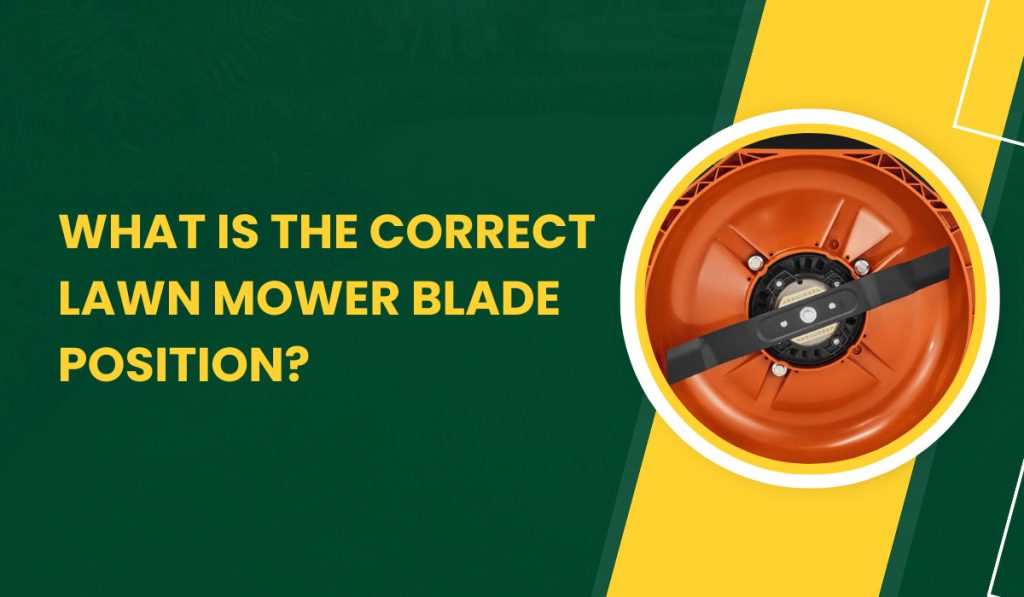
Quick answer: The correct lawn mower blade position is the same on almost every rotary mower: the side stamped “Bottom”, “Grass Side” or with the part number faces the ground, the curved back edge (the sail or air fin) points up toward the inside of the deck, and the sharp cutting edge leads in the direction the blade spins. On 2 and 3 blade riding mower decks, the clock position of each blade only matters on timed decks, where the manual gives a fixed angle (Walker’s gear-driven decks, for example, run their blades at 90 degrees to each other). Most standard residential blades spin clockwise seen from above.
Jump to the table: Lawn mower blade position diagnostic table ↓
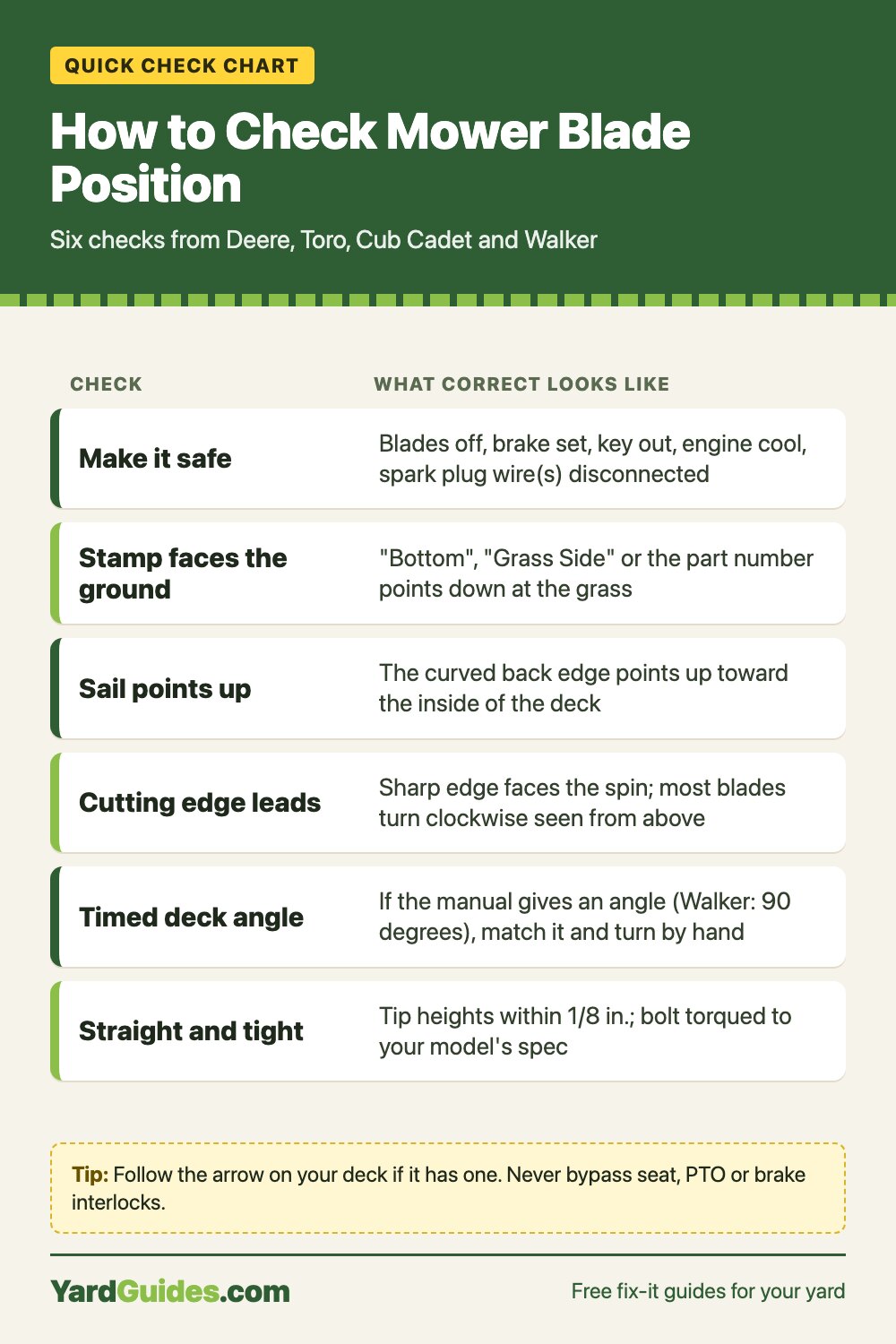
Safety first: Before you touch a blade, park on level ground, disengage the blades (PTO), lower the deck, set the parking brake, stop the engine, take the key out and let the engine and muffler cool. Then disconnect the spark plug wire(s) so the engine can’t start. John Deere’s manuals list exactly these steps and add: “Disconnect the negative battery cable or remove the spark plug wire(s) (for gasoline engines) before servicing the machine” (Deere X300 OM, “Parking Safely” p. 13, dealer-hosted copy). Wear heavy gloves and block the blade with a piece of wood when you loosen or tighten it. Raise the deck only as your manual describes, and never work under a deck held up by a jack alone. Never bypass the seat, PTO, brake or reverse mowing (RMC) interlocks to get a blade turning. Deere’s rule is simple: “Never tamper with safety devices” (p. 16).
What Is the Correct Lawn Mower Blade Position?
There are three checks, and the maker manuals agree on all of them:
- Which side faces the ground. Cub Cadet: “OEM blades are stamped with the part number and the word “Bottom” on the side that should face the ground” (Cub Cadet, Mower Blade Inspection & Service). Husqvarna says to install the blade “with stamped “GRASS SIDE” facing the ground” (Husqvarna, How-to: Remove blades).
- Which way the sail points. The raised, curved back edge lifts the grass and moves clippings. Toro: “The curved part of the blade must point upward toward the inside of the mower to ensure proper cutting” (Toro TimeCutter MAX OM, p. 5-28). Cub Cadet says the air fin “should point up towards the bottom of the mower deck and not down towards the ground.”
- Which edge leads. John Deere’s instruction for its 42, 48 and 54 inch Accel Deep decks is to position the blade “with cutting edge toward ground onto mower spindle” (X300 OM, p. 63). The sharp edge should meet the grass first as the blade turns.
If all three line up, the blade is on the right way. If the stamp is gone (sharpened or painted over), go by the sail: sail up, toward the deck.
Which Way Do Mower Blades Spin?
Most standard rotary mower blades turn clockwise when you look down from above, which is counterclockwise when you look up at them from below. Two maker manuals say the same thing from opposite sides:
- Honda MM60 mid-mount mower: “Blade rotation is clock-wise as viewed from the top of the mower” (Honda MM60 OM, p. 3, via ManualsLib).
- John Deere Frontier grooming mower: “The blade turns in a counter clockwise direction when viewed from the bottom of the deck,” and “The cutting edge must be towards the direction of rotation” (Frontier Grooming Mower OM, p. 26, via ManualsOnline).
Not every deck follows that rule. On Walker’s twin-blade decks the two blades turn toward each other: “The blade cutting edges should move towards each other at the front of the deck on standard rotation decks (e.g., DC42), and towards each other at the back of the deck on reverse rotation decks (e.g., DC36R)” (Walker S18 OM, p. 41). So if your mower has an arrow on the deck or blade, trust the arrow over any general rule.
Blade bolts on most mowers use normal threads. Husqvarna says to “Remove blade bolt by turning counterclockwise.”
Lawn mower blade position diagnostic table
| Symptom | Likely cause | Check (manual section) | Fix |
|---|---|---|---|
| Torn, ragged grass tips; clippings not lifting | Blade upside down (sail pointing at the ground) | Toro TimeCutter MAX OM, “Installing the Blades” p. 5-28; Cub Cadet, Mower Blade Inspection & Service | Flip it: “Bottom” or Grass Side down, sail up toward the deck |
| Discharge chute keeps plugging | Belt installed incorrectly, or blades on wrong | Deere X300 OM, Troubleshooting “Mower” p. 74 (dealer-hosted copy); Walker S18 OM, “Clogging Checklist” p. 41 | Check belt routing against the deck label, then blade orientation and rotation |
| Blades clack or hit each other after striking something (timed deck) | Blade timing knocked out, sheared bolts | Walker S18 OM, p. 34 and “Blade Overload Shear Bolts” p. 71 | Stop, plug wires off, inspect; reset to the manual’s angle or see the dealer |
| Mower vibrates | Bent or unbalanced blade, damaged sheaves | Deere X300 OM, “Checking for Bent Mower Blades” p. 62; Troubleshooting p. 74 | Replace a bent blade (more than 1/8 in. tip difference), balance blades |
| One side cuts lower, uneven stripe | Deck not level, bent blade | Deere X300 OM, “Leveling Mower Deck” pp. 27-28 | Level the deck so outside blade tips are within 1/8 in. |
| Blade wobbles or slips on spindle | Center hole not seated on star or splines, bolt loose | Husqvarna, How-to: Remove blades; Deere D100 OM, “Installing Mower Blades” p. 44 (retailer-hosted copy) | Seat the hole on the star or splines, cupped washer toward blade, torque to spec |
| Patches of grass left uncut | Dull blades, travel too fast, engine not at full throttle | Deere X300 OM, Troubleshooting p. 74 | Sharpen, slow down, mow at full throttle |
Free printable: seasonal maintenance checklist for your mower & tractor
A 2-page spring-to-winter checklist for riding and push mowers and compact tractors. Then short, practical emails a couple of times a month. Unsubscribe anytime.
What Is the Blade Position on a 2 Blade Mower?
“2 blade mower” covers two very different setups, so check which one you have.
Two blades stacked on one spindle (walk-behind). Some walk-behind mowers bolt two blades on top of each other. Honda’s HRX217 is one: you install the blades “using the two blade bolts and special washers as shown” in the manual’s picture, and tighten them to 36 to 43 ft-lb (49 to 59 N·m) with a torque wrench (Honda HRX217 Owner’s Manual, p. 11). On a stacked set, the angle between the blades is fixed by the bolt holes and the manual’s drawing, so take a photo before you remove them and match it on reassembly.
Two blades on two spindles (riding mower). On a belt-driven deck like John Deere’s 42 inch decks, each blade sits on its own spindle and Deere’s manuals give no required angle between the blades. Deere’s leveling steps even tell you to “Turn left blade (A) as shown. Hold drive belt and turn right blade (B) as shown” so you can measure each tip (X300 OM, p. 28). What matters on these decks is the three checks above.
Two blades with overlapping paths (timed deck). This is the one case where blade position is critical. Walker’s gear-driven decks run their two blades at a fixed angle: “Blades Must Operate at Right Angles (90 Degrees)” (Walker S18 OM, p. 41). If the blades hit something, Walker says to make sure “the blade timing has not been disturbed (the blades should be at 90 degrees to each other)” (p. 34).
What Is the Blade Position on a 3 Blade Mower?
On a typical 3 blade riding mower deck, like John Deere’s 48 and 54 inch Accel Deep decks, each blade has its own spindle and the blades go on the same way: cutting edge toward the ground, cupped washer toward the blade, cap screw tightened to 68 N·m (50 lb-ft) on Deere’s 42A, 48A and 54A decks (X300 OM, p. 63; X500 OM, p. 59, dealer-hosted copy). Deere’s manuals give no required clock angle between the three blades on these decks.
If your deck’s blade paths overlap and your manual shows a set angle, match it exactly. If the manual is silent, turn the blades slowly by hand (spark plug wires off, gloves on) through a full turn and make sure every tip clears the others and the deck. That’s the same check Walker gives after reinstalling blades on its gear-driven decks: “Make sure blade tips pass clear of each other. If timing is incorrect, contact your Walker dealer” (Walker S18 OM, p. 71).
If you’re replacing the deck belt at the same time, our John Deere 54 inch mower deck belt diagram guide covers belt numbers and routing for Deere’s 54 inch decks.
What Is the Correct Angle for a Lawn Mower Blade?
There is no universal angle. Your operator’s manual either shows one (timed decks, stacked walk-behind blades) or it doesn’t (most belt-driven riding decks). Walker’s gear-driven decks also use shear bolts to protect the gearbox, and Walker warns that over-tightening the blade nut “defeats (overrides) the function of the shear bolts” (p. 71).
If you mean the sharpening angle, Deere says to “Keep original bevel (A) when grinding” (X300 OM, p. 63). For balancing, see our guide on how to balance lawn mower blades with star holes.
Blade bolt torque by model
Torque is model-specific and set by your mower’s manual. It runs from 36 to 43 ft-lb on Honda push mowers to 70 to 90 ft-lb on Cub Cadet riding mowers. See the blade bolt torque table by mower maker for Honda, EGO, MTD, Toro, Husqvarna, John Deere and Cub Cadet, each cited to its manual page. Walker S18: gear-driven deck, 5/8-18 blade nut, 81 N·m (60 lb-ft), do not over-tighten (OM pp. 34, 71); belt-driven deck, 95 N·m (70 lb-ft) (OM p. 64).
How to Know if Your Blades Are Not in the Correct Position?
Signs that a blade is upside down, bent or out of time: torn, shredded grass tips; clippings that won’t lift or a plugging chute; blades clacking against each other or the deck; strong vibration; and one side cutting lower than the other. The diagnostic table above lists the check for each.
Scalping is usually not a blade position problem. Deere’s chart blames cutting too low, mower wheels not adjusted correctly, turning too fast, ridges, rough terrain and low tire pressure (p. 74).
What Happens if You Put Lawn Mower Blades Upside Down?
The dull back edge leads and the sail points down, so the blade tears the grass instead of slicing it and won’t lift clippings. Expect ragged cuts, poor bagging or discharge, and clumps. Shut down, pull the plug wire(s), and flip the blade so “Bottom” or Grass Side faces the ground.
If a blade has hit a rock, curb or another blade, Deere says to replace it if the tip-to-ground difference after turning it 180 degrees is more than 3 mm (1/8 in.), and “Never straighten or weld them” (X300 OM, p. 62).
What Happens if My Mower Blades Are Too Low?
A deck set too low scalps the lawn and can hit the ground. Raise the cutting height, check tire pressure and level the deck. Deere’s spec is no more than 3 mm (1/8 in.) difference between the outside blade tips side to side (X300 OM, pp. 27-28).
Can I Use the Same Blade Position Year-Round?
Yes. Recheck it whenever you sharpen or replace blades, after any hard strike, and when you change the deck belt. If a pulley is seized when you service the deck, our guide on how to remove a pulley from a mower spindle walks through it. More free mower and tractor tools are on the tools page.
Full schedule: see lawn mower maintenance by engine.
FAQ
Which side of a mower blade faces up? The sail (the curved, raised back edge) faces up toward the deck. The side stamped “Bottom”, “Grass Side” or with the part number faces the ground.
Do lawn mower blades turn clockwise or counterclockwise? Most standard blades turn clockwise seen from above, which is counterclockwise seen from below. Some decks differ: Walker’s twin-blade decks turn their blades toward each other, and reverse rotation decks exist. Follow the arrow on your deck or blade.
Does blade position matter on a 2 blade mower? On most belt-driven riding decks, only the orientation matters (grass side down, sail up). On timed decks, like Walker’s gear-driven decks, the blades must sit at the angle the manual gives, 90 degrees on the Walker S18.
Do I need to disconnect the spark plug to change a blade? Yes. Deere, Cub Cadet and Honda all say to disconnect the spark plug wire (or cap) before blade work, and Cub Cadet adds removing the key and setting the parking brake.
Sources
- John Deere, X300 Select Series Tractors Operator’s Manual OMM174375 Issue D6 (dealer-hosted copy) (Parking Safely p. 13; safety devices p. 16; leveling pp. 27-28; bent blades p. 62; blades and torque p. 63; troubleshooting p. 74)
- John Deere, X500 Select Series Tractors Operator’s Manual OMM174377 Issue D6 (dealer-hosted copy) (blade installation and torque p. 59)
- John Deere, D100 Series Tractors Operator’s Manual OMGX25410 Issue J4 (retailer-hosted copy, Lowe’s) (bent blades pp. 43-44; installing blades p. 44)
- Toro, TimeCutter MAX / MyRIDE 50 in or 54 in Riding Mower Operator’s Manual, Form 3483-555A (Installing the Blades p. 5-28)
- Walker Manufacturing, S18 Operator’s Manual P/N 5000-53 (blade timing p. 34; blade rotation p. 41; shear bolts p. 71)
- Honda, HRX217HYA / HRX217VLA Owner’s Manual (Blade Inspection and Replacement p. 11)
- Honda, MM60 Mid-Mount Mower Operator’s Manual, General Information p. 3 (via ManualsLib)
- John Deere Frontier, GM2072 Grooming Mower Operator’s Manual, p. 26 (via ManualsOnline)
- Cub Cadet, Mower Blade Inspection & Service and How to Change the Blade on a Riding Mower
- Husqvarna US support, How-to: Remove blades (riding lawn mower)