Quick answer: For most lawns up to about a quarter acre, a battery mower is the easier choice: almost no maintenance, push-button starting, quiet, and no fuel to go stale. Consumer Reports found many battery mowers now cut on par with gas. Gas still makes sense for large, thick, wet or hilly lawns, where you’d otherwise need extra batteries. Battery mowers usually cost more up front but less to run.
YardGuides may earn a commission from links on this page, at no cost to you.
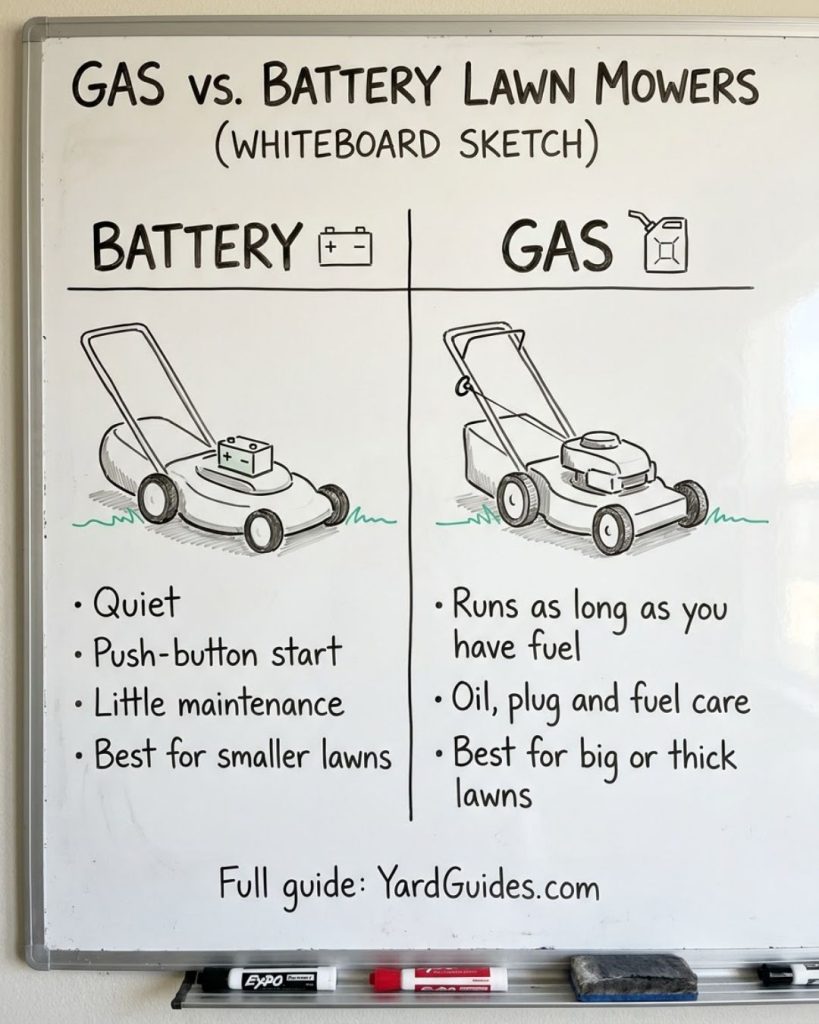
Gas vs battery at a glance
| Battery | Gas | |
|---|---|---|
| Best for | Small to medium lawns (up to ~¼ acre per charge) | Large, thick, wet or hilly lawns |
| Runtime | Limited by the battery; extra batteries extend it | As long as you have gas |
| Starting | Push button | Pull cord (or electric start on some) |
| Maintenance | Blade sharpening, keep it clean, battery care | Oil changes, spark plug, air filter, fuel care |
| Noise and exhaust | Much quieter, no exhaust | Loud, exhaust fumes |
| Upfront cost | Usually higher | Usually lower |
| Running cost | Lower (electricity, little upkeep) | Higher (fuel, oil, parts) |
| Winter storage | Store the battery properly | Stabilize or drain fuel, change oil |
Runtime: will a battery mower finish my lawn?
This is the big question. In Consumer Reports’ tests, the average battery walk-behind ran about 45 to 50 minutes per charge, enough for a quarter acre even on somewhat sloped ground. Runtime drops in tall, wet or thick grass and with self-propel running. If your lawn is bigger than about a quarter acre, CR suggests planning on a second battery. (Consumer Reports)
Rule of thumb: If you mow your lawn in under 45 minutes with a push mower today, one good battery will probably do it. If it takes longer, budget for a second battery or stick with gas.
Maintenance: battery wins easily
A gas mower needs seasonal work: oil changes, a spark plug, an air filter, and fuel care. Gas left sitting goes stale. Briggs & Stratton says fuel can begin to deteriorate in as little as 30 days, which is why so many gas mowers won’t start in spring. (Briggs & Stratton) Our guides to fuel stabilizer and lawn mower maintenance cover all of that.
A battery mower needs very little: keep the blade sharp, keep the deck clean, and store the battery properly. Consumer Reports calls them low-maintenance for this reason. (Consumer Reports)
Free printable: seasonal maintenance checklist for your mower & tractor
A 2-page spring-to-winter checklist for riding and push mowers and compact tractors. Then short, practical emails a couple of times a month. Unsubscribe anytime.
Cost: higher up front, cheaper to run
Battery mowers usually cost more to buy, especially once you add a second battery. They cost less to run, with no gas, oil or tune-up parts. Consumer Reports compared its top battery and gas push mowers and found the battery model’s higher price evened out over years of lower fuel and maintenance costs. How fast depends on the models and how much you mow. (Consumer Reports)
Tip: Battery platforms matter. If you already own a brand’s batteries for a trimmer or blower, a mower on the same platform can save you a battery purchase.
Power and cut quality
Consumer Reports found that many battery mowers now perform on a par with gas models. (Consumer Reports) Gas still has the edge for long sessions in heavy, wet or overgrown grass, where a battery drains fast.
Live in California? The rules changed
California’s Air Resources Board requires most newly manufactured small off-road engines, including lawn mower engines, to be zero-emission starting with model year 2024. The rule applies to manufacturers selling new equipment. It doesn’t stop you from using, maintaining or repairing the gas mower you already own. (CARB: 2021 amendments, CARB announcement)
Which should you buy?
Choose battery if:
– Your lawn is small to medium (roughly a quarter acre or less, or more with a second battery)
– You hate pull cords, oil changes and stale gas
– Noise matters (early mornings, close neighbors)
– You already own tools on a battery platform
Choose gas if:
– Your lawn is large, hilly, or often thick and wet
– You need to mow for long stretches without stopping to recharge
– You want the lowest upfront price
– You’re comfortable with basic engine maintenance
Bigger than an acre? You’re likely looking at a riding mower or zero-turn instead. If you go that route, our riding mower battery guide covers the battery side.
Shop battery lawn mowers · Shop gas push mowers
FAQ
Are battery lawn mowers as good as gas?
For most residential lawns, yes. Consumer Reports found many battery mowers perform on a par with gas. Gas keeps the edge in very large, thick or wet lawns.
How long does a battery mower run?
About 45 to 50 minutes per charge on average in Consumer Reports’ tests, enough for roughly a quarter acre. Thick grass and self-propel shorten it.
Do battery mowers need maintenance?
Very little: sharpen the blade, clean the deck, and store the battery properly over winter. There’s no oil, spark plug or fuel to deal with.
Are gas mowers banned?
Not nationally. In California, most new small off-road engines sold from model year 2024 must be zero-emission, but existing gas mowers can still be used and repaired.
Sources
- Consumer Reports: Gas vs. electric lawn mower, which is better?
- Consumer Reports: Can a battery mower save money over a gas mower?
- California Air Resources Board: 2021 amendments to small off-road engine regulations
- CARB: Updated regulations requiring most new small off-road engines be zero emission by 2024
- Briggs & Stratton: Fuel recommendations