
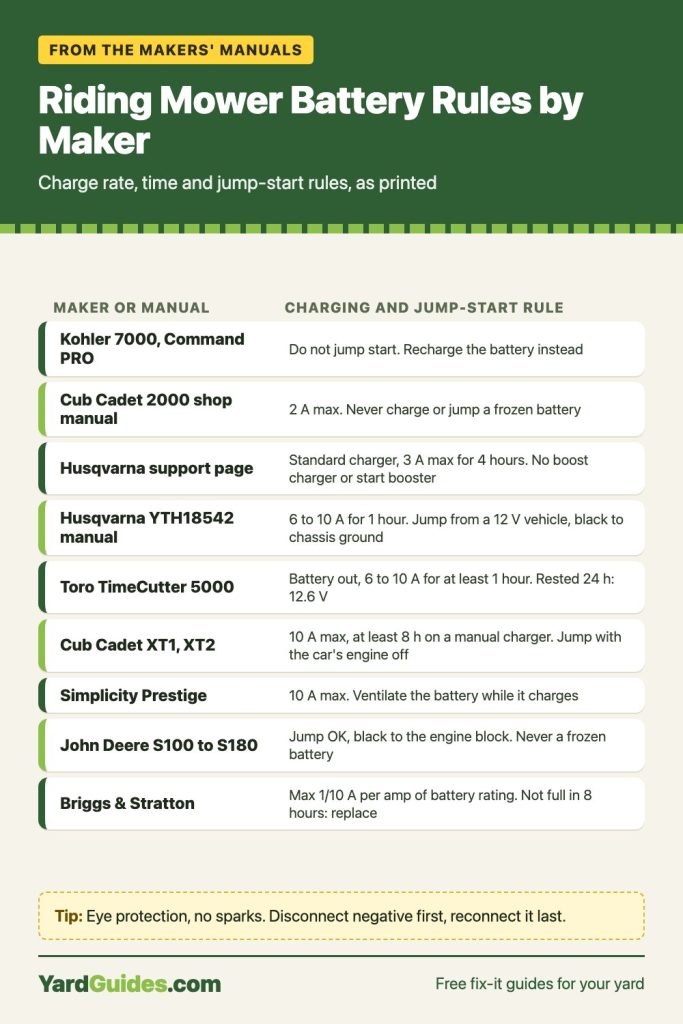
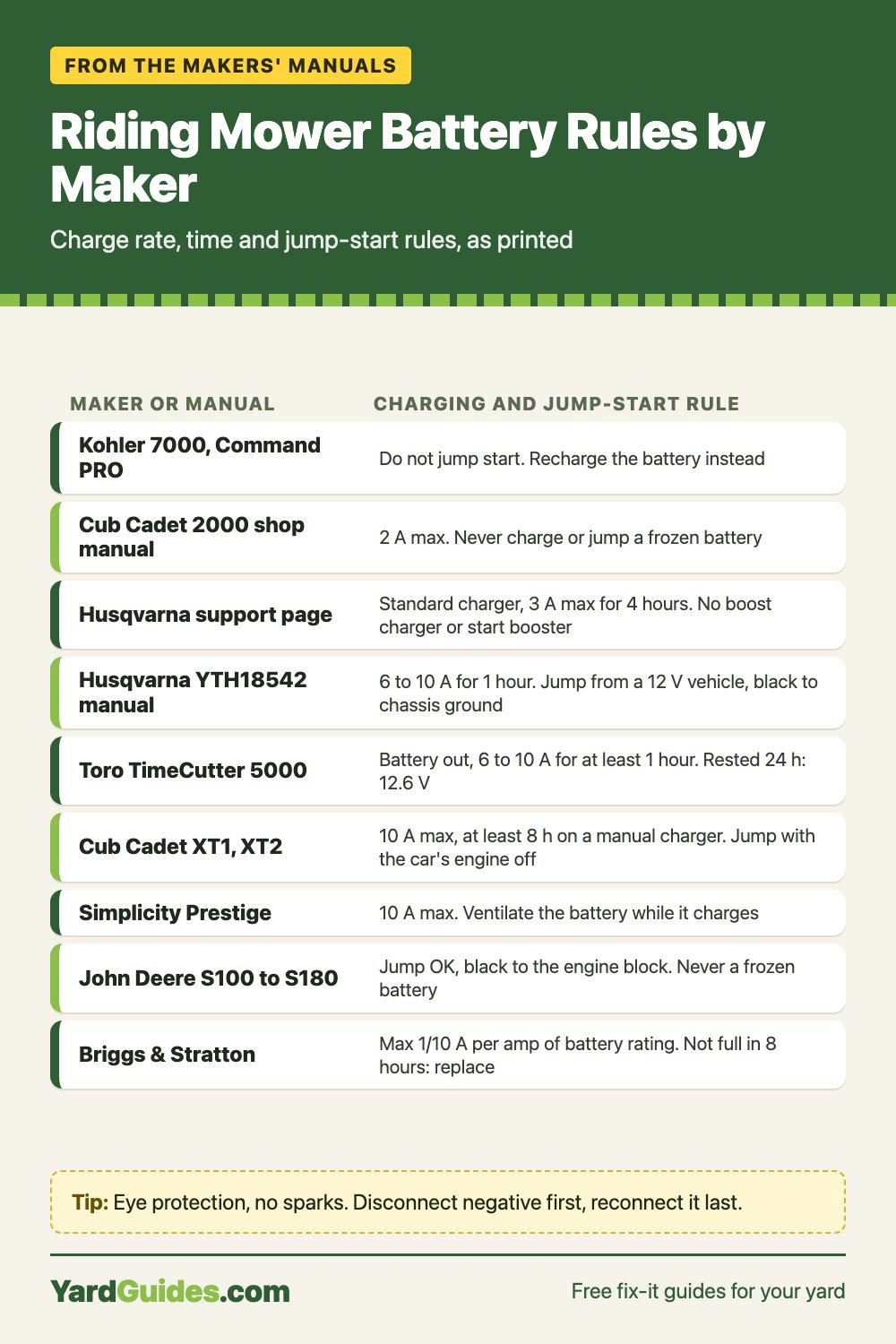
Quick answer: Riding mowers run on a 12-volt battery. Charge it with a standard 12 V charger, not a boost setting, at the rate your manual allows: 2 amps in Cub Cadet’s 2000 Series shop manual, 3 amps for 4 hours on Husqvarna’s support page, 6 to 10 amps for 1 hour in Toro TimeCutter and Husqvarna YTH manuals, and no more than 10 amps for Simplicity and Cub Cadet XT tractors. Disconnect the negative cable first and reconnect it last. Rested and full, it should read 12.6 V (Toro). Under 12 V after a full charge, Husqvarna says replace it. Jumping it from a car is allowed by some makers with the car’s engine off, but Kohler’s 7000 Series and Command PRO manuals say do not jump start.
Jump to the table: Is it the battery? Check the voltage first ↓
YardGuides may earn a commission from links on this page, at no cost to you. As an Amazon Associate I earn from qualifying purchases. Learn more.
Safety first. Batteries give off hydrogen, an explosive gas, most of all while charging. Briggs & Stratton’s repair manual puts it in capitals: “BATTERIES PRODUCE HYDROGEN, AN EXPLOSIVE GAS!” Before you touch the battery:
- Park it and take the key out. Cub Cadet: disengage the PTO, set the parking brake, stop the engine and remove the key before any maintenance (XT1/XT2 manual, p. 22).
- Wear eye protection and gloves. John Deere and Cub Cadet’s shop manual both say so. Take off rings and watch bands (Husqvarna).
- No sparks or flames. Charge in a well-ventilated area, away from pilot lights on a water heater, furnace or dryer (Cub Cadet XT, p. 26). Husqvarna’s TS 248XD manual says to keep flammable materials at least 1 m (about 3 ft) away while charging.
- Cable order: negative (black) off first, positive (red) on first and negative on last. Every mower manual below says this. A wrench that touches the frame while it’s on the positive post makes sparks.
- Never charge or jump a frozen battery. Cub Cadet’s shop manual and John Deere both say this. A case that bows out in the middle means the battery froze or overheated and should be replaced (Cub Cadet shop manual, p. 130).
- Unplug the charger before you connect or disconnect the battery (Toro TimeCutter 5000, p. 36).
Is it the battery? Check the voltage first
Set a multimeter to DC volts and touch red to the positive post, black to the negative. Measure a rested battery: Toro says to let it sit 24 hours after charging before you check it, and Cub Cadet’s shop manual says to let it sit ten minutes and put a load on it for 15 seconds to burn off the surface charge. A reading straight off the charger reads high.
| Reading | What the maker says it means | What to do | Source |
|---|---|---|---|
| 12.6 V or more, rested 24 hours | Fully charged | Nothing. In storage, keep it at 12.4 V or higher | Toro TimeCutter 5000, p. 49 |
| Under 12.6 V after charging and a 24-hour rest | Not fully charged | Charge it again and re-check | Toro, p. 49 |
| Under 12.4 V in storage | Toro’s recharge point | Recharge, rest 24 hours, re-check | Toro, p. 49 |
| 12.2 V or less, open circuit | May keep a Kohler eChoke from working right | Charge before you chase a choke problem | Kohler 7000 service manual, p. 44 |
| Under 12 V after a full charge (3 A, 4 hours) | Bad battery | Replace it | Husqvarna support |
| “LO BATT” on a Cub Cadet hour meter (under 11.5 V) | Low battery or weak charging | Charge it, or have the charging system checked | Cub Cadet XT1/XT2, p. 16 |
| Not full after 8 hours on a charger | Dead battery | Replace it | Briggs charging FAQ |
These are the mower and engine makers’ own numbers. We didn’t use the percentage charts that battery sites publish, because none of the mower manuals prints one.
How to charge a riding mower battery
- Park, PTO off, brake on, key out. Lift the seat or hood to reach the battery.
- Disconnect the negative (black) cable first, then the positive (red). Briggs warns that doing it in the wrong order can arc. Lift out the battery if you can: Toro says to remove it from the machine to charge it, and Cub Cadet’s shop manual says charging it out of the tractor cuts corrosion from out-gassing and protects the charging system. On Briggs engines with Electronic Fuel Management, Briggs says to turn the key OFF and disconnect the negative cable before you charge (80107981, p. 8).
- Clean the terminals with a wire brush until bright. John Deere washes the battery with 4 tablespoons of baking soda per gallon of water, keeping it out of the cells, then rinses and dries it (p. 41).
- Use a charger made for 12 V lead-acid batteries (Cub Cadet XT, p. 26). Husqvarna: “Use a standard battery charger” and “Do not use a boost charger or start booster.”
- Set the rate your manual allows (table below). If you don’t know, the lowest figure any maker prints is 2 amps. Briggs’ rule: “DO NOT EXCEED CHARGE RATE of 1/10 AMPERE for every ampere of battery rating,” and consult the battery maker. Briggs doesn’t say which rating. Our reading, not Briggs’: if that means amp-hours, the 28 amp-hour battery in Husqvarna’s YTH18542 manual works out to 2.8 amps.
- Connect the charger red clamp to positive, black to negative, then plug it in.
- Charge until it’s full, not longer. An automatic charger tells you when it’s done (Cub Cadet XT). On a manual charger with an amp gauge, Cub Cadet’s shop manual says stop when the gauge reads zero. Toro: “Do not overcharge the battery.”
- Unplug, then remove the clamps. Let it rest and check the voltage against the table above.
- Reinstall: positive cable first, negative last, red boot back over the positive post, a light coat of petroleum jelly or grease on both terminals (Cub Cadet XT, p. 22). Husqvarna: always disconnect the charger before starting the engine.
How long to charge a lawn mower battery
It depends on the rate. Husqvarna’s support page says 4 hours at 3 amps. Toro and Husqvarna’s YTH18542 manual say at least 1 hour at 6 to 10 amps. Cub Cadet’s XT manual says to charge until an automatic charger says it’s complete, or “no fewer than eight hours” on a charger that isn’t automatic. Briggs: if it isn’t fully charged within 8 hours, the battery is dead.
What charger to use
- A standard 12 V charger with a low-amp setting. A 2 amp setting stays inside the strictest manual (Cub Cadet’s 2000 Series shop manual) and every other maker’s printed amp limit; Husqvarna’s support page allows up to 3 amps. That’s our read of the table, not a maker’s recommendation.
- One that tapers or shuts off on its own. Briggs: “Use a taper charge (automatically reduces charge rate),” because “Overcharging may cause battery failure.”
- A maintainer for storage. Cub Cadet says to recharge periodically in storage, and John Deere says every 90 days.
- Skip the boost or engine-start setting. Husqvarna says a boost charger or start booster will “cause damage to the electrical system,” and Briggs says not to use a battery charger to start an engine with Electronic Fuel Management.
Shop 12 V battery maintainers and chargers
Charging and jump-start rules by maker
Use your mower’s manual and your engine’s manual. Where they disagree, the stricter one is the safer read.
| Maker and manual | Max charge rate and time | Jump start? | Cable rule |
|---|---|---|---|
| Kohler 7000 Series (service manual 32 690 03, p. 42, 50) and Command PRO (owner’s manual 24 590 54, p. 4) | Not printed. “If battery charge is insufficient to turn over engine, recharge battery” (SM p. 55) | No. “Do not jump start using another battery.” Command PRO: “Do not jump start.” | Disconnect negative before service (SM p. 2) |
| Cub Cadet 2000 Series (shop manual, p. 129) | 2 amps. “Never charge an outdoor power equipment battery at a rate higher than 2 amps.” Stop when the amp gauge reads zero | Warns jump starting can damage solid-state components. Never a frozen battery | Ground cable off first, on last |
| Cub Cadet XT1 / XT2 (769-10976, p. 26) | 10 amps max. Until an automatic charger says done, or at least 8 hours | Yes, with the donor car’s engine off. Final clamp on the engine block. Never a frozen or damaged battery | Negative off first, positive on first |
| Husqvarna riders (support page 854c) | 3 amps for 4 hours, standard charger | No boost charger or start booster | Red to positive, black to negative |
| Husqvarna YTH18542 (114 25 66-32, p. 15, 23) and TS 248XD (manual, p. 22-23) | YTH18542: 6 to 10 amps for 1 hour. TS 248XD: 6 to 10 amps, at least 1 hour (p. 11) | Yes (YTH18542: the other vehicle must be 12 V). Black to chassis ground, away from the fuel tank and battery | Black off first, red on first |
| Toro TimeCutter 5000 (3466-168, p. 37) | 6 to 10 amps, at least 1 hour, battery out. “Do not overcharge” | Not covered | Negative off first, positive on first (p. 36) |
| Simplicity Prestige (manual via ManualsLib, p. 20) | 10 amps max. Ventilate while charging | Not covered | Negative off first, on last |
| John Deere S100 to S180, Briggs engines (OMUC22642, p. 41-42) | Not printed | Yes. Negative booster cable to the engine block, not the frame. Never a frozen battery: warm it to 60°F (16°C) | Negative off first, on last |
| Briggs & Stratton V-twin (repair manual via ManualsLib, p. 59; charging FAQ) | 1/10 amp for every amp of battery rating (rating not defined). Not full in 8 hours: replace | EFM engines: don’t use a battery charger to start the engine (OM 80107981, p. 8) | Negative off first, positive on first |
| Kawasaki FR and FX (FR 99920-2289-03, p. 38; FX 99920-2299-03, p. 43) | Not printed. Battery: 12 V, 550 CCA class | Not covered | Negative off first before any repair |
Where the makers disagree:
Free printable: seasonal maintenance checklist for your mower & tractor
A 2-page spring-to-winter checklist for riding and push mowers and compact tractors. Then short, practical emails a couple of times a month. Unsubscribe anytime.
- Charge rate. Cub Cadet’s manuals differ: its 2000 Series shop manual (2011) caps charging at 2 amps, but its XT1 and XT2 owner’s manual allows 10. Husqvarna’s support page says 3 amps for 4 hours, while its YTH18542 manual says 6 to 10 amps for 1 hour. If your charger has a low setting, the lower number keeps you inside both.
- Jump starting a Kohler-powered tractor. Cub Cadet’s XT manual prints a jump-start procedure, and it covers both Kohler- and Kawasaki-powered tractors. Kohler’s 7000 Series service manual and Command PRO owner’s manual say not to jump start. If your engine is one of those, follow Kohler and charge the battery instead.
How to jump-start a riding mower
First, check that your engine maker allows it. Kohler 7000 Series and Command PRO: don’t. Our Kohler 7000 Smart-Choke guide has the starting routine Kohler wants instead. Cub Cadet’s shop manual also warns that jump starting can damage solid-state components. Our take: if you have a few hours, charging is the gentler fix.
If your manual allows it (Cub Cadet XT, Husqvarna YTH and TS, John Deere S100 series), the steps are nearly the same. Follow your own manual’s order:
- 12 V only. Husqvarna: “THE OTHER VEHICLE MUST ALSO BE A 12 VOLT SYSTEM.” Don’t jump a frozen or damaged battery.
- Car engine off. Cub Cadet: “If the jumper battery is installed on a vehicle (i.e. car, truck), do NOT start the vehicle’s engine when jump starting your tractor.” Keep the vehicles from touching and both ignitions off.
- Red cable to both positive (+) posts. Cub Cadet and Husqvarna’s TS 248XD start at the mower’s dead battery; John Deere starts at the booster battery. Don’t let the red clamps touch the chassis.
- Black cable: good battery’s negative (-).
- Last clamp on the mower’s engine block, on bare metal, away from the battery. John Deere says the engine block, not the frame, and away from belts and the fan. Husqvarna says a chassis ground away from the fuel tank and battery. Never the dead battery’s negative post.
- Start the mower. Crank no more than 5 seconds and wait a minute between tries (Briggs). John Deere says to run the machine for several minutes.
- Remove the cables in exact reverse order: black from the mower first, then black from the good battery, then the red cables.
Don’t use your mower’s battery to start a car. Husqvarna’s manuals say not to.
Battery won’t hold a charge
Owner-level checks, in order:
- Clean and tighten. Husqvarna says corrosion and dirt can cause the battery to “leak” power (YTH18542, p. 15). Cub Cadet’s shop manual calls cable corrosion the most common cause of high-resistance faults.
- Fully charge it, rest it, re-check. If it won’t reach full in 8 hours, Briggs says replace it. Under 12 V after a full charge, Husqvarna says replace it.
- Check for a drain. Briggs says a fully charged battery “should not drain if it is not in use.” Cub Cadet’s shop manual adds a common cause: getting off the seat to kill the engine and leaving the key ON can leave a relay or fuel solenoid energized. Off the mower, a good battery should lose less than 0.2 V over three days.
- Check that the mower charges it. Briggs’ quick test: headlights on, then shut the engine off. If the lights dim, the alternator was charging. John Deere lists “Low engine speed or excessive idling” as a cause of a battery that won’t charge, and Husqvarna’s chart adds a faulty regulator or alternator.
Past that, it’s the charging system. Our Cub Cadet voltage regulator guide and Simplicity electrical guide cover regulator and stator tests, and how to wire an amp gauge shows you whether it’s charging while you mow.
Battery is fine but it still clicks
A charged battery with clean, tight terminals that still gives only a click points to the next suspects: the solenoid, the starter and the safety interlocks. Our lawn mower won’t start guide walks through them in order. For zero-turns, see the zero turn safety switch guide, and for the key switch, the 5-pole ignition switch diagram.
Replacing a riding mower battery
Are lawn mower batteries 12 V or 6 V? Every riding mower and engine manual we checked is 12 V: Husqvarna (“YOUR TRACTOR IS EQUIPPED WITH A 12 VOLT SYSTEM”), John Deere (“Battery Voltage 12 Volts”), Kawasaki (“12 V 550 CCA Class”) and Cub Cadet (a charger “designed for 12V lead-acid batteries”). Check the label on yours.
Match the new battery to the spec in your manual and on the old battery’s label:
- Husqvarna YTH18542: 28 amp-hours, 230 CCA minimum, case size U1R (p. 4)
- John Deere S100 to S180: 12 V, BCI Group U1 (p. 49)
- Kawasaki FR and FX engines: 12 V, 550 CCA class. See our Kawasaki FX1000V guide
- Cub Cadet 2000 Series: ships with a 230 CCA battery (shop manual, p. 131)
- Kohler 7000 Series: 400 CCA “generally recommended,” with minimums of 200 CCA above 32°F, 250 CCA from 0 to 32°F, 300 CCA from -5 to 0°F and 400 CCA at -10°F or below (SM p. 55)
To swap it: negative off first, then positive. Lift it out, set the new one in with “terminals in same position as old battery” (Husqvarna), and secure the hold-down or strap. Positive on first, negative last, red boot on, grease the terminals. Cub Cadet warns that reversing the cables “could result in serious damage to your engine’s alternating system.”
Shop battery terminal brushes and terminal protector spray
Cordless 40 to 80 V mower packs are a different animal. Follow the pack maker’s charger, and see our winterizing guide for storage.
Storing it for winter
Charge it fully, disconnect the negative cable, and keep it where it won’t freeze. John Deere says recharge every 90 days, and Toro says keep it at 12.4 V or higher. The rest of the off-season routine is in our lawn mower winterizing guide, the oil change is in what oil your lawn mower takes, and what fuel stabilizer does covers the gas. Cold-climate tractor owners: our tractor block heater guide covers cold starts.
What you’ll need
- A 12 V battery charger or maintainer with a low-amp setting
- A digital multimeter set to DC volts
- Safety glasses and gloves
- A terminal brush, baking soda and water, and petroleum jelly or terminal spray
- Jumper cables, only if your manual allows jump starting
Spring: the battery is one step in our spring tune-up checklist.
FAQ
Are lawn mower batteries 12 V or 6 V? Riding mower batteries are 12 V. Husqvarna, John Deere, Kawasaki and Cub Cadet manuals all specify a 12-volt system. Check the label on the battery to be sure.
How long does it take to charge a riding mower battery? About 1 to 8 hours, depending on the rate. Husqvarna’s support page says 4 hours at 3 amps, Toro says at least 1 hour at 6 to 10 amps, and Cub Cadet says at least 8 hours on a charger that isn’t automatic. If it isn’t full after 8 hours, Briggs says replace it.
Can you jump a riding mower with a car? Some makers allow it. Cub Cadet and Husqvarna manuals give jumper-cable steps from a 12-volt car or truck, and Cub Cadet says not to start the car’s engine. John Deere gives booster-battery steps. Kohler’s 7000 Series and Command PRO manuals say do not jump start, so charge the battery instead.
Can you overcharge a lawn mower battery? Yes. Toro says “Do not overcharge the battery,” and Briggs says overcharging may cause battery failure. Use an automatic charger that tapers or shuts off, at or below your manual’s amp limit.
Does a riding mower charge its battery while running? Yes. Husqvarna says its charging system “is sufficient for normal use,” but periodic charging with an automotive charger will extend battery life (YTH18542, p. 15). Output varies: 3 A on the YTH18542, 9 to 16 A on John Deere’s S100 to S180. John Deere lists low engine speed or excessive idling as a reason the battery won’t charge.
Why does my riding mower battery keep dying? Corroded terminals, an old battery, a drain such as a key left ON, or a charging system that isn’t keeping up. Charge it fully, then check for a drain and run Briggs’ headlight test before replacing parts.
What size battery does my riding mower need? The one your manual specifies, which is usually printed on the old battery’s label too. For example, Husqvarna’s YTH18542 calls for 230 CCA minimum, case size U1R, and John Deere’s S100 series uses BCI Group U1.
Sources
- Cub Cadet (MTD), Professional Shop Manual, 2000 Series Tractors (2011), copy via ManualsDir: batteries and charging p. 129, checking battery condition p. 130, battery testers p. 131, discharge test and storage p. 133
- Cub Cadet, XT1 and XT2 Enduro Series Operator’s Manual 769-10976: battery cables p. 12, hour meter low battery p. 16, battery p. 22, storage p. 25, jump starting and charging p. 26
- Husqvarna US support, Battery will not charge or stay charged
- Husqvarna, YTH18542 Operator’s Manual 114 25 66-32: specifications p. 4, connect battery p. 5, battery p. 15, weak battery and jumper cables p. 23, storage p. 25, troubleshooting p. 26-27
- Husqvarna, TS 248XD Operator’s Manual (2024): battery safety p. 9, battery and jumper cables p. 22-23, troubleshooting p. 31 and 33, storage p. 35
- Toro, TimeCutter 5000 Operator’s Manual 3466-168: electrical safety and removing the battery p. 36, charging p. 37, storing the battery p. 49
- Simplicity, Prestige Series Tractor Operator’s Manual 1752401 Rev. B, copy via ManualsLib: battery maintenance and charging p. 20
- John Deere, S100 to S180 Lawn Tractors Operator’s Manual OMUC22642: safety p. 13, battery and booster battery p. 40-42, troubleshooting p. 47, storage p. 48, specifications p. 49. Retailer-hosted copy (Lowe’s)
- Briggs & Stratton, Intek V-Twin 405777 and 445777 repair manual, copy via ManualsLib: battery p. 59 (viewer page)
- Briggs & Stratton, How to test a small engine charging system, battery and alternator
- Briggs & Stratton, Why won’t my lawn mower engine starter engage?
- Briggs & Stratton, Operator’s Manual 80107981 Rev A, 400000, 440000, 490000: start cycles p. 7, Electronic Fuel Management p. 8
- Kohler, 7000 Series KT610-KT745 Service Manual 32 690 03 Rev. N: safety p. 2, Smart-Choke starting p. 42, eChoke p. 44, unitized throttle and choke starting p. 50, battery p. 55, charging system tests p. 61
- Kohler (Rehlko), Command PRO CH/CV620-CV750 Owner’s Manual 24 590 54: starting p. 4
- Kawasaki, FR651V / FR691V / FR730V Owner’s Manual 99920-2289-03: wiring diagram and battery p. 38
- Kawasaki, FX Series Owner’s Manual 99920-2299-03: wiring diagram and battery p. 43