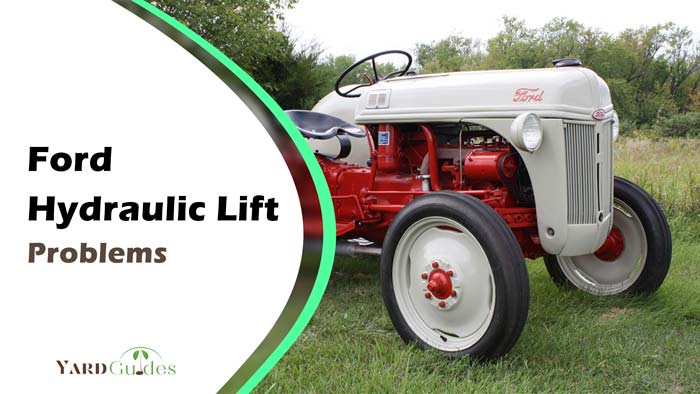
The hydraulic lift is a major part of the Ford 8N, 4000 and other Ford tractors. When it showcases problems, it’s crucial to identify the exact issues and take the proper troubleshooting measures.
So, what are the Ford 8n, 4000, and other Hydraulic lift problems? Well, the lift might not raise at all, lowers slowly or quickly, or it won’t hold in the least. Or the lift may raise and lowers erratically. Besides, you may even notice that the lift is making weird or unusual noises.
You may face the issue for one reason or a combination of issues. Read ahead to know how you can pinpoint the exact cause of your problem and how you can resolve the issues.
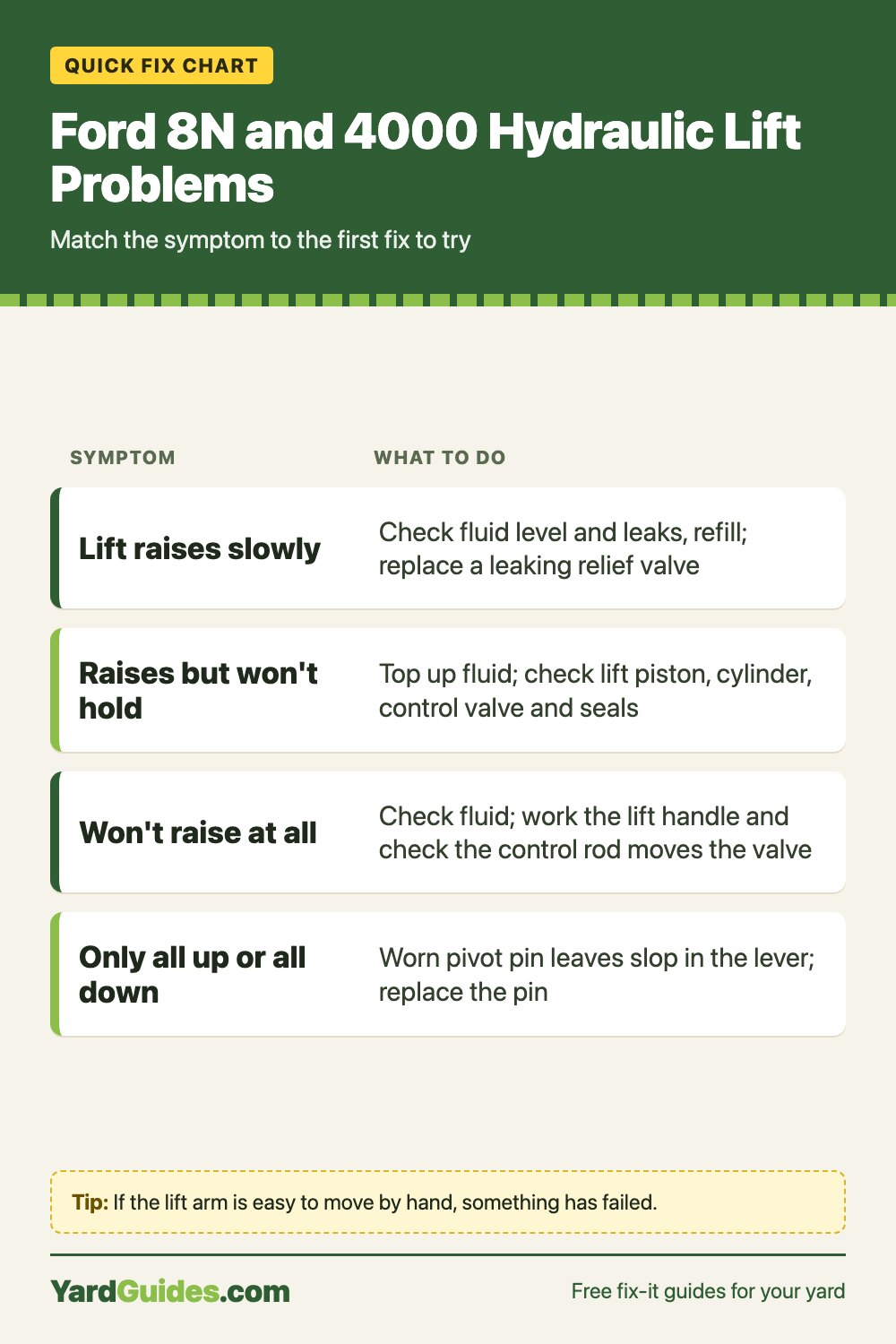
Here is a quick overview of the possible problems you might be facing on Ford 8N, 4000 and other tractors and their fixes:
| Problems | Solution |
| Lift won’t raise or lowers slowly | Check the hydraulic fluid level, oil leakage, and refill if necessary |
| Hydraulic Lift raises but won’t hold | Repair the piston or valve |
| Lift won’t raise at all | Check the hydraulic fluid level, then check that the control rod is connected and moving the control valve |
| Going all the way up or totally down | Inspect the lift control linkage for worn pivot pins or bushings and replace worn parts |
Which fluid does your tractor take? Our tractor hydraulic fluid cross-reference shows which aftermarket fluids claim the Ford/New Holland 134 spec, quoted from each maker’s data sheet.
Ford Hydraulic Lift Problems With Solutions – 8N, 9n, 4000, NAA and Other
There are mainly 4 problems related to Hydraulic lift. Your lift may be acting up due to one or more problems. Here we will discuss both the problem and their fixes:
1. Lift Won’t Raise or Lowers Slowly
This is a common Ford tractor problem. You may notice that the lift is working very slowly. This could be due to oil leakage or low fluid level. Another possible cause can be a damaged pump drive or clogged filter.
Fix
- Step 1: With the lift lowered and the engine off, check the fluid level and look for leaks or broken parts. If the lift arms are easy to push up by hand with the engine running and the control raised, something inside has likely failed.
- Step 2: Check that the control valve linkage moves freely and is adjusted as shown in the service manual for your model.
- Step 3: The next thing you need to check is the relief valve. You need to change it if it has any leaks.
- Step 4: When you start up your tractor your lift arm should work properly
2. Hydraulic Lift Raises But Won’t Hold
You may notice that your lift is rising just halfway or rise perfectly but won’t hold at all. One possible cause of this issue is low hydraulic fluid level. Another possible cause is a faulty lift piston or hydraulic cylinder.
Free printable: seasonal maintenance checklist for your mower & tractor
A 2-page spring-to-winter checklist for riding and push mowers and compact tractors. Then short, practical emails a couple of times a month. Unsubscribe anytime.
Moreover, a faulty control valve and, finally, a clogged hydraulic filter can also cause the lift to raise but not hold the implement. Moreover, over time, the seals on the components can wear out, causing the lift to lose pressure and drop the implement.
Fix
- Step 1: First, check the hydraulic fluid level and add more fluid if necessary. Use the fluid type and fill level in your operator’s manual.
- Step 2: If everything is checked out here, the fault might lie in the lift piston or hydraulic cylinder.
- Step 3: If this is the case, you may need to replace the lift piston or hydraulic cylinder.
3. Lift Won’t Raise at All
This is perhaps the issue that most Ford 8N, 4000, and other users face. The problem may lie with faulty hydraulic pumps. The hydraulic pump is responsible for pumping fluid to the lift. If the pump is not working correctly, the lift won’t work.
Another possibility is a cracked internal oil line between the pump and the lift cylinder, or a damaged relief valve.
A worn ball socket in the control linkage can also stop the lift from rising. A failed pump or worn socket needs replacing, but try the check below first.
Fix
- If the hydraulic lift is not raising at all, first make sure the hydraulic fluid level is not too low.
- If the level is good, lower the lift, switch off the engine, remove the key and let the oil cool. Then remove the access cover on the right side (the one with the dipstick).
- Reach into the oil and feel the end of the control rod where it enters the control valve.
- As you keep moving the lift control handle upward and downward, ensure the rod is attached and shifting the control valve spindles in and out. If the rod has come loose, reconnect it. Working the lever this way can also free a sticking valve.
4. Going All the Way up or Totally Down
If the hydraulic lift only goes all the way up or all the way down, with no control in between, the trouble is often worn pivot pins or bushings in the lift control linkage.
If it is worn out or damaged, it will cause a lot of free slop in the lever and not much action will happen.
Fix
The solution is to replace the worn linkage parts. Linkage layout differs between the 8N, NAA and 4000, so follow the service manual for your model.
- Step 1: Park on level ground, set the brakes, lower the lift fully and shut off the engine.
- Step 2: Work the lift control lever and watch the linkage between the lever and the control valve for free play.
- Step 3: Locate the pivot pins and bushings in the lift control linkage where you see the slop.
- Step 4: Remove the cotter pin or clip that secures the worn pin using a pair of pliers
- Step 5: Tap the pin out with a hammer and punch.
- Step 6: Inspect the pivot pin for wear or damage. If it’s worn or damaged, replace it with a new one.
- Step 7: Apply a light coat of grease to the new pin, install it, and secure it with a new cotter pin.
Here’s a Youtube video to help you understand it better
Conclusion
The Ford 8N, 4000, and others have simple yet elegant hydraulic systems. When positioned correctly and maintained properly, they work quite well. Wear and tear on the hydraulic pump or other components can cause reduced performance or complete failure of the hydraulic lift system.
Regular maintenance, including oil changes and component inspections, can help to prevent these issues and keep the hydraulic lift system functioning properly. However, everything might not always go your way. So ask a mechanic to check it every once in a while.