
Quick answer: Most Ford tractor PTO problems come down to the clutch, not a failed PTO. On an 8N, 9N or 2N (and single-clutch 600/800 and 2000/3000/4000 tractors), the PTO is driven through the main clutch, so it stops when you press the pedal and a mower can push the tractor unless you fit an overrunning clutch. On live PTO models (660/860, 661/861, some 2000/3000) the pedal has two stages, and on independent PTO models (4000/5000, Select-O-Speed) a separate PTO clutch does the work. Check pedal free travel first, then the engagement procedure for your model.
Safety first: Before you touch the PTO, the shaft, the shields or the clutch linkage: PTO lever out of gear, engine off, key out (or the 8N ignition switched off), parking brake or brake locks set, wheels blocked, and the implement lowered to the ground. Wait until the shaft has fully stopped. If anything is lifted, support it on jack stands, never on the hydraulic lift or a jack alone. Penn State Extension’s advice is plain: “Disengage the PTO and shut off the tractor before dismounting to clean, repair, service, or adjust machinery.” A 540 rpm shaft turns 9 times a second, and as Penn State puts it, “our reaction time is slower than the speed of the turning PTO shaft.” Keep the master shield and the implement driveline shields on, and replace a missing one: Penn State notes that “Many tractors, particularly older tractors, may no longer have PTO master shields.” Ford’s 8N manual says it directly: “Always use this shield. It is designed to protect the operator.”
Which Ford PTO do you have?
The fix depends on how your tractor drives its PTO. This is the part most generic advice gets wrong.
| Ford model | PTO type (per Ford manuals) | What the pedal does | 540 rpm at |
|---|---|---|---|
| 9N, 2N, 8N (8N: 1947-1952) | Transmission-driven, through the single clutch | Full pedal stops the tractor and the PTO | 1500 engine rpm (Ford lists 545 rpm) |
| 640, 650, 850 and other single-clutch 600/800 (1954 manual) | Transmission-driven | Full pedal stops both | Proof-Meter PTO band (526 to 546 rpm) |
| 660, 860, 661, 861 | Live PTO, double clutch | About half pedal stops the tractor; full pedal stops both | Proof-Meter PTO band |
| 2000, 3000, 4000 (1965-1975, “Transmission” PTO) | Transmission-driven | Full pedal stops both | 1800 rpm (6/7-speed 2000/3000), 1600 rpm (8-speed 2000/3000), 1800 rpm (8-speed 4000) |
| 2000, 3000 with Live PTO | Live PTO, two-stage pedal | Intermediate position stops the tractor only | 1800 rpm |
| 4000, 5000 with Independent PTO | Separate PTO clutch, own lever | Pedal does not stop the PTO | 1800 rpm (4000), 1900 rpm (5000) |
| Select-O-Speed models | Hydraulic PTO clutch pack, T-handle | PTO is engaged with the handle | See your manual (540 or 1000 rpm on two-speed units) |
Sources: Ford 8N Operator’s Manual, pp. 13, 25; Ford 600/800 Owner’s Manual, p. 20; Ford 601/801 Owner’s Manual, p. 20; Ford 2000/3000/4000/5000 Operators Handbook, Section C pp. 1-2; Ford Select-O-Speed Shop Manual Supplement, pp. 1, 17. All Ford copies are via archive.org. Not sure which you have? TractorData’s Ford 3000 page lists transmission, live and Select-O-Speed independent PTO as options on the same model, so look at your pedal and levers, not just the badge.
Ford tractor PTO diagnostic table
| Symptom | Likely cause | Check (manual section) | Fix |
|---|---|---|---|
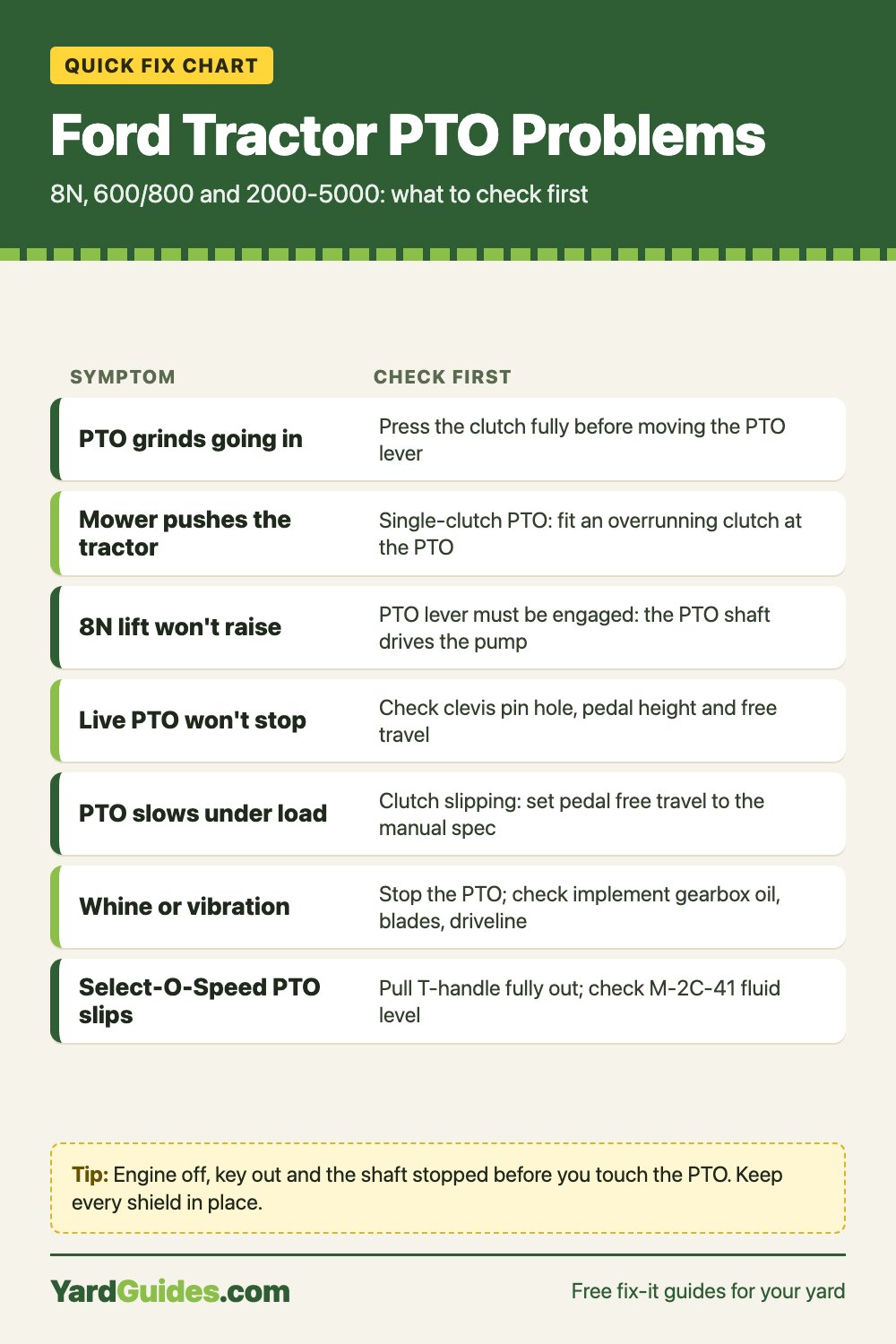
| PTO won’t engage or grinds going in | Lever moved with the clutch engaged | 8N OM, sec. 121 e, p. 15; 600/800 OM, p. 9 | Press the clutch fully, then move the lever all the way (rear = engaged on 8N and 600/800) |
| Lift won’t raise on an 8N, 9N or 2N | PTO lever out, so the hydraulic pump isn’t turning | 8N OM, sec. 121 f, p. 16 | Engage the PTO lever; see our lift guide if it still won’t raise |
| Mower pushes the tractor when you clutch | No overrunning clutch on a transmission-driven PTO | Bush Hog 2515 OM, sec. 4-6 | Fit an overrunning clutch between the PTO and the mower driveline |
| Live PTO keeps turning at full pedal | Double clutch PTO release out of adjustment | 600/800 OM, p. 45; 2000-5000 Handbook, sec. G p. 11 | Set free travel and pedal height to spec; shop adjusts internal gap |
| PTO slows or stalls under load | Main clutch slipping | 8N OM, sec. 221, p. 43 | Adjust pedal free play or replace the clutch |
| Implement stops but tractor PTO turns | Implement slip clutch slipping | Bush Hog 2515 OM, sec. 4-48 | Service the slip clutch per the implement manual |
| Whine, rattle or vibration with PTO on | Implement gearbox, blades or driveline | Bush Hog 2515 OM, secs. 4-34, 4-48 | Disengage at once; check gearbox oil, blades, driveline phasing |
| Select-O-Speed PTO weak or slipping | Low fluid, handle out of adjustment or circuit leak | SOS Supplement, sec. 8, pp. 18-27 | Check level with M-2C-41 fluid, adjust handle, pressure test |
Problem 1: PTO won’t engage or drive
Start with the procedure, because Ford is specific about it. On the 8N, “Depress the clutch pedal when engaging or disengaging the power take-off shaft while the engine is running,” and “In the forward position the power take-off is disengaged” (8N OM, p. 15). The 600/800 manual says the same thing: lever to the rear is engaged, forward is disengaged, and always press the clutch first (600/800 OM, p. 9). Forcing the lever with the clutch engaged grinds the gears.
On a 2000/3000/4000 with Transmission PTO, the lever is on the left side of the rear transmission: clutch down, lever fully rearward to engage, clutch down and lever forward to disengage. On a 4000 with Independent PTO the lever goes forward to engage, and on a 5000 it goes rearward (Operators Handbook, Section C pp. 1-2).
If the lever goes in but nothing turns, check whether the main clutch is slipping (Problem 5) before assuming the PTO itself is broken. Ford’s 8N service section treats PTO shaft replacement as a drain-the-oil-and-pull-the-housing job (sec. 372, p. 98), so it pays to rule out the clutch first.
N-series bonus check: on a 9N, 2N or 8N, the hydraulic pump is driven by the PTO shaft. The 8N manual says “The power take-off shaft must be engaged to operate the hydraulic control” (p. 16), and the 9N/2N manual says the pump and PTO are thrown in and out of gear together by the same lever. A “dead lift” on an N is often just the PTO lever out. More lift checks are in our Ford 8N and 4000 hydraulic lift problems guide.
Free printable: seasonal maintenance checklist for your mower & tractor
A 2-page spring-to-winter checklist for riding and push mowers and compact tractors. Then short, practical emails a couple of times a month. Unsubscribe anytime.
Problem 2: Whine noise or vibration with the PTO running
None of the Ford manuals we checked has a troubleshooting entry for a PTO whine, so treat noise as a symptom to trace, not a part to replace. Most of the time it’s on the implement side. Bush Hog’s rotary cutter manual says: “If you hear unusual noises or see or feel abnormal vibrations, disengage the PTO immediately” and inspect the implement (Bush Hog 2515 OM, sec. 4-34). Its troubleshooting chart lists a noisy gearbox (rough gears, worn bearing), low gearbox lubricant, loose or unevenly worn blades, and drivelines not phased correctly (sec. 4-48).
What to do, with the engine off, key out and the shaft stopped:
- Check the implement gearbox oil level and look for a leaking seal.
- Check the blades and blade bolts for looseness, damage and uneven wear.
- Make sure the driveline yokes are in line (phased) and the driveline telescopes freely.
- On an N-series tractor, check that the implement fits. The 8N stub shaft is 1-1/8 inches with 6 splines, and Ford supplied a PTO adaptor with a 1-3/8 inch ASAE spline for standard implements (8N OM, p. 24).
- Run at the right speed. Ford rated the 8N at 1500 engine rpm for PTO work and says the 1750 rpm rating “is for general field use without power take-off tools” (p. 25).
If the noise is clearly inside the tractor with no implement attached, that’s a job for a tractor shop. For getting the implement shaft off its gearbox, see how to remove a PTO shaft from a gearbox and how to remove a PTO shaft lock pin.
The 8N overrunning clutch: why your mower pushes the tractor
This is the most searched Ford PTO question, and it isn’t a defect. On a 9N, 2N, 8N and other single-clutch Fords, the PTO is driven through the main clutch. When you press the pedal, the PTO lets go too, and a heavy spinning rotary cutter can keep driving the tractor forward through the PTO shaft. TractorData’s overrunning clutch explainer describes exactly this: the mower’s momentum pushes back through the shaft and propels the tractor.
Implement makers are clear about the fix. Bush Hog’s rotary cutter manual: “If operating an older model tractor where the tractor’s transmission and PTO utilize one master clutch, an over-running clutch must be used between the PTO output shaft and the driveline of the mower” (Bush Hog 2515 OM, sec. 4-6). It’s a one-way coupler: the tractor can drive the mower, but the mower can’t drive the tractor.
A few notes:
- It goes on the tractor’s PTO shaft, between the tractor and the implement driveline. Adding it lengthens the driveline, so recheck the implement’s driveline length.
- Live and independent PTO tractors stop the wheels without depending on the PTO, but check your implement manual for what it requires.
- An overrunning clutch is not a slip clutch. It doesn’t protect the driveline when the blades hit a stump.
Problem 3: Live PTO won’t stop (the shaft keeps turning)
On live PTO Fords, the pedal works in two stages. The 600/800 manual: “To stop the forward motion of the tractor when operating with PTO driven equipment, depress the clutch pedal about half way,” and to stop the tractor and the implement, “depress the clutch pedal all the way” (600/800 OM, p. 20). The 2000/3000 Live PTO works the same way: “an intermediate clutch pedal position (1) stops the tractor without stopping the PTO shaft” (Operators Handbook, Section C p. 2).
If the PTO keeps turning at full pedal, or the tractor creeps at half pedal:
- Check the clevis pin position. Ford’s live PTO linkage has two holes. The rear hole runs the PTO and the tractor; the forward hole is for when the PTO is not in use (Handbook, Section C p. 2; 600/800 OM p. 45).
- Check pedal height on 600/800 double-clutch models. 10 inches from the running board on 660/860 (600/800 OM, p. 45), 9-3/8 inches on 661/861 (601/801 OM, p. 48).
- Check free travel (Problem 5 has the figures).
- If it still won’t release, the internal PTO release gap needs adjusting with the tractor split. An I&T-style shop manual for the 2000-3000-4000 describes the after-adjustment check: with the PTO cap off and the PTO engaged, push the pedal to the stop and see whether the PTO shaft stops turning (third-party shop manual via archive.org, para. 183). Stand clear of the shaft during that check, keep everyone away, and if you’re not comfortable with it, let a shop do it.
Problem 4: Decrease working capacity and produce heat (the “PTO pump” question)
You’ll see “replace the PTO pump” in a lot of Ford PTO advice. For most Fords people search for, that part doesn’t exist. On the 9N, 2N and 8N, the PTO drives the hydraulic pump, not the other way around (8N OM, p. 13: pump drive “Direct power take-off shaft”). The 600/800 “Live Action” hydraulics run whether the PTO is engaged or not (600/800 OM, p. 16). A worn hydraulic pump won’t make the PTO lose power on these tractors.
The exception is Select-O-Speed. There, the PTO is a hydraulic clutch pack inside the transmission, engaged with a T-handle. Its mid-position “is the feathering point which permits P.T.O. clutch slippage,” so a handle that isn’t pulled fully out will slip the PTO and make heat (SOS Supplement, p. 17). Ford’s checks:
- Fluid level and type. Ford fills it with “Ford Hydraulic Fluid, Specification M-2C-41” (p. 18). Check the level on level ground with the engine off. Our tractor hydraulic fluid cross-reference can help you match a current fluid; confirm it against the spec.
- PTO handle adjustment. A misadjusted handle can “continually feather the P.T.O. clutch pack” (p. 21).
- Pressure test. “Pull the P.T.O. handle out. If the pressure drops, a leak is occurring in the P.T.O. clutch circuit” (p. 23). Ford’s low-pressure list starts with low fluid level and a plugged suction screen (pp. 26-27). Pressure testing takes gauges and the shop manual. Most owners hand this to a shop.
Problem 5: PTO clutch is disengaging or slipping
On transmission-driven and live PTO Fords, the PTO only gets the power the main clutch passes. The 8N troubleshooting section says: “If the clutch slips under load, adjust pedal free play or replace the clutch, whichever is required” (8N OM, p. 43). Free travel is how far the pedal moves before you feel resistance. Too little and the clutch can slip; Ford gives these figures:
| Model | Clutch pedal free travel | Source |
|---|---|---|
| 8N | 3/4 in | 8N OM, sec. 335 e, p. 77 |
| 640, 650, 660, 850, 860 | 3/4 in at the pedal pad | 600/800 OM, p. 45 |
| 601/801 series | 1-1/2 to 1-3/4 in | 601/801 OM, p. 48 |
| 2000, 3000 (Transmission PTO) | 1.12 to 1.38 in (29 to 35 mm) | Operators Handbook, Section G p. 11 |
| 4000 (Transmission PTO) | 1.25 to 1.50 in (32 to 38 mm) | Same |
| 4000 (Independent PTO) | 1.62 to 1.88 in (35 to 48 mm) | Same |
| 5000 (Independent PTO) | 1.25 to 1.50 in (32 to 38 mm) | Same |
| 2000, 3000 (Live PTO) | 1.38 to 1.63 in (35 to 41 mm) | Same |
For 9N/2N and any model not listed, see your operator’s manual.
If the tractor’s PTO keeps turning but the implement stops, look at the implement’s slip clutch. Bush Hog lists worn linings, warped plates, oil on the facings and glazed facings as causes of a slip clutch that “slips excessively” (Bush Hog 2515 OM, sec. 4-48). Service it per your implement manual. Penn State also says to “avoid over tightening of slip clutches on PTO-driven machines.”
Comparing brands? Our Mahindra tractor PTO problems guide covers a modern independent PTO, and Ford 1000 tractor problems covers Ford’s compact. More owner tools are on our tools hub.
FAQ
Does a Ford 8N have a live PTO? No. Ford’s 8N manual has you press the clutch to engage or disengage the PTO, and TractorData lists the 8N’s rear PTO as transmission-driven. When you press the clutch, the PTO stops too. That’s why an overrunning clutch is recommended for rotary cutters.
What engine rpm gives 540 PTO rpm on a Ford? It depends on the model. Ford lists 545 rpm at 1500 engine rpm on the 8N and 9N/2N. On 1965-1975 2000/3000/4000/5000 tractors, Ford’s handbook gives 1600 to 1900 engine rpm depending on model and transmission (see the table above). On 600/800 series, use the PTO band on the Proof-Meter.
Do I need an overrunning clutch on a Ford 3000 or 4000? If yours has the single-clutch Transmission PTO, it behaves like an 8N, and Bush Hog says an overrunning clutch must be used with its cutter on that kind of tractor. Live and independent PTO models are different, so check your rotary cutter’s manual.
Why won’t my 8N’s three-point lift work? On the 9N, 2N and 8N, the hydraulic pump is driven by the PTO shaft, so the PTO lever must be engaged for the lift to work. If it’s engaged and still won’t lift, see our Ford lift problems guide.
Can I work on the PTO with the engine running? No. Shut off the engine, take the key, and wait for the shaft to stop. The only running check in this guide is the shop-manual release check on a live PTO, done from the seat with shields in place and everyone clear.
Sources
- Ford, 8N Operator’s Manual (1950), via archive.org (specs p. 13; controls pp. 15-16; PTO and shield pp. 24-25; safety p. 33; troubleshooting p. 43; clutch free travel p. 77; PTO replacement p. 98)
- Ford, 9N/2N Owner’s Manual (Instruction Book), via archive.org (transmission, PTO and pump drive)
- Ford, 600/800 Owner’s Manual (1954), via archive.org (PTO lever p. 9; hydraulics p. 16; PTO operation and live PTO p. 20; clutch p. 45)
- Ford, 601/801 Owner’s Manual (1957), via archive.org (PTO operation p. 20; PTO shaft and shield p. 21; clutch p. 48)
- Ford, Operators Handbook, Ford 2000, 3000, 4000 and 5000 (international edition), via archive.org (Section C pp. 1-2 PTO; Section G p. 11 clutch)
- Ford, Select-O-Speed Transmission Shop Manual Supplement, Series 2000 and 4000, SE 8175-S1 (1963), via archive.org (pp. 1, 17, 18, 21, 23, 26-27)
- Shop Manual, Ford Series 2000-3000-4000 (prior to 1975), third-party I&T-style manual, via archive.org (paras. 183, 320)
- Bush Hog, 2515 Rotary Cutter Operator’s Manual (01/11) (Operation sections 4-6, 4-34, 4-48)
- Penn State Extension, Power Take-Off (PTO) Safety
- TractorData, Ford 8N, Ford 3000, and Overrunning PTO Clutch