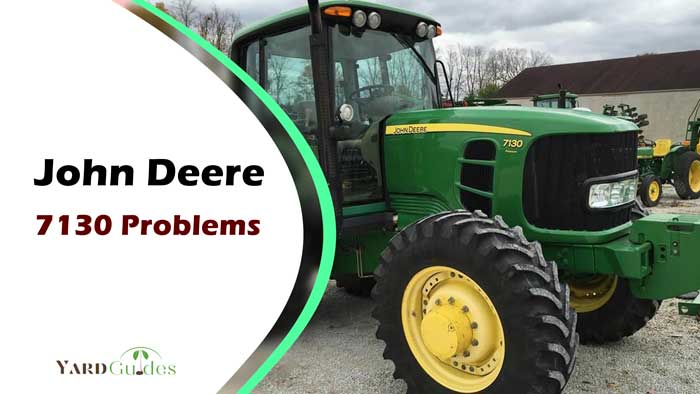
Like any other machine, the John Deere 7130 tractor isn’t immune to problems. As an owner, you will face some common problems with your John Deere 7130. The fact is, you should be aware of them and troubleshoot them efficiently.
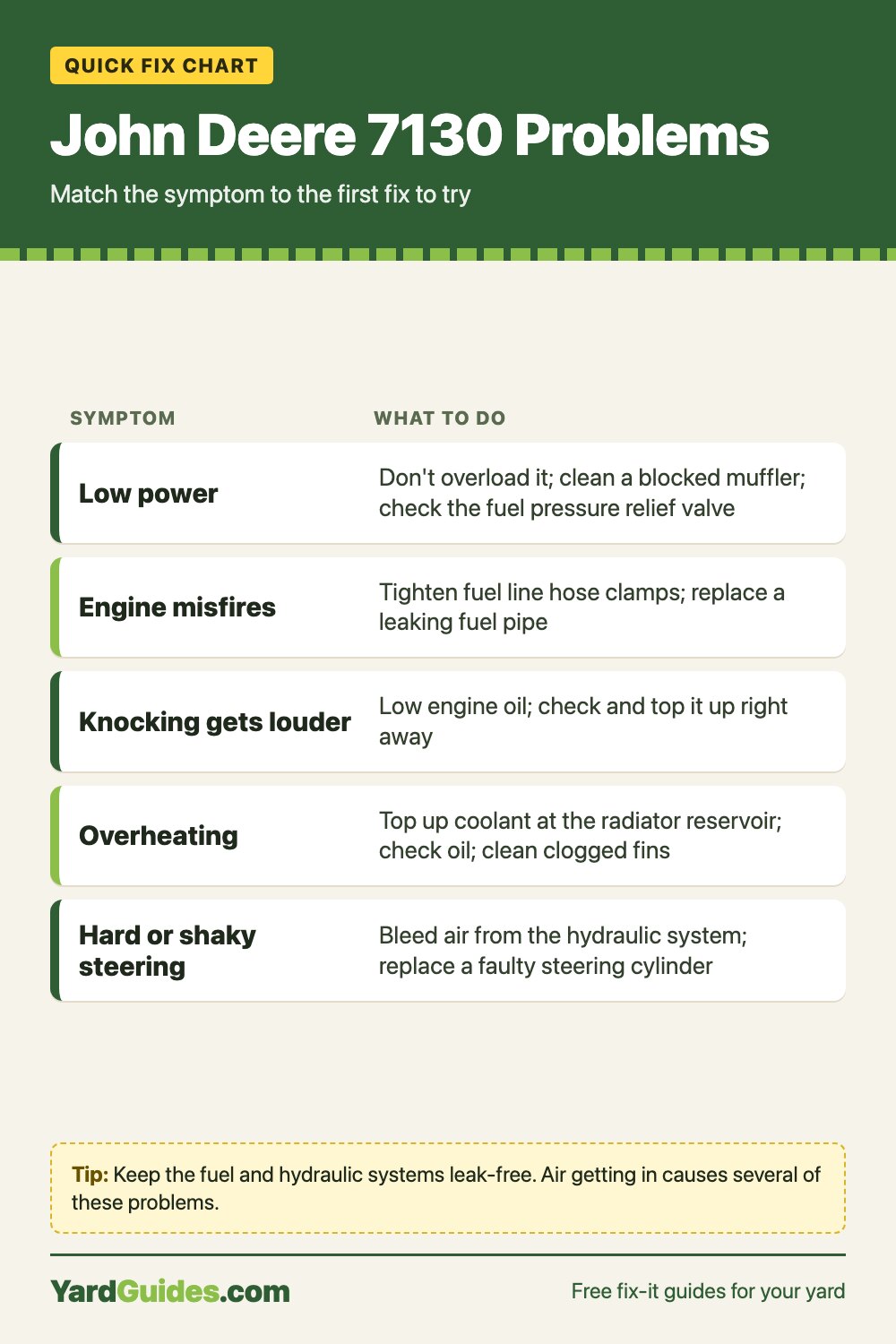
So, what are John Deere 7130 problems? You will come across engine problems like a short supply of power, a misfiring engine, and engine knocks that get progressively louder. Similarly, there are other problems such as engine overheating and steering that feels heavy or shaky.
In this guide, we will discuss all common problems with their solutions. If you are an owner of a tractor, or going to purchase one for farming, read on to learn more about the issues with solutions.
Table: Problems And Solutions
Before we dig in deep, let’s look at a table of the problems and the fixes available for problems.
| Problems | Solutions |
| A short supply of power | Check the air filter and exhaust for restrictions |
| Have a dealer test the fuel system | |
| A misfiring engine | Tighten fuel line clamps and bleed air from the fuel system |
| Replace the fuel pipe if leaks are found | |
| Engine knocks that get progressively louder | Stop the engine, check the oil, and have the bearings inspected |
| Engine overheating | Top up coolant with the engine cold |
| Clean the radiator and cooler screens | |
| Inconsistent steering | Check hydraulic fluid level and bleed air per the manual |
| Replace faulty steering cylinder |
John Deere 7130 Problems And How To Fix Them
We have come to the point where we will discuss the problem in-depth and cover the solutions that you can apply to fix them easily. So without any further ado, let’s get started.
1. A Short Supply Of Power
Your tractor is supposed to provide the same amount of power just like when you bought it. Well, engines do degrade over time. But if you notice a sudden change in the power, this is certainly a problem.
There are numerous reasons for this specific problem. An engine overload, a dirty muffler, and a faulty fuel pressure relief valve are to blame.
Solution
First, make sure you are not overloading the engine by pulling more than the tractor and implement are rated for, or running in too high a gear for the load.
Secondly, check for a restricted air filter or a blocked exhaust. A clogged air filter is one of the most common causes of power loss on a diesel, so service it as your operator’s manual describes.
It might also be a fuel system fault, such as a clogged fuel filter or a problem with the high-pressure fuel system. High-pressure diesel fuel systems are dangerous to work on, so have a John Deere dealer diagnose them.
Free printable: seasonal maintenance checklist for your mower & tractor
A 2-page spring-to-winter checklist for riding and push mowers and compact tractors. Then short, practical emails a couple of times a month. Unsubscribe anytime.
2. A Misfiring Engine
You know it’s an engine misfire when you feel that the engine is hesitating to power up, especially when you are accelerating harder. You will feel like the engine is not coping up at the speed that you expected.
Additionally, the engine will make weird sounds and vibrates. You will also notice high consumption of fuel and carbon emissions to increase.
A common cause is air getting into the diesel fuel supply line through a loose clamp or a cracked line. As a result, the engine cannot process things smoothly. A significant decrease in engine performance is seen, and the engine starts to misfire.
Solution
- To resolve this issue, check the fuel lines and clamps between the tank and the filters, and tighten any loose clamps. Then bleed the air out of the fuel system as your operator’s manual describes.
- Likewise, the fuel pipe may also be damaged and thus leaking. It’s best if you replace the fuel pipe with a new one.
3. Engine Knocks That Get Progressively Louder
The third problem is the constant knocking on the engine. Well, as you accelerate harder, the sound keeps increasing, and at a point, it’s just unbearable.
One serious cause is a lack of engine oil. When there isn’t sufficient engine oil, the engine rod bearing, and main bearing fails to function properly.
Knocking is heard when the bearings run without enough oil, and by the time you hear it, the bearings may already be damaged.
Solution
Stop the engine right away. Check the oil level with the tractor on level ground. If it is low, top it up with the oil grade listed in your operator’s manual and find out where the oil went.
Topping up won’t repair bearings that are already worn. If the knock is still there after the oil is full, don’t keep running the engine; have a John Deere dealer or diesel mechanic inspect it.
4. Diesel Overheating
It is a very bad sign if you come across diesel overheating. Yes, it’s a common problem, yet a serious one. An overheating diesel engine can be badly damaged if you keep running it. Well, the primary reason for this problem is insufficient coolant.
It’s the coolant’s job to keep the engine stable by keeping it cool in there. Thus, any lack of coolant will lead to engines not getting sufficient temperature control.
You will find a temperature gauge in your John Deere dashboard. From there, you will see that it’s in the high-temp zone. This indicates the temperature of your engine’s coolant.
Solution
Shut the engine down and let it cool before you open the radiator or coolant tank cap, because hot coolant is under pressure. Then top up the coolant with the type in your operator’s manual and look for leaks. Check the engine oil level as well.
Lastly, chaff and dust packed into the radiator and cooler cores is a common cause. Clean the screens and cores as your manual describes. Here’s a demonstration of how you can do it;
5. Inconsistent Steering
Inconsistent steering here means that you are having a hard time moving the steering left or right. It can also get shaky sometimes. Well, the main problem here is the hydraulic system.
The air might have entered the system and interrupted the steering system. Well, you might be wondering how they are connected.
An engine-driven pump presses the hydraulic fluid, giving the steering system hydraulic pressure. As a result, you get smooth steering.
On the other side, the steering cylinder might be faulty.
Solution
- Step 1: Park on level ground, lower implements and check the hydraulic fluid level. Top up with the fluid John Deere specifies.
- Step 2: Look for leaks at steering hoses and fittings. Never feel for a leak with your hand; use cardboard.
- Step 3: Bleed air from the steering system using the procedure in your operator’s or technical manual.
On the other hand, you can’t do much about a faulty steering cylinder. You must take it to a mechanic and replace it if you can’t do it yourself.
Conclusion
To sum up, the John Deere 7130 problems aren’t that hard to cure. As long as you keep your tractor’s internal system clean and rust-free, you are ahead of other tractor users.
On the other hand, it’s crucial that your tractor’s system doesn’t have any leaks so that no air gets inside. As you can see from the problems above, the air is not your tractor’s best friend. Lastly, don’t let your 7130 have any deficiency when it comes to engine oil.