
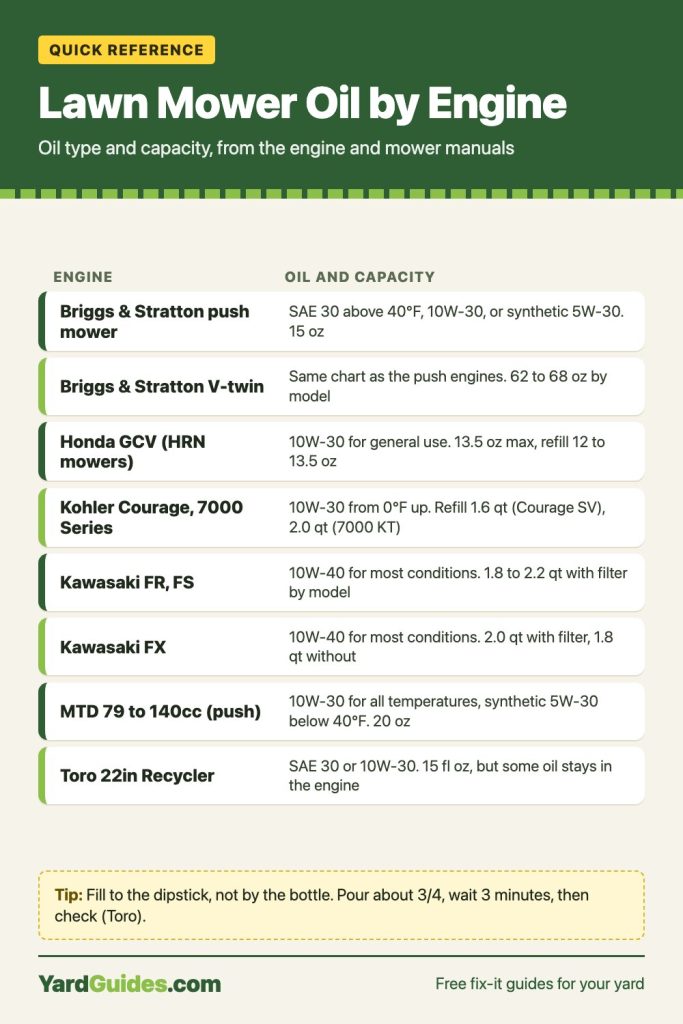
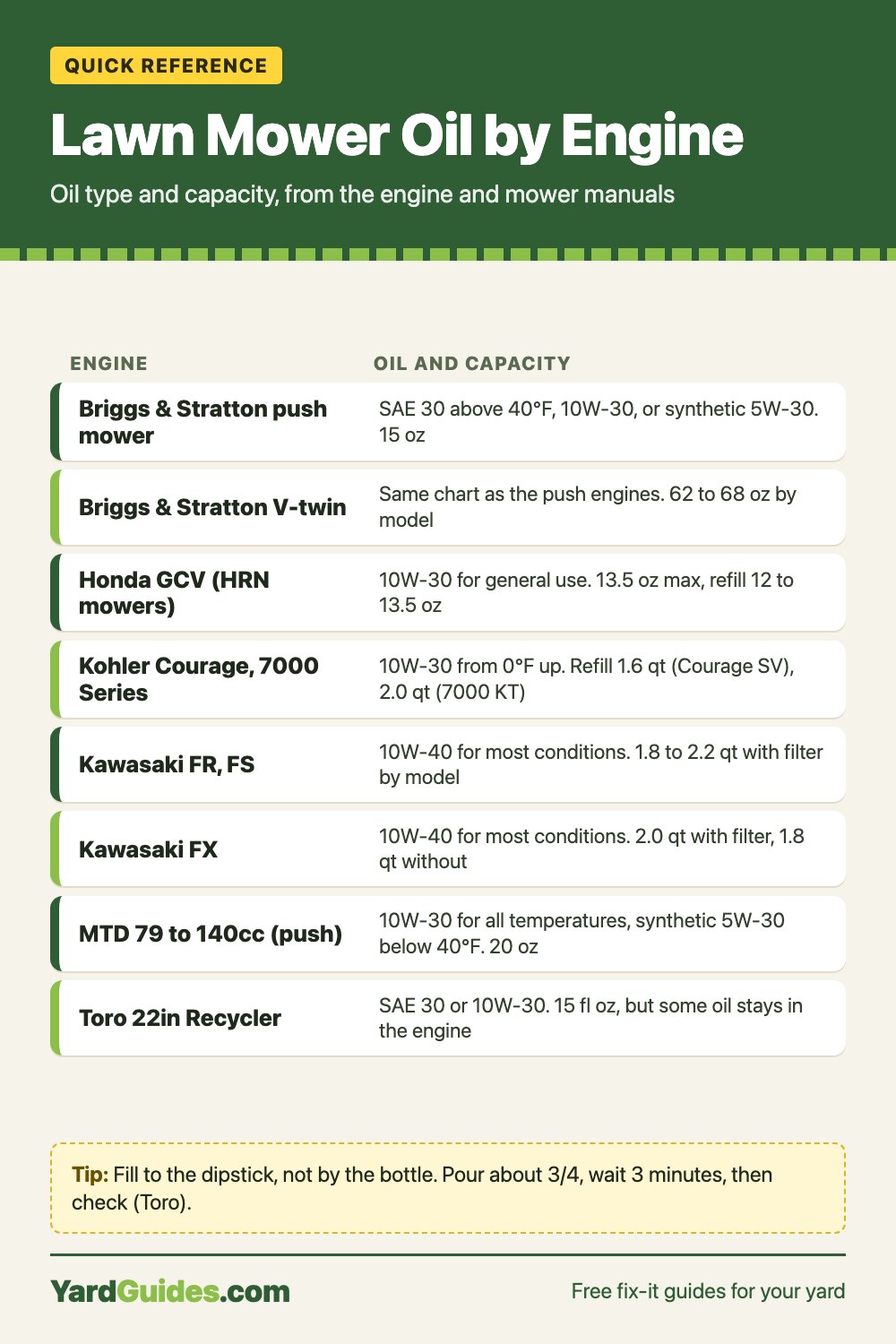
Quick answer: Most 4-cycle lawn mower engines take a detergent motor oil rated API SJ or newer: SAE 30 or 10W-30 in mowing weather, and 5W-30 (Briggs & Stratton recommends synthetic) when it’s cold. The grade belongs to the engine, not the mower brand, and makers disagree: Honda recommends 10W-30, Kohler’s chart starts SAE 30 at 50°F, and Kawasaki calls 10W-40 “the recommended oil for most conditions.” Push mower engines hold 13.5 to 20 oz. Most riding mower engines hold about 1.5 to 2.2 US quarts with the filter. Fill to the dipstick, not by the bottle. Change it after a 5-hour break-in if your manual lists one, then every 50 hours or yearly (Briggs, MTD, John Deere) or every 100 hours (Kohler, Kawasaki).
Jump to the table: Push mower engines ↓
YardGuides may earn a commission from links on this page, at no cost to you. As an Amazon Associate I earn from qualifying purchases. Learn more.
Every grade, capacity, filter number and interval below comes from the engine or mower maker’s own manual, linked with its page number. If a manual doesn’t print a number, we leave it out. Your engine’s decal and manual have the final say.
First, find your engine
The oil spec belongs to the engine. A Toro, Cub Cadet, Troy-Bilt, John Deere, Husqvarna or Craftsman mower can carry a Briggs & Stratton, Honda, Kohler, Kawasaki, MTD or Toro engine. Cub Cadet’s XT tractor manual doesn’t even list a capacity: it says to “refer to the engine operator’s manual for refilling instructions, oil type and amount” (Cub Cadet XT1/XT2 manual, p. 22).
Check the label on the engine, not the mower: the blower housing or valve cover shows the maker and usually the model number or displacement in cc. Then find that row below. Same engine on your snow blower? Winter grades differ, so see our snow blower oil guide.
Gas and oil mixed in the tank? If there’s no dipstick and the fuel cap says something like “50:1,” it’s a 2-cycle engine. The oil goes in the gas, and nothing on this page applies.
What oil does a lawn mower take? (by engine)
Push mower engines
| Engine (manual) | Oil the manual names | Temperatures in the manual | API class |
|---|---|---|---|
| Briggs & Stratton 080000, 090000, 093J00, 100000, 125 to 163cc (manual 80098074, p. 6) | SAE 30, 10W-30, 5W-30, synthetic 5W-30 or Vanguard synthetic 15W-50. “Engines on most outdoor power equipment operate well with 5W-30 Synthetic oil” | SAE 30: “Below 40 °F (4 °C) the use of SAE 30 will result in hard starting.” 10W-30: above 80°F it “may cause increased oil consumption.” Synthetic 5W-30 covers the chart from below -20°F to 100°F | SF, SG, SH, SJ or higher. No additives |
| Honda GCV170, GCV200 (engine manual, pp. 4, 10), as in the HRN216 (mower manual, p. 13) | “SAE 10W-30 is recommended for general use.” 4-stroke automotive detergent oil | Chart: 5W-30 and 10W-30 from about 40°F up, SAE 30 from about 50°F up | SJ or later |
| MTD 79cc, 132cc, 140cc, in Cub Cadet and Troy-Bilt push mowers (manual 769-25030, p. 5) | “SAE 10W-30 is recommended for general, all temperature use.” Synthetic 5W-30 for cold starts below 40°F | Single grades by the manual’s chart | SJ minimum. No non-detergent or 2-stroke oil |
| Toro 22in Recycler 21462, 21464 (manual 3441-821, p. 22) | SAE 30 or SAE 10W-30 detergent oil | No chart | SJ or higher |
Riding mower engines
| Engine (manual) | Oil the manual names | Temperatures in the manual | API class |
|---|---|---|---|
| Briggs & Stratton V-twin 400000, 440000, 490000 (manual 80107981, p. 6) | The same five oils as the push engines, same chart | SAE 30 means hard starting below 40°F. 10W-30 may raise consumption above 80°F | SF, SG, SH, SJ or higher |
| Kohler Courage SV470 to SV620 (20 590 06, p. 5) and 7000 Series KT610 to KT745 (32 590 31, p. 6) | 10W-30, SAE 30 or 5W-30. Synthetic detergent oil is acceptable | 10W-30 from 0°F up. SAE 30 from 50°F up. 5W-30 at 32°F and below | SJ or higher |
| Kohler Command PRO CV620 to CV750 (24 590 54, p. 5) | Kohler calls its PRO 10W-50 synthetic “the ideal oil for KOHLER engines.” 10W-30, SAE 30 and 5W-30 are also on the chart | 10W-50 across the whole chart. The others as in the row above | SJ or higher |
| Kawasaki FR651V to FR730V (99920-2289-03, p. 14), FS481V to FS730V (FS481V-FS600V, p. 16; FS651V-FS730V, p. 15), FX921V and FX1000V (99920-2299-03, p. 15) | “10W-40 engine oil is the recommended oil for most conditions.” The chart also lists 10W-30, SAE 30, SAE 40, 20W-50 and 5W-20 | 10W-40 from about 14°F up. 10W-30 from about 14°F to about 90°F. SAE 30 from about 50°F to 86°F. 20W-50 from 32°F up. 5W-20 below 32°F | SF, SG, SH, SJ or SL (FS481V to FS600V: SJ or SL) |
What the riding mower manuals say
Some mower makers print their own oil spec for the engine they install. Where it differs from the engine maker, we say so below the table.
| Mower (manual) | Oil the mower manual names | Temperatures in the manual | API class |
|---|---|---|---|
| John Deere S100 to S180, Briggs & Stratton engines (OMUC22642, pp. 29, 49) | 5W-30, 10W-30, 10W-40 or 15W-40. Tractors with the Easy Change 30-Second Oil Change System: 10W-30 | 5W-30 from about -22°F and 10W-30 from just below 0°F, both to 104°F. No straight SAE 30 on the chart | SJ or higher |
| Husqvarna YTH18542 (114 25 66-32, p. 4) | SAE 30 or SAE 5W-30 | SAE 30 above 32°F. 5W-30 below 32°F | SJ to SN |
| Husqvarna TS 248XD, Kawasaki FR engine (manual, p. 36) | Technical data: SAE 20W-50 or SAE 5W-20 (p. 36). Its oil chart (p. 27) also shows 10W-40, 10W-30, SAE 30 and SAE 40 | 20W-50 above 32°F. 5W-20 below 32°F (p. 36) | SJ to SN |
| Toro TimeCutter 5000 (3466-168, p. 32) | Detergent oil. Its chart runs from 5W-20 to SAE 40 | Read off the chart in the manual | SF, SG, SH, SJ or SL |
Temperatures marked “about” are read off a bar chart, so they’re approximate. We didn’t pull a manual for Honda’s GXV engines, so they have no row. Use the manual for your engine.
Where the makers disagree:
- When SAE 30 gets too thick. Briggs & Stratton says below 40°F. Kohler’s chart starts SAE 30 at 50°F, Honda’s at about 50°F, and Husqvarna’s YTH18542 manual at 32°F. John Deere’s chart for its Briggs-powered S-series doesn’t list straight SAE 30 at all.
- Kawasaki’s FR engine. Kawasaki recommends 10W-40 for most conditions. Husqvarna’s TS 248XD manual, for the same FR engine family, names 20W-50 above freezing in its technical data (p. 36), while its own oil chart (p. 27) repeats Kawasaki’s range. Both oils are on Kawasaki’s chart, which notes that 20W-50 “in higher ambient temperatures may reduce oil consumption.”
- Our take: if the engine manual and the mower manual name different oils, use one that appears on both. 10W-30 is on the Briggs, Honda, Kohler, Kawasaki, MTD, Toro and John Deere charts for normal mowing weather. The exception is Husqvarna’s YTH18542 manual, which lists SAE 30 or 5W-30 only. That’s our reading of the charts, not a maker’s instruction.
How much oil does a lawn mower take?
Push mowers
| Engine | Oil capacity (manual) | When to change (manual) |
|---|---|---|
| Honda GCV170, GCV200 (HRN216) | 13.5 oz (0.40 L). Refill amount 12.0 to 13.5 oz (0.35 to 0.40 L) (GCV manual, pp. 10, 13) | First month or 5 hours, then every 6 months or 50 hours. Every 25 hours under heavy load or in high heat (p. 9) |
| Briggs & Stratton 080000 to 100000 | 15 oz (0.44 L) (pp. 9 to 10) | First 5 hours, then every 50 hours or annually. Not required on models labeled Just Check & Add or No Oil Changes (p. 8) |
| Toro 22in Recycler 21462, 21464 | 0.44 L (15 fl oz), “Do not pour the entire capacity of oil into the crankcase” (p. 22) | Yearly. Toro: “Changing the engine oil is not required, but if you want to change the oil,” follow its steps |
| MTD 79cc, 132cc, 140cc | 600 ml / 20 oz (p. 5) | First 5 hours, then every season or 50 hours. Every 25 hours under heavy load or high temperatures (p. 9) |
Riding mowers
| Engine (manual) | Oil capacity | Oil filter part number (as printed) | When to change |
|---|---|---|---|
| Briggs & Stratton V-twin 400000, 440000 | 62 to 64 oz (1.8 to 1.9 L) (p. 10). The manual doesn’t split with and without filter | Standard black 492932S. High-efficiency yellow 696854 or orange 798576 (p. 10) | First 5 hours on engines without a filter. Then oil every 50 hours or annually (no filter or black filter), or every 100 hours or annually with a yellow or orange filter (pp. 7 to 8) |
| Briggs & Stratton V-twin 490000 | 66 to 68 oz (1.9 to 2.0 L) (p. 10) | Same as above | Same as above |
| Kohler Courage SV470 to SV620 | Refill 1.6 US qt (1.5 L) (p. 8) | Not printed in the owner’s manual | Oil and filter every 100 hours or annually (p. 5) |
| Kohler 7000 Series KT610 to KT745 | Refill 2.0 US qt (1.9 L) (p. 8) | Not printed in the owner’s manual | Oil and filter every 100 hours (p. 5) |
| Kohler Command PRO CV620 to CV750 | Refill 1.7 to 1.9 US qt (1.6 to 1.8 L) (p. 8) | Not printed in the owner’s manual | Oil every 100 hours or annually, filter every 200 hours. Both at 300 hours only with Kohler PRO 10W-50 and a Kohler PRO filter (p. 5) |
| Kawasaki FS481V, FS541V, FS600V | 1.5 L (1.6 US qt) without filter, 1.7 L (1.8 US qt) with (p. 14) | Not printed in the owner’s manual | Oil every 100 hours or 1 year (p. 29). Filter every 200 hours (p. 30) |
| Kawasaki FS651V, FS691V, FS730V | 1.8 L (1.9 US qt) without filter, 2.0 L (2.1 US qt) with (p. 13) | Not printed in the owner’s manual | Oil every 100 hours or 1 year (p. 27). Filter every 200 hours (p. 28) |
| Kawasaki FR651V, FR691V, FR730V | 1.8 L (1.9 US qt) without filter, 2.1 L (2.2 US qt) with (p. 12) | Not printed in the owner’s manual | Oil every 100 hours or 1 year (p. 26). Filter every 200 hours (p. 27) |
| Kawasaki FX921V, FX1000V | 1.7 L (1.8 US qt) without filter, 1.9 L (2.0 US qt) with (p. 13). See our FX1000V guide | Not printed in the owner’s manual | Oil every 100 hours or 1 year (p. 29). Filter every 200 hours (p. 30) |
| John Deere S100, S110 (Briggs single) | 1.4 L (1.5 qt) with filter (p. 49) | Not printed | Oil and filter yearly or every 50 hours (p. 28) |
| John Deere S140 | 1.9 L (2.0 qt) with filter (p. 49) | Not printed | Same as above |
| John Deere S120, S130, S160, S170, S180 with Easy Change | 2.6 L (2.8 qt) (p. 50) | Easy Change system | Same as above |
| Husqvarna YTH18542 | 48 oz (1.4 L) with filter, 44 oz (1.3 L) without (p. 4) | Not printed | Oil every 50 hours or at least once a year (p. 16). Filter every season, or every other oil change past 100 hours a year (p. 17) |
| Husqvarna TS 248XD (Kawasaki FR) | 70 oz (2.1 L) with filter, 61 oz (1.8 L) without (p. 36) | Not printed | Oil every 50 hours, at least once a year (p. 27) |
| Toro TimeCutter 5000 | 1.8 L (61 fl oz) without filter, 2.1 L (70 fl oz) with (p. 32) | Not printed | First 8 hours, then oil every 100 hours, filter every 200 hours (p. 29) |
| Cub Cadet XT1, XT2 (Kohler or Kawasaki engine) | See the engine manual (p. 22) | Kawasaki: KM-49065-7007. Kohler: KH-12-050-01-S (Cub Cadet part numbers, p. 32) | Break-in change after 5 hours, then oil and filter every 50 hours and before storage (p. 21) |
Treat capacity as a ceiling. Some oil stays in the engine when you drain it. Toro says not to pour in the whole capacity, and Honda says the actual refill “will vary due to residual oil in the engine. Always use the dipstick to confirm the actual level” (HRN216 manual, p. 18). Briggs says to “pour in a few ounces at a time to avoid overfilling” (Briggs oil FAQ).
Free printable: seasonal maintenance checklist for your mower & tractor
A 2-page spring-to-winter checklist for riding and push mowers and compact tractors. Then short, practical emails a couple of times a month. Unsubscribe anytime.
Two intervals that disagree. Kohler’s Courage and 7000 Series manuals say oil and filter every 100 hours, but Cub Cadet’s XT manual says every 50 hours on its Kohler and Kawasaki engines. Kawasaki says every 100 hours for the FR, and Husqvarna’s TS 248XD manual says every 50 hours for the same engine family. Our take: follow the shorter interval. Oil is cheap next to an engine.
SAE 30 vs 10W-30 vs 5W-30 (and can you use car oil?)
- SAE 30 is a single-grade, warm-weather oil. It’s fine for summer mowing in any engine whose chart lists it, but Briggs & Stratton says below 40°F “the use of SAE 30 will result in hard starting.”
- 10W-30 is a multigrade that flows more easily when cold. Honda recommends it “for general use,” MTD “for general, all temperature use,” and Kohler lists it from 0°F up. Briggs warns it “may cause increased oil consumption” above 80°F, so check the dipstick more often in summer.
- 5W-30 and synthetic 5W-30 are the cold-weather choices. Briggs says synthetic 5W-30 “Provides the best protection at all temperatures” (Briggs oil FAQ). Kohler and MTD list 5W-30 for cold weather only.
- 10W-40 is Kawasaki’s pick “for most conditions” on its riding mower engines.
Can you use car oil? Usually, yes, if it’s the right grade and API class for your engine. Honda’s GCV manual says “Use 4-stroke automotive detergent oil” (p. 10). MTD asks for oil “certified to meet or exceed U.S. automobile manufacturer’s requirements” for API SJ or higher (p. 5). Two cautions: Briggs says “Do not use special additives,” and MTD says “Do not use non-detergent oil or 2-stroke engine oil.”
Synthetic? Yes. Briggs recommends synthetic 5W-30, and Kohler accepts “high-quality detergent oils (including synthetic).” Synthetic doesn’t stretch the interval: Briggs says it “does not alter your required 50-hour oil change intervals.” The one exception in our manuals is Kohler’s 300-hour interval on Command PRO engines, and only with Kohler PRO 10W-50 oil and a Kohler PRO filter.
How to change lawn mower oil (push mower)
What you’ll need: the right oil, a drain pan, a funnel, rags and a sealable container for the old oil. A siphon pump (oil extractor) saves tipping: Honda says one “will save time and make the oil change easier.” Browse SAE 30 small engine oil, 10W-30 small engine oil, an oil drain pan or an oil extractor pump.
- Warm it up. Run the engine a few minutes. Toro says “Warm oil flows better and carries more contaminants,” and Briggs says to drain with the engine “off but warm.”
- Stop it and pull the plug wire. Disconnect the spark plug wire so it can’t start.
- Deal with the gas. If you’ll tip the mower, the tank should be empty. Briggs: “Operate the engine until the fuel tank is empty.” Toro says to run it dry or use a hand pump, and “never siphon the fuel.” On a Honda HRN, turn the fuel valve OFF. The fuel side is covered in our fuel stabilizer guide.
- Drain it the way your engine maker says. This is where makers differ, and tipping the wrong way puts oil in the air filter:
- Briggs & Stratton: drain from the top oil fill tube with the spark plug end up (80098074, p. 9).
- Toro Recycler: “tip the machine onto its side, with the dipstick down,” so the air filter is up (pp. 21 to 22).
- Honda HRN216: “tilt the mower on its right side” and let it drain through the filler neck (p. 13). Honda’s GCV engine manual says to tilt “with the muffler side down. Do not tilt with the carburetor side down” (p. 9).
- MTD: remove the drain plug (p. 10), and if you tip the mower, “keep spark plug side of engine up” (p. 9).
- Refill a little at a time. Toro’s method (our tip: it works on any engine): pour about 3/4 of the capacity, wait 3 minutes, then check. Briggs says to add oil slowly and wait one minute before you check.
- Read the dipstick the right way. Briggs and Toro Recycler: screw the dipstick in, then remove it and read. Honda GCV and MTD’s short dipstick: insert it but don’t screw it in. MTD’s extended dipstick: fasten it, then remove and read (p. 6). Fill to the full mark, never past it.
- Reconnect the plug wire, start it and recheck once it has run.
How to change oil and filter on a riding mower
- Warm the oil, then park on level ground. Kohler says to “Change oil while engine is warm,” and Kawasaki says to “Run the engine to warm oil” and make sure the engine is level. Exception: John Deere’s Easy Change system is changed with the engine cool. Toro has you park the TimeCutter with the drain side slightly lower.
- Engine off, key out, brake set, plug wires off.
- Drain it. Most riding mower engines have a drain plug, a drain valve or a drain hose. Kohler’s Command PRO drain valve takes a 1/2 in. I.D. hose to direct the oil. Cub Cadet’s XT tractors have a drain hose on the left side and call for a container of at least 2.5 quarts.
- Reinstall the plug to spec. Kohler: 125 in. lb. (14 N·m) on Courage, 10 ft. lb. (13.6 N·m) on 7000 and Command PRO. Kawasaki FS481V to FS600V: new O-ring, greased, 6.9 N·m (61 in·lb).
- Change the filter. Wipe the mount, coat the new filter’s gasket with clean oil, and spin it on by hand until the gasket touches. Then turn it the extra amount your manual gives:
| Engine or mower | Extra turn after the gasket touches |
|---|---|
| Briggs & Stratton V-twin | 1/2 to 3/4 turn (p. 9) |
| Kawasaki FR, FS | 3/4 turn by hand (FR p. 27, FS481V p. 30, FS651V p. 28) |
| Kawasaki FX | 2/3 turn by hand (p. 30) |
| John Deere S-series | One-half turn (p. 31) |
| Husqvarna TS 248XD | A half turn (p. 29) |
| Toro TimeCutter 5000 | 3/4 turn (p. 33) |
| Kohler | Kohler says to prefill the new filter with oil “until oil reaches bottom of threads,” wait 2 minutes, then follow the instructions on the filter |
- Refill below the full capacity. Toro says to pour about 80% of the oil first, then bring it up to the full mark.
- Run it and recheck. Kawasaki says to run about 3 minutes, check for leaks around the filter, then “Add oil to compensate for oil level drop due to oil filter capacity.”
Zero-turn? The engine oil change is the same as above. The transaxle or hydraulic oil is a separate job with its own fluid and interval in your mower manual. Our advice: check which fluid the mower manual names before topping up the hydraulic reservoir; it isn’t always engine oil.
How often should you change lawn mower oil?
- Break-in: Briggs, Honda, MTD and Cub Cadet call for a first change at 5 hours (Honda: first month or 5 hours). Toro’s TimeCutter says 8 hours. The Kohler and Kawasaki owner’s manuals and John Deere’s S-series manual list no separate break-in change.
- Push mowers: every 50 hours or once a season (Briggs, MTD). Honda says every 6 months or 50 hours, and every 25 hours under heavy load or in high heat.
- Riding mowers: every 50 hours or yearly (Briggs with a standard filter, John Deere, Husqvarna, Cub Cadet) or every 100 hours (Kohler, Kawasaki, Toro TimeCutter, Briggs with a high-efficiency filter).
- Check it every time. Briggs says every 8 hours or daily; Honda, MTD, John Deere and Toro’s TimeCutter say before each use, and Kawasaki says daily before starting.
Briggs says “a typical walk-behind lawn mower is used 20 to 25 hours per year” (80107981, p. 12), so for most push mowers that works out to once a year.
Spring or fall? Most makers say fall, before storage. Briggs: “While the engine is still warm, change the engine oil” in its storage steps, and Kohler, John Deere and Husqvarna also change it before storage. Kawasaki’s FR manual says the opposite: “Change engine oil for next use after period of storage” (p. 32). Our winterizing guide does it in the fall.
Why is my lawn mower smoking?
White or blue smoke means the engine is burning oil. Black smoke means it’s burning too much fuel.
| Smoke and when | Cause (maker) | What to do |
|---|---|---|
| White or blue, right after an oil change | Overfilled. MTD: overfilling “may cause smoking, hard starting, spark plug fouling, or oil saturation of air cleaner.” Kawasaki: “Excess oil will cause a smoking condition.” Honda: white or blue smoke is “An indication of overfilling” | Check the dipstick on level ground and drain down to the full mark |
| White or blue, after tipping the mower | Oil ran into the cylinder or air cleaner. MTD: tipping “spark plug down may cause smoking.” Briggs lists “Turning/tilting the engine on its side for storage, oil change or any other reason” | Set it level and run it. Briggs: “Smoking should clear after a few minutes of running on a flat surface.” Check the air filter |
| White or blue that keeps coming back | Wrong oil grade, running past a 15 degree angle, a blocked or crimped breather tube, a crankcase air leak, a blown head gasket, or worn cylinder or rings (Briggs smoke FAQ). Kohler: “Ring failure is usually indicated by excessive oil consumption and blue exhaust smoke” | Check the grade against the tables above and the breather tube. Rings and head gaskets are dealer work |
| Black | Running rich. John Deere: “Air filter is dirty or oil soaked. Choke partially engaged” (manual, p. 47). Kohler adds a choke partly closed during operation and carburetor settings (SV710-SV840 service manual, p. 25) | Open the choke fully and replace a dirty or oily air filter. If it persists, the carburetor needs work |
| A brief puff on the first start after storage | Oil put in the cylinder during storage prep. MTD: “the engine will smoke briefly at startup. This is normal” (p. 12) | Nothing. It should clear |
If your mower smokes and then won’t restart, work through our lawn mower won’t start guide.
Too much oil in the lawn mower (or oil in the air filter)
- Drain the excess before you run it. Toro: “If the oil level on the dipstick is too high, drain the excess oil until the oil level on the dipstick is correct.” Our tip: on a push mower without a drain plug, a siphon pump through the fill tube is easier than tipping it again.
- Check the air filter. Honda says an overfilled engine can push “excess oil … to the air cleaner housing and air filter,” and MTD lists “oil saturation of air cleaner.” John Deere ties an oil-soaked air filter to black smoke.
- Our take on the filter: replace an oil-soaked paper element. Kohler says a paper element “cannot be blown out with compressed air,” and Briggs says to replace a dirty paper filter. Foam elements are different: wash them, soak them in clean engine oil and squeeze out the excess (Briggs foam filters and Kohler precleaners; Briggs says not to oil the pre-cleaner on paper-filter models), so a little oil in foam is normal.
Lawn mower leaking oil
Owner-level checks, in order:
- Overfill. Honda says excess oil “may get transferred to the air cleaner housing and air filter” (HRN216 manual, p. 4). Our reading: it can also find its way out the breather and seals. Check the dipstick first.
- Drain plug. Snug, with its washer or O-ring. Kawasaki’s FS481V to FS600V manual has you replace the drain plug O-ring at each change.
- Oil filter. Our tip: make sure the old gasket came off with the filter, because it can stick to the engine and double up. Use a new filter with an oiled gasket, tighten it the amount in the table above, then run the engine and look for leaks, as Briggs, Kawasaki and John Deere all say to.
- Dipstick and fill tube. Seated and tight.
- Breather tube. Kohler says to “Ensure both ends of breather tube are properly connected.”
- Governor shaft seal on a Briggs V-twin. See our Briggs V-twin governor guide.
Crankshaft seals, valve cover gaskets and oil pan gaskets are dealer work on most mowers.
Dispose of the old oil
Put it in a sealed container and take it to a recycling center or an auto parts store that takes used oil. Honda: “Do not throw it in the trash, pour it on the ground, or pour it down a drain.” Briggs calls used oil “a hazardous waste product.” MTD warns that repeated, prolonged skin contact with used oil may cause skin cancer, so wash your hands with soap and water.
Model-specific troubleshooting: Kohler 7000 Series, Kohler CV742 and Kawasaki FX1000V.
Gas in the oil or a leaking carburetor? See lawn mower carburetor cleaning.
The rest of the schedule: plug, air filter, fuel filter and more by engine in our lawn mower maintenance guide.
FAQ
Can you use car oil in a lawn mower? Yes, if it’s the grade and API class your engine manual lists. Honda’s GCV manual specifies “4-stroke automotive detergent oil,” and MTD accepts oil that meets U.S. automaker requirements for API SJ or higher. Don’t use oil additives, non-detergent oil or 2-stroke oil.
Can I use 10W-30 instead of SAE 30? In most mower engines, yes. Briggs & Stratton, Kohler, MTD, Toro and Honda all list both. Briggs warns 10W-30 may burn a little more oil above 80°F, so check the level more often in hot weather.
Can you use synthetic oil in a lawn mower? Yes. Briggs recommends synthetic 5W-30 and Kohler accepts synthetic detergent oil. Synthetic doesn’t extend the change interval: Briggs still says every 50 hours.
How often should you change lawn mower oil? After the first 5 hours if your manual lists a break-in change, then every 50 hours or once a year for most push mowers. Riding mower engines run 50 to 100 hours depending on the maker. Most homeowners change it once a year.
How much oil does a riding lawn mower take? About 1.5 to 2.2 US quarts with the filter for most engines. John Deere’s S100 holds 1.4 L (1.5 qt), Kohler’s 7000 Series takes a 2.0 qt refill, and Kawasaki’s FR series 2.1 L (2.2 qt) with the filter. Always finish at the dipstick.
Should I change mower oil before or after winter? Before, according to Briggs, Kohler, John Deere and Husqvarna, at the end of the season. Briggs, Kohler and Husqvarna say to change it warm. Kawasaki’s FR manual says to change it after storage instead. See our lawn mower winterizing guide.
Can I use 2-cycle oil in a 4-cycle mower? No. MTD says “Do not use non-detergent oil or 2-stroke engine oil,” and Honda says 2-stroke oil “can damage the engine.”
Why is my lawn mower blowing white smoke? Usually too much oil or a mower tipped the wrong way. Check the dipstick on level ground and drain any excess. Briggs says smoke from tipping “should clear after a few minutes of running on a flat surface.” If it keeps coming back, suspect the breather, head gasket or rings.
Sources
- Briggs & Stratton, Operator’s Manual 80098074 Rev B, Models 080000, 090000, 093J00, 1000000 (oil recommendations and chart, p. 6; tilting and maintenance schedule, p. 8; oil change, pp. 8 to 9; specifications, pp. 9 to 10). Copy hosted by Toro
- Briggs & Stratton, Operator’s Manual 80107981 Rev A, 400000, 440000, 490000 (oil, p. 6; maintenance schedule, pp. 7 to 8; oil and filter change, pp. 8 to 9; specifications and service parts, p. 10)
- Briggs & Stratton, What type and how much oil for my lawn mower?
- Briggs & Stratton, Why is white / blue smoke coming from the engine?
- Honda, GCV170 / GCV200 Owner’s Manual 00X37Z9V0001 (oil chart, p. 4; maintenance schedule and tilting, p. 9; engine oil and oil change, p. 10; specifications, p. 13)
- Honda, HRN216 Owner’s Manual 00X31VR8B004 (overfilling, p. 4; oil change and recommendations, p. 13; specifications, p. 18)
- Kohler (Rehlko), Courage SV470-SV620 Owner’s Manual 20 590 06 (maintenance schedule and oil, p. 5; oil and filter change, p. 6; breather tube, p. 7; specifications, p. 8)
- Kohler, 7000 Series KT610-KT745 Owner’s Manual 32 590 31 (maintenance schedule, p. 5; oil and oil change, p. 6; specifications, p. 8)
- Kohler (Rehlko), Command PRO CH/CV620-CV750 Owner’s Manual 24 590 54 (maintenance schedule and oil, p. 5; oil change, pp. 5 to 6; specifications, p. 8)
- Kohler, SV710-SV840 Service Manual 32 690 01 (rich running, p. 25; ring failure, p. 65)
- Kawasaki, FR651V / FR691V / FR730V Owner’s Manual 99920-2289-03 (oil capacity, p. 12; engine oil, p. 14; overfilling, p. 15; maintenance chart, p. 24; oil change, p. 26; oil filter, p. 27; storage, p. 32)
- Kawasaki, FS481V / FS541V / FS600V Owner’s Manual 99920-2294-04 (oil capacity, p. 14; engine oil, p. 16; oil change, p. 29; oil filter, p. 30)
- Kawasaki, FS651V / FS691V / FS730V Owner’s Manual 99920-2290-03 (oil capacity, p. 13; engine oil, p. 15; oil change, p. 27; oil filter, p. 28)
- Kawasaki, FX921V / FX1000V Owner’s Manual 99920-2299-03 (oil capacity, p. 13; engine oil, p. 15; oil change, p. 29; oil filter, p. 30)
- MTD, 79cc, 132cc and 140cc OHV Vertical Shaft Engine Operator’s Manual 769-25030 (2020; oil, p. 5; tipping and maintenance schedule, p. 9; oil change, p. 10; storage, p. 12)
- Toro, 22in Recycler Operator’s Manual 3441-821 (maintenance and tipping, p. 21; engine oil, pp. 22 to 23)
- Toro, TimeCutter 5000 Operator’s Manual 3466-168 (maintenance schedule, p. 29; engine oil, pp. 32 to 33)
- John Deere, S100 to S180 Lawn Tractors Operator’s Manual OMUC22642 Issue H0 (service intervals, p. 28; engine oil, p. 29; oil and filter change, pp. 30 to 31; troubleshooting, p. 47; specifications and capacities, pp. 49 to 50). Retailer-hosted copy (Lowe’s)
- Husqvarna, YTH18542 Operator’s Manual 114 25 66-32 (specifications, p. 4; engine oil, pp. 16 to 17)
- Husqvarna, TS 248XD Operator’s Manual (2024; engine oil, p. 27; oil filter, p. 29; technical data, p. 36)
- Cub Cadet, XT1 and XT2 Enduro Series Operator’s Manual 769-10976 (2015; maintenance schedule, p. 21; oil change, p. 22; parts, p. 32)