
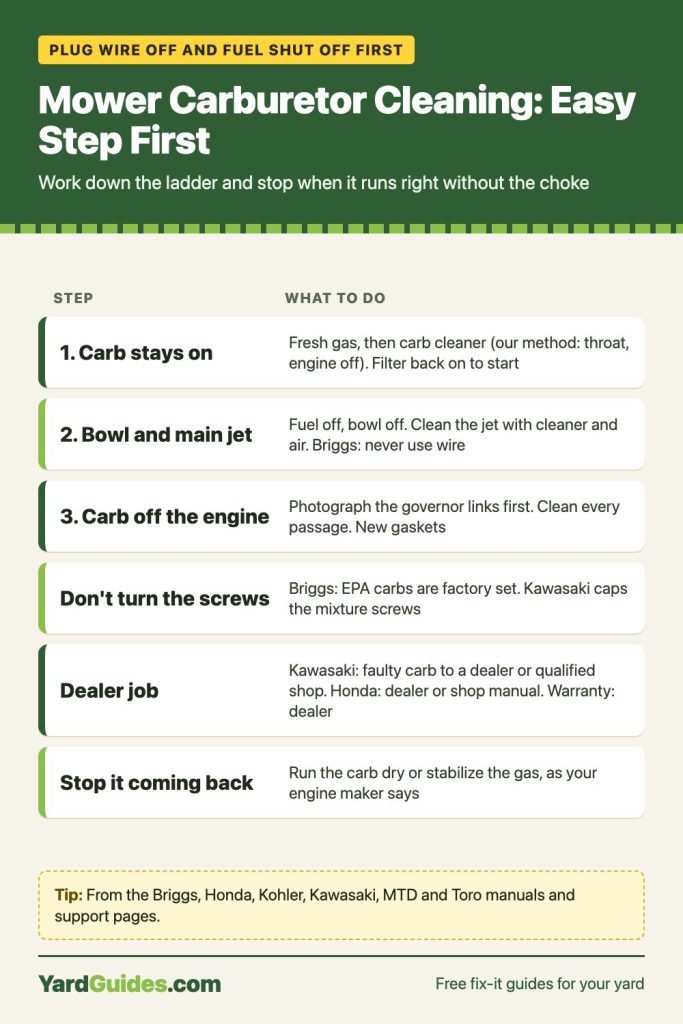
Quick answer: Start without removing anything: fresh gas, then carb cleaner sprayed into the carburetor throat with the engine off (our method). Still runs only on choke or surges? Shut off the fuel, pull the plug wire, take off the float bowl and clean the main jet (in the bowl nut on many Briggs & Stratton carbs) with carb cleaner and compressed air, never wire. Remove the whole carb only if that fails. Don’t turn the screws: Briggs says EPA carburetors “are not adjustable, they are factory set.”
Jump to the table: What each engine maker lets you do ↓
YardGuides may earn a commission from links on this page, at no cost to you. As an Amazon Associate I earn from qualifying purchases. Learn more.
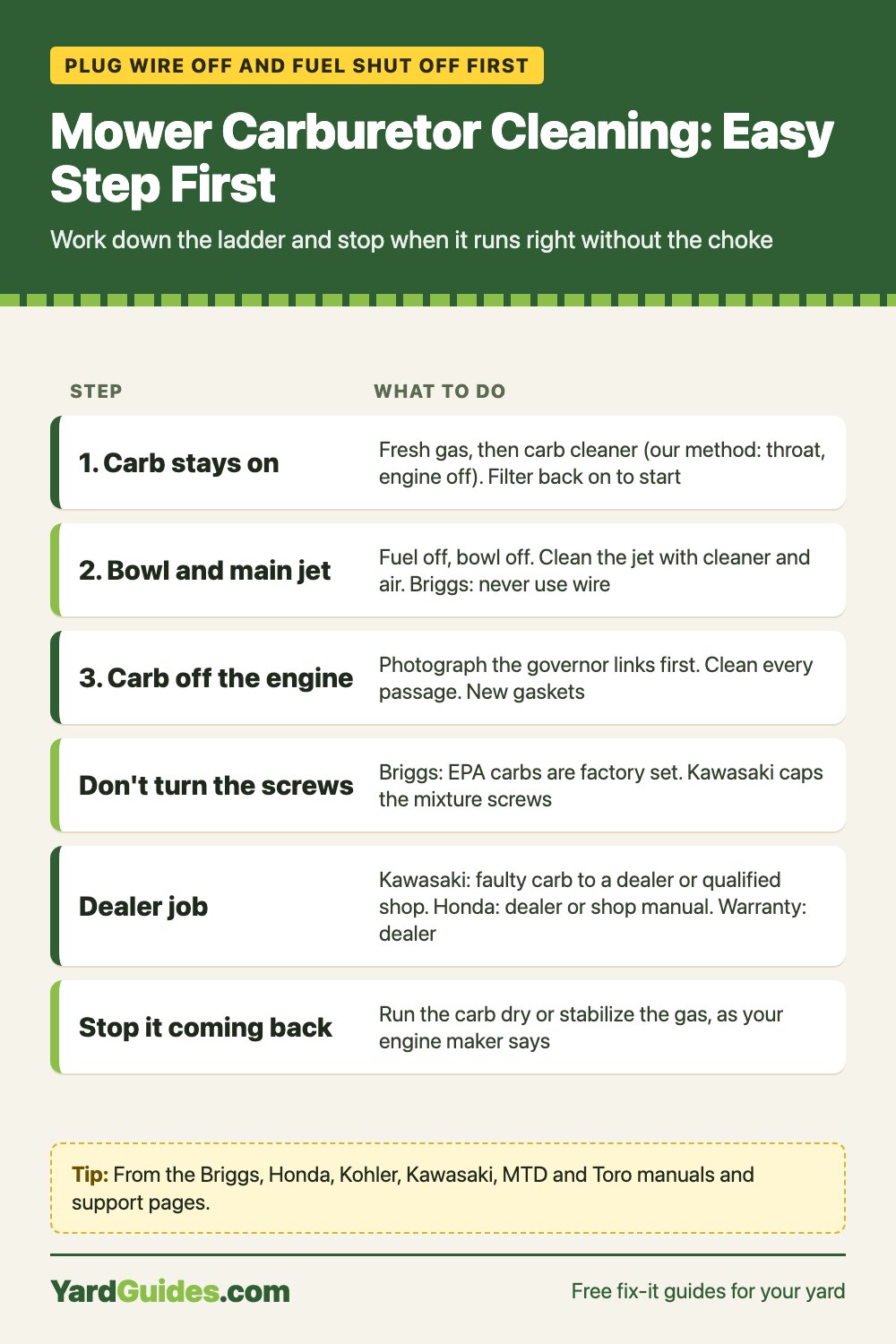
Every permission, dealer line, number and quote on this page comes from the engine maker’s own manual or support page, linked with the page number. Where we fill a gap with our own method or tip, we say so. Where the makers disagree, we show both. Where a manual says nothing, we say so instead of guessing. When something is our own reasoning, we label it.
Is it the carburetor? Rule these out first
Plenty of “carb problems” are something simpler. Before you reach for a wrench, check:
- Stale gas. Honda says gasoline can go bad “in as little as 30 days” (GCV manual, p. 15).
- A fuel valve that’s off or only partly open (Honda, Kawasaki and some Briggs engines).
- A blocked gas cap vent. MTD lists “Vent in gas cap plugged” under “Engine runs erratic” (p. 13).
- The choke left on. MTD lists running with the choke applied in the same row.
Our lawn mower won’t start guide walks through these by symptom. Start with its 5-minute checklist. If it fires and then quits, see starts, then dies. Smells of gas and won’t fire? That’s the flooded engine section. If it only runs with the choke on, you’re in the right place: that’s the classic partly clogged jet (our reading; no maker chart names that symptom).
Find your engine and carburetor type
The engine decides the procedure, not the mower brand. A Craftsman, Troy-Bilt, Husqvarna, Cub Cadet or Toro can carry a Briggs & Stratton, Honda, Kohler, Kawasaki or in-house engine. Read the label on the engine’s shroud or valve cover. Then note which kind of carburetor you have:
- Float-bowl carb with the main jet in the bowl nut. Briggs says the main fuel jet is “located in your carburetor’s fuel bowl nut” on its carbs, and that it’s easy to block (Briggs carburetor guide).
- Fixed-jet carb on a riding mower V-twin. Kohler’s 7000 Series (KT610 to KT745) uses a Keihin or Walbro “fixed main jet carburetor” with a removable main jet (Kohler service manual 32 690 03, pp. 33 and 35).
- A fuel shut-off solenoid on the bowl. Kohler: “Most carburetors utilize a fuel shut-off solenoid” (p. 33). Briggs says some of its carbs have an anti-afterfire solenoid “at the base of the fuel bowl” (Briggs rebuild FAQ).
- Primer or automatic choke. This changes how you start it after cleaning, not how you clean it. The starting steps by engine are in our first-start table.
Where is the carburetor on a lawn mower? Right behind the air filter. Briggs’ removal steps start by taking off the air cleaner assembly, and on Kohler 7000 riders the air cleaner base comes off to reach the carburetor (Kohler, p. 31).
Parts you’ll see (Kohler’s own labels for its one-barrel carbs, p. 33): idle speed screw, carburetor body, idle jet, main jet, float, shut-off solenoid, fuel bowl and choke lever. For an exploded diagram of your exact carb, look it up by engine model number in the maker’s parts lookup. We don’t redraw maker diagrams.
What each engine maker lets you do
Read across for your engine. “Not covered” means the owner’s manual doesn’t describe that job.
| Engine (manual) | What the owner may do | Where the maker draws the dealer line | Source |
|---|---|---|---|
| Briggs & Stratton push mower 080000 to 100000 | Drain untreated gas and “Operate the engine until it stops from lack of fuel.” Bowl and jet cleaning is not covered in the owner’s manual, but Briggs’ support pages show it (carb cleaner and compressed air) | “Do not make adjustments to the carburetor or engine speed.” Briggs recommends a dealer “for all maintenance and servicing” | 80098074, pp. 8 and 9 |
| Briggs & Stratton V-twin 400000, 440000, 490000 (riders) | Replace the fuel filter yearly with part 84001895, fuel valve closed or tank drained. Run it out of fuel for storage if the gas isn’t stabilized | Same carburetor rule: if adjustments are necessary, contact an authorized dealer | 80107981, pp. 8 to 10 |
| Honda GCV170, GCV200 (the HRN mower manual says dealer only for carb repair, p. 16) | Run the carburetor out of fuel if it will sit 3 to 4 weeks. Owner maintenance of emission parts is allowed with EPA-certified parts. Clean parts with a non-flammable solvent | “Carburetor malfunction”: take it to an authorized Honda dealer “or refer to the shop manual.” Fuel tank and filter cleaning and idle speed are dealer items unless you have the tools and are “mechanically proficient” | 00X37Z9V0001, pp. 8, 9 and 12 |
| MTD 79, 132, 140 cc (Cub Cadet, Troy-Bilt push mowers) | Run the tank empty before storage. Replace the in-tank fuel filter yearly or every 100 hours. Carb cleaning not covered | “Do not modify engine in any way.” If fuel goes bad in storage “you may need to have the carburetor … serviced or replaced” | 769-25030, pp. 3, 11 and 12 |
| Toro 22in Recycler and TimeCutter | Recycler: stabilizer on the last fill, then run it until it won’t restart. Carb cleaning not covered | TimeCutter: dirt, water or stale fuel in the fuel system means “Contact an Authorized Service Dealer” | 3441-821, p. 25; 3466-168, p. 50 |
| Kohler 7000 Series and Courage (riders) | “Normal maintenance, replacement or repair of emission control devices and systems may be performed by any repair establishment or individual.” Kohler’s service manual prints the full carb cleaning steps | Warranty repairs at a Kohler dealer. Anything needing “special timing or adjustment procedures” goes to a dealer | 7000: 32 590 31, pp. 5 and 8; Courage: 20 590 06, pp. 5 and 8 |
| Kawasaki FR651V, FR691V, FR730V (riders) | Stabilizer, run 5 minutes, drain the tank, then run at idle until it stalls. Maintenance of emission parts by “any nonroad engine repair establishment or individual” | “Faulty carburetor” goes to a dealer “or equally qualified service facility” in its chart. Carb adjustment by a dealer “or equally qualified service facility” | 99920-2289-03, pp. 22, 23, 32 and 34 |
Will cleaning the carb void my warranty? Not by itself, on the makers that address it. Honda “cannot deny coverage under the emission warranty solely for … service performed at a location other than an authorized Honda dealership” (GCV, p. 13). Kohler and Kawasaki say any individual may maintain emission parts. Two catches: free warranty work has to be done by the dealer (Briggs, p. 8; Kohler, p. 5), and Honda’s mower warranty doesn’t pay for “carburetor cleaning” anyway, because it’s normal maintenance (HRN216 manual, p. 21).
Safety before you start
- Plug wire off. Disconnect the spark plug wire and keep it away from the plug before any repair (Briggs, p. 8). On electric-start riders, also disconnect the negative battery cable (Briggs, p. 8; Kohler, p. 5).
- Fuel off. Turn off the fuel valve. “If your engine does not contain a fuel valve, use a fuel line clamp” (Briggs rebuild FAQ).
- Outdoors, cold engine, no sparks. Kohler: carburetor cleaners and solvents “are extremely flammable.” Use them “only in well ventilated areas away from ignition sources” (service manual, p. 2).
- Never clean with gasoline. Honda: “Use only a non-flammable solvent, not gasoline, to clean parts” (GCV, p. 9). Kohler says the same about gasoline.
- Carb cleaner on painted, rubber or plastic parts: none of these makers says it’s safe. Kohler says to follow the cleaner maker’s “warnings and instructions.” Read the can’s label before it touches paint, the float, O-rings or gaskets.
- Eye protection. Briggs has you wear safety glasses when spraying carb cleaner.
Step 1: Try the no-removal fixes
Briggs says you can fix many carburetor problems “often without even removing the carburetor from the engine” (Briggs clean FAQ). This covers how to clean a carburetor without removing it:
- Fresh gas. Drain the old fuel (see how to drain gas from a lawn mower) and refill. Briggs also suggests adding “system cleaners/stabilizers to the fuel.” Husqvarna disagrees: “Never use engine or carburetor cleaner products in the fuel tank or permanent damage may occur” (YTH18542 manual, p. 12). Follow your own manual.
- Check the air filter. Briggs’ first carb step is making sure the filter is in place, clean and “not soaked with oil.”
- Spray carb cleaner into the throat. Briggs only says the spray cans are “for periodic cleaning of both inside and outside the carburetor,” and that the choke and throttle linkages “can bind or stick when dirty.” Our method: with the engine off, take off the air filter and spray carburetor cleaner into the carb throat and onto those linkages. Follow the directions on the can.
- Put the filter back before you start it. Briggs: “Do not start and operate the engine with the air cleaner assembly … or the air filter … removed” (80098074, p. 9). Run it a few minutes outdoors.
If it now idles and runs smoothly with the choke off, stop here.
Step 2: Clean the bowl and main jet (carb stays on)
This is the fix for a mower that runs only on choke. A partly clogged main jet starves the engine of fuel, and the choke makes up the difference (our reading of why the symptom points here).
What you’ll need: carb cleaner, compressed air, a catch pan and rags, a wrench for the bowl nut or screws, a fuel line clamp if there’s no fuel valve, and a new bowl gasket bought by engine model number.
- Fuel off, plug wire off, catch pan under the carburetor.
- Remove the bowl. Briggs says it’s held by a bolt or screw. On Kohler carbs you take out the bowl screws or the solenoid assembly, though Kohler’s service manual does this with the carburetor removed (p. 35). Some fuel will spill.
- Look in the bowl. Briggs: inspect it for dirt and debris “to determine the condition of your carburetor.” Corrosion or breakage means replace it.
- Clean the main jet. On a Briggs bowl-nut carb, clean it “with carburetor cleaner and compressed air to blow out loosened debris” (carburetor guide). Our tip: hold it to the light. You want clean, round holes.
- Clean the bowl and blow out the passages you can reach in the carb body with air.
- Check the float. Kohler says to check the float hinge and shaft for wear or damage (service manual, p. 35). Our tip: it should swing freely on its pin.
- Reassemble with a good gasket. Kohler has you fit a new O-ring for the bowl. Torque Keihin bowl screws to 2.5 N·m (23 in. lb.) (p. 36). Briggs prints no bowl nut torque, so snug it without crushing the gasket.
- Fuel on, plug wire on, start it. Our tip: give the bowl a moment to fill first.
Never enlarge a jet. Briggs: “Never use wire because it can damage plugged openings. A wood toothpick can be used for cleaning jets” (Briggs rebuild FAQ). Kohler is stricter on the small slow (idle) jet: “Clean slow jet using compressed air. Do not use wire or carburetor cleaner” (service manual, p. 35). So no paper clips or drill bits. Briggs and Kohler say no wire; if your engine’s own service manual says otherwise, follow it. If a jet won’t clear, replace it.
Free printable: seasonal maintenance checklist for your mower & tractor
A 2-page spring-to-winter checklist for riding and push mowers and compact tractors. Then short, practical emails a couple of times a month. Unsubscribe anytime.
Step 3: Remove and clean the whole carburetor
If the bowl-and-jet clean didn’t fix it, the varnish is deeper in the body. Briggs calls rebuilding carburetors “routine servicing” that’s “still perfectly acceptable” on EPA engines. Its rebuild FAQ, in short:
- Plug wire off, air cleaner off, fuel off (or clamp the line).
- Disconnect any solenoid wire at the base of the bowl.
- Photograph the governor spring and linkage “before disconnecting them.” Then unbolt the carb, “taking special care not to bend or stretch links, springs or control levers.”
- Take it apart over a pan: bowl, float, hinge pin and inlet needle.
- Clean: Briggs soaks the metal and plastic carb parts in all-purpose parts cleaner for “no more than 15 minutes,” or sprays them with carb cleaner while wearing safety glasses. Replace anything “damaged or permanently clogged.”
- Reassemble with new gaskets, reconnect the linkage to match your photo, and check that “all linkage moves freely with no binding.”
Some carbs have “tamper-proof idle screws that only a certified dealer should be servicing,” Briggs warns. Leave those alone.
Riding mower carburetors
Most how-tos skip what a rider adds. From Kohler’s 7000 Series service manual and the Briggs V-twin manual:
- The air cleaner base comes off to reach the carb. Kohler first has you remove the fuel pump screws (if equipped) and raise or remove the blower housing. Then disconnect the ground lead “and fuel shut-off solenoid lead (if equipped),” remove the Smart-Choke or eChoke bracket, then the choke linkage (p. 31). Torque the base nuts back to 6.2 to 7.3 N·m (55 to 65 in. lb.). If the choke system acts up after, see Kohler Smart-Choke problems.
- The solenoid. Kohler’s pin retracts with 12 volts to let fuel reach the main jet. Its bench test: shut off the fuel, remove it (gas will leak out, so have a container ready), take it somewhere with good ventilation and no fuel vapors, connect 12 volts, and the pin “should retract with power ON and return to its original position with power OFF” (p. 34).
- The fuel pump. Some Kohler engines use a pulse pump driven by crankcase pressure (p. 32). Briggs says a dry fuel system needs extra cranking on choke: “This will give the fuel pump time to prime the fuel system” (80107981, p. 7).
- The fuel filter. Briggs V-twins: replace it yearly with an original filter (part 84001895) (pp. 8 to 10). Kohler 7000: every 100 hours (owner’s manual, p. 5).
- Clean, don’t adjust. Kohler’s steps clean the body, jets and vent ports with carburetor solvent and compressed air, then fit new gaskets (p. 36). The exception is the slow jet, which Kohler says to clean with compressed air only: “Do not use wire or carburetor cleaner” (p. 35).
Why is my lawn mower surging?
Surging (the engine revs up and down on its own) is usually fuel or air, not the governor (our reading of the charts below). Kohler’s service manual lists “governor hunting” as a sign of an engine running too lean or too rich (p. 34). Work down this table; the first rows need no tools.
| Cause | Check | Fix | Source |
|---|---|---|---|
| Choke left partly on | Is the choke fully off once warm? | Move it to OFF or RUN. Husqvarna lists the throttle in the CHOKE position under loss of power | MTD 769-25030, p. 13; Husqvarna YTH18542, p. 26 |
| Blocked gas cap vent | Does it run better with the cap loosened? (our test, not a maker’s) | MTD: “Clear vent.” Toro TimeCutter sends a blocked tank vent to a dealer | MTD, p. 13; Toro 3466-168, p. 50 |
| Fuel not reaching the carb | Fuel valve fully open, fuel filter clear | Kohler’s checklist: fuel shut-off valve, tank screen, in-line filter, fuel lines and fuel pump | Kohler service manual, p. 33; MTD, p. 13 |
| Water, dirt or stale fuel | Old gas, or water drops in the bowl | MTD: siphon the tank and refill with fresh fuel. Husqvarna: empty the tank and carburetor and replace the fuel filter | MTD, p. 13; Husqvarna, p. 26 |
| Dirty air filter or debris screen | Look at the filter | Clean or replace it. Kohler’s chart lists both under “Operates Erratically” | Kohler 32 590 31, p. 8 |
| Oil level wrong | Dipstick, on level ground | Toro and Husqvarna list low oil under lost power. See lawn mower oil | Toro 3466-168, p. 50; Husqvarna, p. 26 |
| Lean carb: dirty jet or passages | Surges on fresh fuel with the choke off | Kohler: “Clean main fuel jet and all passages; blow out with compressed air.” That’s Step 2 | Kohler service manual, p. 34 |
| Governor | Still hunts with a clean carb and good fuel | Don’t change the governor spring or linkages (Briggs, p. 8). See Briggs V-twin governor problems or Kawasaki governor problems | Briggs 80098074, p. 8 |
Can you adjust a lawn mower carburetor?
On most modern mower engines, no. That’s why “turn the screw” advice so often makes things worse.
| Maker | What the manual says about adjusting the carb | Source |
|---|---|---|
| Briggs & Stratton | “Do not make adjustments to the carburetor or engine speed.” EPA carbs “are not adjustable, they are factory set.” Older non-EPA carbs only: high-speed needle 1-1/2 turns open, idle valve 1-1/4 turns | 80098074 and 80107981, p. 8; Briggs carburetor guide |
| Honda GCV | Idle speed 1,700 ± 150 rpm, a yearly dealer check unless you’re mechanically proficient. High-altitude changes by a dealer above 2,000 ft | GCV, pp. 9, 12 and 13 |
| Kohler 7000 | “Main fuel jet is calibrated at factory and is not adjustable. Idle fuel adjusting needles are also set at factory and are not adjustable.” The service manual sets engine speed (idle and high-speed RPM) and, on Keihin carbs only, float height: “Correct float height adjustment is 12.0 mm (0.472 in.)” (p. 36) | Kohler service manual, p. 35 |
| Kawasaki FR | Each mixture screw has a cap or stop plate from the factory. Any adjustment by a dealer “or equally qualified service facility” | Kawasaki FR, p. 22 |
| MTD | “Do not modify engine in any way.” Never tamper with the governor setting | 769-25030, p. 3 |
Why it matters legally: Honda counts “removal or alteration of any part of the intake, fuel, or exhaust systems” and “altering or defeating the governor linkage” as tampering (GCV, p. 13). Kawasaki’s list starts with the “Carburetor or DFI system, and their internal parts” (p. 7). Kohler says tampering voids the EPA certificate (p. 8). Our reading: cleaning and rebuilding with the right parts isn’t tampering, but changing settings is. Briggs calls rebuilding carburetors “perfectly acceptable” on EPA engines, while telling owners not to adjust them.
Moving to or from the mountains? High-altitude jets are a legal change. Kawasaki lets “the consumer” install its high-altitude main jets above 3,300 ft (p. 6). Honda wants a dealer above 2,000 ft, and Kohler requires a kit at 4,000 ft and up (p. 5).
Lawn mower leaking gas from the carburetor
Don’t run it while it leaks. Close the fuel valve, move it outdoors, and find the drip.
| Where it leaks | Likely cause | Fix and source |
|---|---|---|
| Bottom of the bowl | Bowl gasket | Kohler: “Carburetor bowl gasket leaks. Replace gasket” (service manual, p. 34) |
| Out of the carb or air filter | Float stuck open, dirt under the inlet needle, or float set too high | Kohler: “Remove needle; clean needle and seat and blow with compressed air” (p. 34). Briggs blames gumming from stale fuel or tipping, and says to clean the carb thoroughly (Briggs fuel-in-oil FAQ) |
| Gas in the oil, oil level rising | The same stuck float, a fuel valve left open, or a bad fuel pump (Briggs FAQ) | Clean the carb, close the valve after use, and change the oil (our advice; Briggs’ FAQ doesn’t say so). See too much oil or oil in the air filter |
| Fuel line or fittings | Cracks or loose clamps | MTD: “Check fuel line, tank, cap, and fittings frequently for cracks or leaks. Replace if necessary” (p. 3) |
| After tipping it | Wrong side down | Tip it the way your manual says (next section) |
Tip it the right way. The makers don’t agree on which side goes up, so follow your own engine:
- Honda GCV: “tilt it 90 degrees with the muffler side down. Do not tilt with the carburetor side down” (p. 9). Honda HRN mowers: tip onto the right side, “fuel cap side is up” (p. 11).
- Briggs and MTD: spark plug side up, with the fuel tank empty first, because a full tank can leak and start a fire (Briggs, p. 8; MTD, p. 9). Toro also has you run the tank dry or hand-pump it out before tipping (p. 21).
- Toro Recycler: “Always tip the machine onto its side, with the dipstick down” (p. 21).
Clean, rebuild or replace?
| Choose | When | What to buy |
|---|---|---|
| Clean (Steps 1 to 3) | Varnish or gum from old fuel, no corrosion | Carb cleaner, compressed air, a bowl gasket |
| Rebuild kit | Gaskets hard or torn, inlet needle leaking, body sound. Briggs: a carb “gummed up beyond simple maintenance” may need a rebuild | A kit matched to your engine model and type number |
| Replace | Corrosion, breakage or passages that won’t clear. Briggs: “if corrosion or breakage is observed a replacement would be best” | A carburetor matched to the engine, not the mower |
Search for carburetor rebuild kits or replacement carburetors with your engine’s model and type numbers. Aftermarket carbs are common, but the makers warn about them: Briggs isn’t liable for emission-warranty failures “caused by the use of add-on or modified parts” (80098074, p. 11), and Honda says the maker of an aftermarket part must certify it won’t break emission rules (GCV, p. 13). Check that the mounting, linkage holes and fuel inlet match before you buy.
Keep it from happening again
Old fuel varnished the carb, so the fix is fall storage, and here the makers split:
- Run it dry: Briggs if the gas isn’t stabilized (p. 9), and Honda for a short layup (carb out of fuel if it will sit 3 to 4 weeks, GCV p. 8).
- Stabilize and run it through: Kohler (fuel treatment, run 2 to 3 minutes, p. 7).
- Both: Honda for 1 to 3 months (stabilize, run 10 minutes, then run the carb dry, GCV p. 15), MTD (pre-treat fuel kept over 30 days, then run the tank dry, p. 12), Kawasaki (stabilizer, run 5 minutes, drain, run until it stalls, p. 32) and the Toro Recycler (stabilizer, then run until it won’t restart, p. 25).
The full rules by maker are in does fuel stabilizer work?, and the whole fall routine is in how to winterize a lawn mower. Toro Recycler owners with a hard starter can also use our Recycler 22 guide. Riders that sit all winter also need the battery kept up: see the riding mower battery guide. Snow blower with the same engine? See snow blower carburetor cleaning.
Fuel filter and the rest of the schedule: see lawn mower maintenance.
FAQ
How do I clean a lawn mower carburetor without removing it? Start with fresh gas, then spray carb cleaner into the carburetor throat and onto the choke and throttle linkages with the engine off and the air filter removed. Put the filter back before starting. If it still runs only on choke, shut off the fuel, remove just the float bowl and clean the main jet with carb cleaner and compressed air. Briggs & Stratton says many carb problems can be fixed without removing the carburetor.
How often should I clean a lawn mower carburetor? Only when it shows symptoms, like running only on choke, surging or hard starting after storage. The Briggs, Honda, Kohler, Kawasaki, MTD and Toro Recycler maintenance schedules we checked don’t list carburetor cleaning as a timed job. Good storage habits (running it dry or stabilizing the gas, as your engine maker says) prevent most clogs.
Why is my lawn mower surging? Check the easy causes first: the choke left partly on, a blocked gas cap vent, a closed fuel valve or dirty fuel filter, stale or watery gas, and a dirty air filter. MTD lists several of these under “Engine runs erratic.” If it still surges on fresh fuel, Kohler’s service manual says a lean engine causes governor hunting and to clean the main fuel jet and passages.
Can I use WD-40 or brake cleaner on a carburetor? None of the engine makers we checked addresses either one. Briggs and Kohler call for carburetor cleaner or carburetor solvent, and Honda says to clean parts with a non-flammable solvent, never gasoline. Use a product made for carburetors and follow its label.
Why is there gas in my lawn mower oil? Usually a float stuck open, a fuel valve left open, or a bad fuel pump. Briggs & Stratton lists all three and says to clean the carburetor thoroughly if it’s the float. We’d also change the oil afterward (our advice, not Briggs’), and close the fuel valve whenever the mower is parked.
Will cleaning the carburetor void my warranty? Not on its own. Honda says it cannot deny emission warranty coverage just because service was done somewhere other than a Honda dealer, and Kohler and Kawasaki say any individual may maintain emission parts. Free warranty repairs still have to go through the dealer, and Honda’s mower warranty doesn’t pay for carburetor cleaning.
How do I clean a Tecumseh carburetor? We don’t cover Tecumseh engines here, because we couldn’t find a current maker’s manual to cite. Use the service manual for your engine’s model number. The general rules on this page still apply: fuel off, plug wire off, no wire in the jets.
Sources
- Briggs & Stratton, Operator’s Manual 80098074 Rev B (080000, 090000, 093J00, 100000): fuel and high altitude p. 6; maintenance, emissions service and carburetor adjustment p. 8; air filter and storage p. 9; emission warranty p. 11. Copy hosted by Toro
- Briggs & Stratton, Operator’s Manual 80107981 Rev A (400000, 440000, 490000 V-twin): fuel pump priming and maintenance p. 7; carburetor adjustment and schedule p. 8; fuel filter and storage p. 9; part numbers p. 10
- Briggs & Stratton, Carburetor repair, maintenance and adjustment guide (updated January 13, 2026)
- Briggs & Stratton, How to clean a small engine carburetor (updated January 15, 2026)
- Briggs & Stratton, How do you rebuild or overhaul a small engine carburetor? (updated April 6, 2026)
- Briggs & Stratton, Why is fuel mixing with engine oil in the crankcase? (updated January 13, 2026)
- Honda, GCV170 / GCV200 Owner’s Manual 00X37Z9V0001: running the carburetor dry p. 8; maintenance safety, schedule and tilting p. 9; high altitude and troubleshooting p. 12; tampering, emission warranty and idle speed p. 13; fuel problems p. 15
- Honda, HRN216 Lawn Mower Owner’s Manual 00X31VR8B004: tipping p. 11; troubleshooting p. 16; warranty exclusions p. 21
- MTD, 79cc, 132cc and 140cc Engine Operator’s Manual 769-25030: do not modify and fuel line checks p. 3; tipping p. 9; fuel filter p. 11; storage p. 12; troubleshooting p. 13
- Toro, 22in Recycler Operator’s Manual 3441-821: tipping p. 21; storage p. 25
- Toro, TimeCutter 5000 Operator’s Manual 3466-168: troubleshooting p. 50
- Husqvarna, YTH18542 Operator’s Manual 114 25 66-32: troubleshooting p. 26
- Kohler, 7000 Series KT610-KT745 Owner’s Manual 32 590 31: governor, high altitude, emission maintenance and schedule p. 5; storage p. 7; troubleshooting and tampering p. 8
- Kohler, Courage SV470-SV620 Owner’s Manual 20 590 06: emission maintenance p. 5; troubleshooting p. 8
- Kohler, 7000 Series Service Manual 32 690 03 Rev N: solvent safety p. 2; air cleaner base p. 31; fuel pump p. 32; carburetor types and checklist p. 33; carburetor troubleshooting and solenoid test p. 34; adjustments and servicing p. 35; cleaning and reassembly p. 36
- Kawasaki, FR651V / FR691V / FR730V Owner’s Manual 99920-2289-03: high altitude p. 6; tampering p. 7; engine speed adjustment p. 22; maintenance p. 23; storage p. 32; troubleshooting p. 34
More mower fixes: lawn mower won’t start · lawn mower oil · riding mower battery · Kohler Smart-Choke problems