
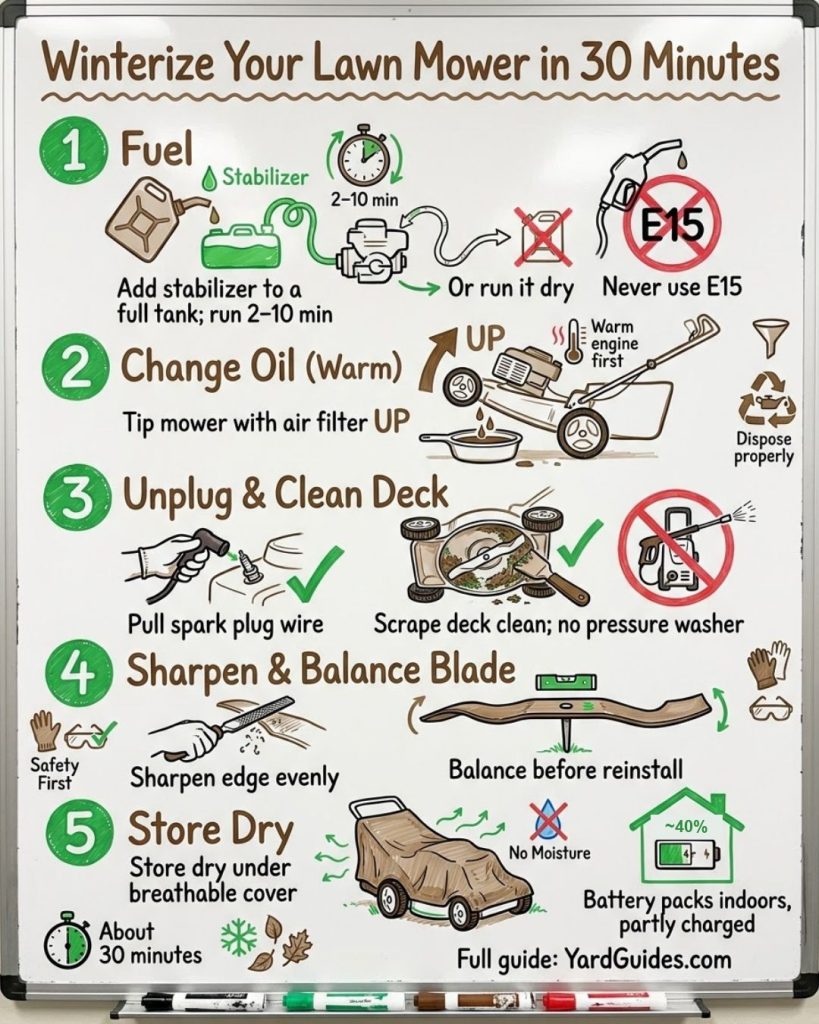
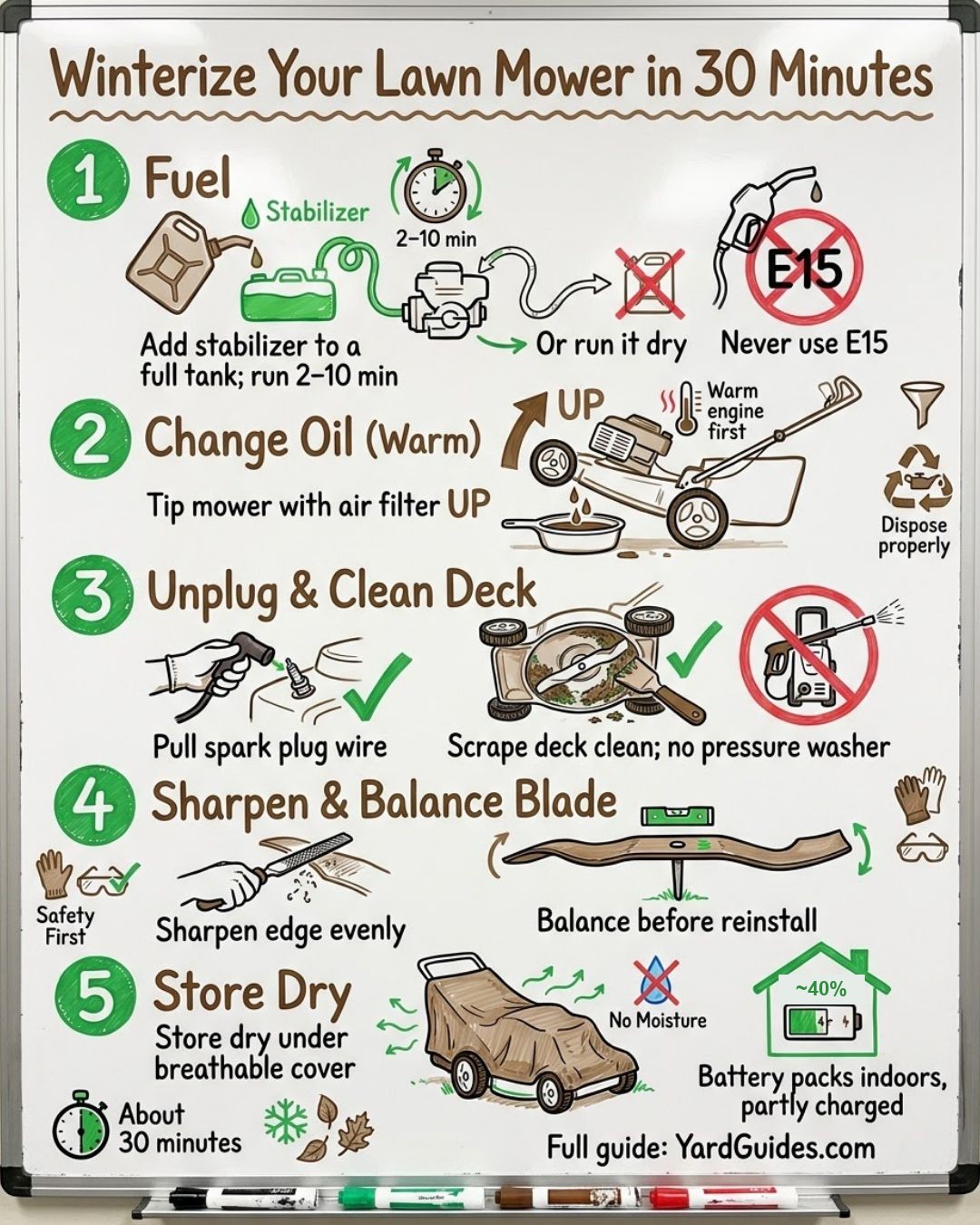
Quick answer: To winterize a gas lawn mower, (1) add fuel stabilizer to a full tank and run the engine a few minutes, or run the tank dry, (2) change the oil while it’s warm, (3) disconnect the spark plug and clean under the deck, (4) sharpen or replace the blade, and (5) store it somewhere dry. For battery mowers, take the battery inside and store it partly charged. The whole job takes about 30 minutes. It’s the single best way to avoid the classic “won’t start in spring” problem.
YardGuides may earn a commission from links on this page, at no cost to you.
Prefer video? Here’s the 40-second version:
Why winterizing matters
Most spring no-starts trace back to fuel that sat all winter. Modern gas is usually E10 (10% ethanol). Over a few months it oxidizes and absorbs moisture, leaving varnish and gum that clog the tiny jets in a small-engine carburetor. A few minutes in November beats a carburetor rebuild in April. (If you’re already there, see our guide to a Toro Recycler 22 that won’t start.)
What you’ll need
- Fuel stabilizer (STA-BIL, Star Tron, or similar)
- Correct engine oil for your mower (usually SAE 30 or 10W-30; check the manual), plus a drain pan
- Spark plug socket and a new plug if yours is worn
- Putty knife or deck scraper, stiff brush
- Blade wrench or socket, a blade balancer, and a file (or a replacement blade)
- For riding mowers: a battery maintainer (trickle charger)
Step 1: Deal with the fuel (the most important step)
There are two accepted approaches. Your engine manual will say which the manufacturer prefers.
Option A: Stabilize (Briggs & Stratton’s recommendation). Add stabilizer to fresh gas at the rate on the bottle, fill the tank, then run the engine a few minutes so treated fuel reaches the carburetor. Briggs’ guidance ranges from about 2 to 10 minutes. A full tank leaves less room for moisture to condense. Briggs says that if you stabilize the fuel, you don’t need to drain it.
Option B: Run it dry. Run the mower until it stalls from lack of fuel, then try to restart it once or twice to burn off the last of it. Some owners also drain the carburetor bowl via its drain screw or bowl nut. Many repair shops prefer this for storage longer than about 90 days. If you didn’t treat the fuel, empty it. Don’t leave untreated gas in the tank all winter.
Either way, don’t put E15 or higher in a small engine. EPA prohibits E15 in lawn mowers and other small off-road engines. That’s why pumps that share a hose for E10 and E15 carry warning labels. Use E10 or less, or ethanol-free fuel if you can get it.
Step 2: Change the oil while it’s warm
Used oil contains acids and combustion byproducts that sit on engine parts all winter. Change it now, not in spring. Warm oil drains faster, so do this right after Step 1.
- Disconnect the spark plug wire.
- Drain through the drain plug, or tip the mower with the air filter and carburetor facing up so oil and gas don’t soak the filter.
- Refill to the full mark on the dipstick. Don’t overfill.
Take the old oil to an auto-parts store or recycling center.
Step 3: Disconnect the plug and clean the deck
With the spark plug wire still off, scrape caked clippings from under the deck. Wet clippings hold moisture against the steel and rust it from the inside. Brush off the engine cooling fins and around the muffler too.
Skip the pressure washer. High-pressure water can push into bearings and seals. A scraper, brush, and garden hose are enough.
Step 4: Sharpen (or replace) the blade
Pull the blade now so you’re ready for the first spring cut. Sharpen to the original angle, then check balance on a blade balancer or a nail. An unbalanced blade shakes the engine and wears the crankshaft seal. When you reinstall it, make sure it’s right-side up; see correct lawn mower blade position.
Step 5: Spark plug and air filter
Pull the plug and inspect it. If it’s fouled, cracked, or the electrode is rounded, replace it. They’re cheap. Tap out or replace a paper air filter, and wash foam pre-filters in soapy water and let them dry fully.
Step 6: Store it right
- Pick a dry, covered spot like a garage or shed, away from furnaces and water heaters (fuel vapors plus pilot lights don’t mix).
- Use a breathable cover, not a plastic tarp that traps moisture.
- Lower the deck to its lowest setting to take tension off the springs (on mowers that allow it).
Winterizing a battery (cordless) mower
Battery mowers are easier, but the battery needs care:
- Remove the battery and store it indoors, at room temperature and above freezing.
- Store lithium-ion packs partly charged, around 30–50%, not full and not empty. Ryobi recommends that range for storage over 30 days, and Consumer Reports suggests about 40%. Check your brand’s manual for its exact recommendation.
- Clean the deck and sharpen the blade just like a gas mower.
- Top off the charge once mid-winter if your manual suggests it.
Winterizing a riding mower or lawn tractor
Do everything above, plus:
- Battery: connect a battery maintainer, or remove the battery and store it somewhere cool and dry. A lead-acid battery left discharged in freezing temperatures can freeze and crack.
- Tires: inflate to spec. Flat spots are less likely on properly inflated tires.
- Grease fittings: lube the spindles and front axle per the manual.
- Belts: inspect the deck belt for cracks or glazing. See our John Deere 54-inch deck belt diagram if you’re replacing one.
Common mistakes
- Running the engine on stabilizer for 10 seconds. Give it a few minutes so treated fuel actually reaches the carb.
- Tipping the mower carburetor-side down. Oil floods the air filter and you’ll get white smoke in spring.
- Storing it with a wet, clipping-caked deck. That’s how decks rust through.
- Leaving the battery in a freezing shed. This goes for both lithium packs and lead-acid tractor batteries.
FAQ
Is it better to drain the gas or use stabilizer?
Both work. Stabilizer is easier and keeps seals from drying out. Running dry is best if the mower will sit longer than a season. Follow your engine manufacturer’s recommendation.
How long does gas last in a lawn mower?
Untreated gas can start to degrade in as little as 30 days. Stabilizer extends that to many months or more. Briggs & Stratton rates its own stabilizer for up to 2–3 years depending on the product. Check the label of the one you use.
Do I need to winterize a mower stored in a heated garage?
Yes. The fuel problem is about time, not cold.
Should I change the oil in fall or spring?
Fall. You don’t want acidic used oil sitting on internal parts all winter.
When should I do this?
After your last mow of the season, usually October to November in most of the U.S.
Related guides
- Snow blower won’t start? Start here
- Briggs & Stratton V-twin governor problems
- Worst zero-turn mowers to avoid
- Are Hustler mowers good?
Sources
- Briggs & Stratton: Storing your mower & outdoor power equipment
- Briggs & Stratton: The importance of fuel stabilizer
- Jack’s Small Engines: Lawn mower storage mistakes
- SlashGear: Ryobi battery storage guidance
- Fox News / Consumer Reports: electric mower winter battery care
- OPEI/NMMA comments on E15 (EPA prohibition in small off-road engines)
- Farmers’ Almanac: How to winterize a lawn mower and outdoor power equipment
- Utah State University Extension: November yard and garden tips