
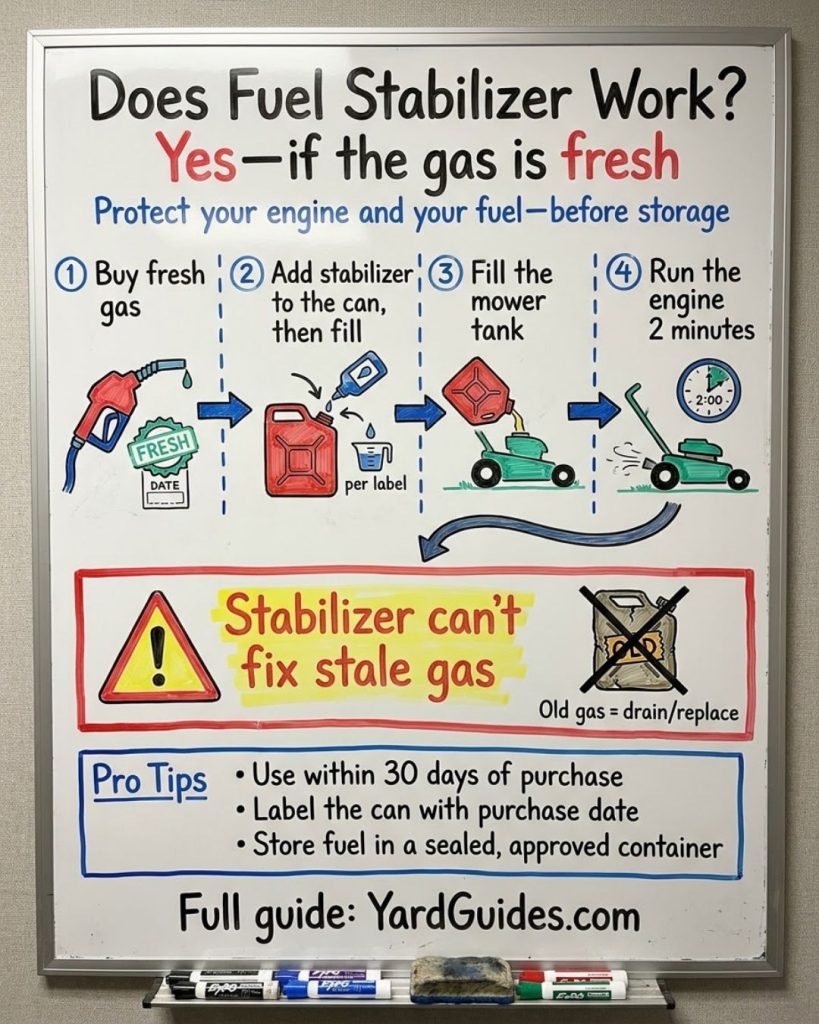
Quick answer: Yes, fuel stabilizer works, as long as you add it to fresh gas and then run the engine for a couple of minutes so treated fuel reaches the carburetor. Briggs & Stratton says untreated gas can start to deteriorate in as little as 30 days, and that stabilized fuel can be stored for up to 24 months. Stabilizer can’t fix gas that has already gone stale, though. Honda is more cautious than Briggs: for storage longer than 90 days, it says to run the mower until the fuel system is empty. Follow the manual for your engine.
YardGuides may earn a commission from links on this page, at no cost to you.
How long does gas last in a lawn mower?
There’s no single expiration date, but the engine makers give clear guidance:
- Briggs & Stratton: fuel “can begin to deteriorate in as little as 30 days,” so buy only as much gas as you’ll use within about 30 days. (Briggs fuel FAQ)
- Honda: if a can of gas will take more than 3 months to use, add stabilizer when you fill it. Don’t leave gas in the mower for more than 90 days of inactivity. (Honda fuel recommendations)
Gas goes bad because its lighter, more volatile parts evaporate and the rest oxidizes into gum and varnish. Ethanol blends also absorb moisture. A small engine’s carburetor has tiny passages, so it’s the first thing to clog. That’s why a mower that ran fine in October won’t start in April.
What fuel stabilizer actually does
Stabilizer slows the oxidation that turns gas into varnish. It protects fuel that’s still good. It doesn’t make old fuel good again: Honda says plainly that “fuel stabilizers will not reconstitute stale fuel.”
According to Briggs & Stratton, treating fresh fuel and running the engine briefly means you don’t have to drain the fuel before storage. Their own stabilizer page says treated fuel stays fresh for up to 24 months (the same page also claims up to 3 years for their product). Treat those numbers as the manufacturer’s upper limits, not a promise. Heat, a half-empty tank, and an old can all shorten them. (Briggs: The importance of fuel stabilizer)
How to use fuel stabilizer the right way
- Start with fresh gas. Buy it the day you treat it. Stabilizer in 3-month-old gas just preserves stale gas.
- Add stabilizer to the gas can, then fill. Briggs recommends adding it to the can before you fill it with fresh fuel, which mixes it well. Follow the ratio on the bottle.
- Fill the mower’s tank with the treated fuel.
- Run the engine for about 2 minutes. Briggs says 2 minutes circulates stabilizer through the fuel system. This step is the one people skip, and it’s the one that protects the carburetor.
- Store it somewhere clean and dry. Follow the rest of our lawn mower winterizing checklist (oil, blade, air filter, spark plug).
Pro tip: Treat every can of gas you buy from fall onward, not just the last tank. Then whatever is left in the can at the end of the season is already protected.
Two more habits that help: write the purchase date on the gas can so you know how old it is, and store fuel only in a sealed, approved fuel container.
Stabilize or drain? Which advice to follow
Engine makers don’t fully agree, so here’s how to decide:
| Your situation | What to do |
|---|---|
| Briggs & Stratton engine, storing for winter | Stabilize fresh fuel and run the engine 2 minutes (Briggs says this lets you skip draining). |
| Honda engine, stored 30–90 days | Add stabilizer per Honda’s instructions. |
| Honda engine, stored more than 90 days | Run the engine until the fuel system is empty, per Honda. |
| Gas is already old (several months, untreated) | Don’t stabilize it. Drain it into an approved container and dispose of it properly. |
| Unsure which engine you have | Check the label on the engine shroud and follow that manual. |
Many mowers use Briggs, Honda, Kohler or Kawasaki engines, so the engine brand matters more than the mower brand.
Does ethanol make it worse?
Yes. Ethanol blends absorb water, and higher blends cause more trouble. Honda says not to use gas with more than 10% ethanol (E10). Briggs says E15 is “not recommended or approved for use in small engines.” E15 is in fact not approved by the EPA for small off-road engines like mowers (OPEI/NMMA comments to EPA). Briggs notes that some stations now sell gas with up to 15% ethanol, so check the pump label before you fill up.
If your mower sits a lot, ethanol-free gas or a canned pre-mixed engine fuel is worth considering. Briggs notes that its canned fuel combines ethanol-free gasoline with a stabilizer. It costs more per gallon, but for a mower that uses only a few gallons a year, many owners think it’s worth it.
Shop ethanol-free small engine fuel
Signs your gas has already gone bad
- The mower won’t start or starts and dies, especially after sitting.
- It surges (revs up and down) at full throttle.
- The gas often looks darker than fresh fuel, or smells sour and varnishy.
- You find gummy residue in the carburetor bowl.
If that sounds familiar, stabilizer won’t help. Drain the old fuel, refill with fresh treated fuel, and if it still won’t run, the carburetor probably needs cleaning. For model-specific help, see our guides to a Toro Recycler 22 that won’t start and Kohler 7000 Smart Choke problems.
FAQ
Does fuel stabilizer really work?
Yes, for slowing down the breakdown of fresh fuel. Engine makers including Briggs & Stratton and Honda recommend it. It does not restore gas that has already gone stale.
How long does gas last in a lawn mower without stabilizer?
Briggs says gas can start to deteriorate in as little as 30 days. Honda recommends stabilizer for any gas you won’t use within about 3 months.
How long does gas last with stabilizer?
Briggs says stabilized fuel can be stored for up to 24 months. Honda says not to leave gas in a mower for more than 90 days of inactivity, even with stabilizer. For long storage it says to run the fuel system dry.
Can I add stabilizer to old gas?
It won’t hurt, but it won’t help either. Stabilizer only protects fuel that’s still fresh.
Do I still need stabilizer with ethanol-free gas?
It’s still a good idea for long storage. All gasoline oxidizes over time. Ethanol-free gas just avoids the water-absorption problem.
Looking for gifts for the mower person in your life? A bottle of stabilizer makes a good stocking stuffer. See our gifts for lawn mower and tractor owners.