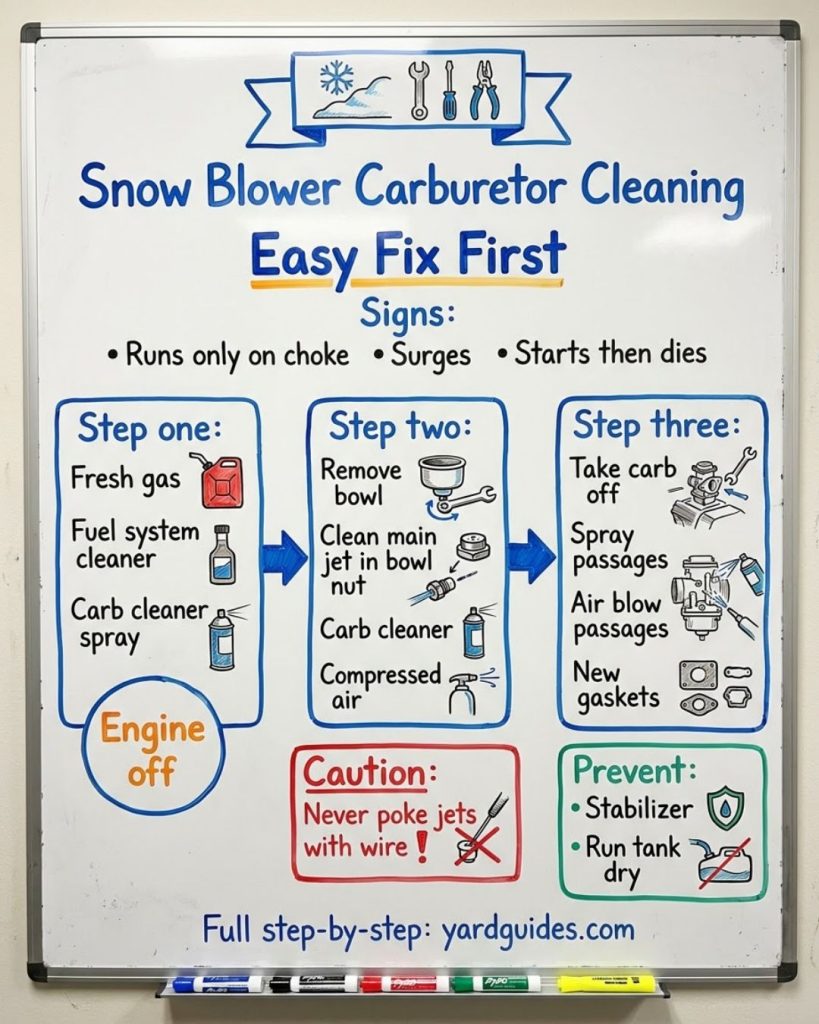
Quick answer: If your snow blower only runs with the choke on, surges, or starts and then dies, old fuel has probably left varnish in the carburetor. Start with the easy fixes: fresh gas, a fuel-system cleaner, and carb cleaner sprayed into the intake. If that doesn’t work, shut off the fuel, take off the float bowl, and clean the main jet (on many small engines it’s inside the bowl nut) with carb cleaner and compressed air. Only take the whole carburetor off, or replace it, if the bowl-and-jet cleaning doesn’t fix it.
YardGuides may earn a commission from links on this page, at no cost to you.
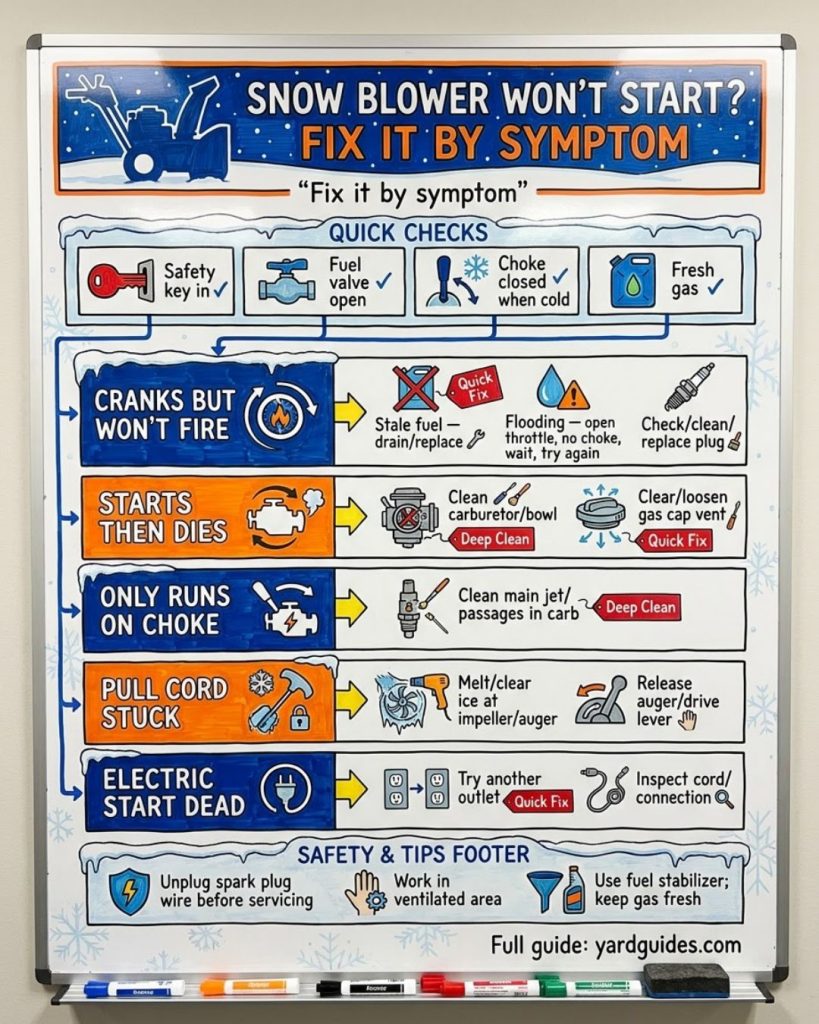
Rule these out first. A blocked gas cap vent, stale gas in the tank, a fouled spark plug, or a closed fuel valve can all look like a carb problem. Our snow blower won’t start guide walks through them by symptom. It’s 5 minutes well spent before you pick up a screwdriver.
Signs your carburetor needs cleaning
- It only runs with the choke on. The choke enriches the mixture, which makes up for a partly clogged main jet.
- It surges or “hunts” (revs up and down by itself).
- It starts, then dies after a few seconds once the bowl runs dry.
- It won’t start after summer storage, even with fresh gas and a good spark.
- Fuel drips from the carburetor, often a stuck float or needle.
Why it happens: Briggs & Stratton says most carburetor problems come from blockages “from things like dirt, varnish, and gasoline deposits” (Briggs & Stratton). Honda notes that the small amount of fuel in the carburetor goes bad faster than the fuel in the tank (Honda Power Equipment). That’s why the carb clogs first.
Step 1: Try the no-removal fixes
Briggs & Stratton says many carburetor problems can be handled “often without even removing the carburetor from the engine” (Briggs & Stratton). Try these in order:
- Fresh fuel. Drain the old gas and refill with fresh gasoline, no more than 10% ethanol. Honda’s limit for its snow blowers is 10% ethanol (Honda).
- Add a fuel-system cleaner to the fresh tank. Briggs suggests adding system cleaners or stabilizers to the fuel. Run the engine (on choke if that’s the only way it runs) for several minutes, outdoors.
- Spray carb cleaner into the intake. Take off the air filter cover and spray carburetor cleaner into the carb throat and around the choke and throttle linkages. Briggs notes those linkages “can bind or stick when dirty.” Follow the directions on the can.
- Drain the float bowl if your carb has a drain screw at the bottom of the bowl. This flushes out water and the worst of the old fuel.
If it now idles and runs smoothly with the choke off, you’re done. Skip to prevention.
Step 2: Clean the bowl and main jet (carb stays on)
This is the fix that solves most “only runs on choke” machines.
What you’ll need: carb cleaner, a can of compressed air, a catch pan and rags, a socket or wrench for the bowl nut, and a replacement bowl gasket/O-ring (search with your engine model number).
Safety: Work outside or in a well-ventilated space, with the engine cold. No flames, pilot lights or smoking nearby. Pull the spark plug wire off and keep it away from the plug. Close the fuel shutoff valve. If there’s no valve, pinch the fuel line with a fuel line clamp. Wear eye protection when using sprays and compressed air.
- Shut off the fuel and set a catch pan under the carburetor.
- Remove the bowl nut at the bottom of the float bowl and lower the bowl. Fuel will spill, which is expected.
- Inspect the bowl. White crust, brown varnish or water droplets confirm the diagnosis. Clean the bowl with carb cleaner and a rag.
- Clean the main jet. On many small engines, the main fuel jet is inside the bowl nut. Briggs & Stratton says you can clean it “with carburetor cleaner and compressed air” (Briggs & Stratton). Spray through each tiny hole, then blow it out. Hold it up to the light: you should see clean, round openings.
- Spray up into the carb body where the bowl was (the emulsion tube and passages), and blow those out too.
- Check the float. It should move up and down freely on its pin. If fuel was dripping, the float or needle may be sticking.
- Reassemble with a good gasket. A torn or swollen bowl gasket leaks. Snug the bowl nut without overtightening.
- Open the fuel, reconnect the plug wire, and test. Give it a minute to refill the bowl.
Don’t push wire or drill bits through the jets. The jets are precisely sized brass openings. Scraping or enlarging them changes the fuel mixture for good. Use solvent and air. If a jet stays blocked, replace it.
Don’t turn the adjustment screws “to fix it”. According to Briggs & Stratton, carburetors made to EPA emission standards “are not adjustable, they are factory set”. Only older carbs can be adjusted.
Step 3: Remove and clean the whole carburetor
If the bowl-and-jet clean didn’t fix it, the varnish is deeper in the carb body’s passages.
- Photograph everything first: the throttle and governor linkages, springs, choke linkage and fuel line routing. Getting a linkage into the wrong hole is the most common reassembly mistake.
- Remove the air filter housing.
- Disconnect the fuel line, with the fuel off or clamped.
- Unhook the throttle and choke linkages, noting which hole each one came from.
- Unbolt the carburetor from the intake. Keep the gaskets, and replace them if they’re torn.
- On the bench, remove the bowl, float and needle. Take care not to lose the small float pin.
- Spray every passage with carb cleaner, then blow it out with compressed air. Check the carb cleaner’s label before you spray or soak any rubber or plastic parts (the float, needle tip and O-rings). Many cleaners are made for bare metal.
- Reassemble with new gaskets, reinstall it, reconnect the linkages to match your photos, and test.
If the passages won’t clear, or the carb body is corroded or pitted, it’s time for the next section.
Clean, rebuild, or replace?
| Option | When it makes sense |
|---|---|
| Clean (Steps 1–3) | Varnish or gum from old fuel, with no corrosion or damage. Try this first |
| Rebuild kit (gaskets, needle, float pin) | The carb body is fine, but the gaskets are hard or torn, or the needle leaks. Briggs notes a carb “gummed up beyond simple maintenance” may need a rebuild |
| Replacement carburetor | Corroded or pitted body, stripped threads, passages that won’t clear, or you’d rather not rebuild. Match it to your engine model number, not just the snow blower model |
Search for rebuild kits and replacement carburetors using your engine model number. It’s usually stamped on the engine’s shroud or valve cover. Aftermarket carbs are common and inexpensive, but check that the fit, linkage points and mounting match before you buy.
Common mistakes
- Skipping the fuel tank. Put dirty or stale fuel back in and the clean carb clogs again. Drain the tank and check the fuel line and any inline filter.
- A linkage in the wrong hole. This is why you take photos.
- Losing the float pin, or reusing a torn bowl gasket.
- Poking jets with wire, which enlarges them (see above).
- Overtightening the bowl nut, which crushes the gasket.
Keep it from happening again
Old fuel is what clogged the carb, so the fix is at the end of every season:
– Either add fuel stabilizer and run the engine a few minutes so treated fuel reaches the carb, or run the tank dry. Honda says not to leave gasoline, with or without stabilizer, in the machine for more than 90 days of inactivity.
– Drain the float bowl before storage if your carb has a drain screw.
– Consider ethanol-free canned fuel for the last tank of the season.
The same routine protects your mower. See how to winterize a lawn mower. If a walk-behind mower acts the same way in spring, see our Toro Recycler 22 won’t start guide.
FAQ
Can I clean a snow blower carburetor without removing it?
Often, yes. Briggs & Stratton says many carburetor problems can be fixed without taking the carburetor off. Start with fresh fuel, a fuel-system cleaner and carb cleaner in the intake. Then remove just the bowl and bowl nut to clean the main jet. Full removal is the last step.
Why does my snow blower only run with the choke on?
The main jet is partly clogged, so the engine only gets enough fuel when the choke enriches the mixture. Cleaning the bowl nut and main jet usually fixes it.
How often should I clean the carburetor?
Only when it shows symptoms. With good fuel habits (stabilizer or a dry tank at the end of the season), many carbs never need cleaning.
Is carb cleaner safe on rubber and plastic parts?
Check the can’s label. Carb cleaners are strong solvents meant for metal. Keep them off rubber and plastic parts, or follow the label’s directions, and replace rubber gaskets and O-rings rather than soaking them.
Should I adjust the carburetor screws?
On most newer engines, there’s nothing to adjust. Briggs & Stratton says EPA-compliant carburetors are factory set. A carb that runs badly needs cleaning, not adjusting.
Sources
- Briggs & Stratton, How to clean a small engine carburetor
- Briggs & Stratton, Carburetor repair, maintenance & adjustment guide
- Honda Power Equipment, Snow blower fuel recommendations